Pierre Boulez Organiser of Delirium

There’s much more to Boulez than the abrasive provocateur, says Peter Quantrill, as he picks out highlights from a life’s work driven by an ambition to fuse poetry and music
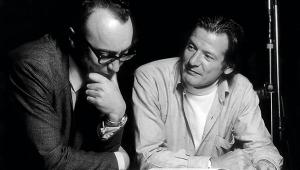
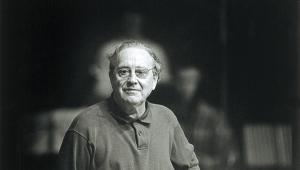
There were a lot of angry young men (and women) after the Second World War. Think (in cultural terms) of Vladimir and Estragon, waiting for Godot, and Lucky’s climactic outburst of babble; of Francis Bacon, and his anguished Crucifixion figures; of Rossellini’s Rome, Open City. Pop offered three minutes of escapism. Meanwhile Pierre Boulez [pictured top left with pianist Roger Woodward] and his fellow students at the Paris Conservatoire were finding their feet in a new and desolate world.
Boulez was angry about more than the war. He had escaped the family home in Montbrison, near Lyon, and his engineer father’s wish for his son to follow in his footsteps. ‘Our parents were strong’, Boulez later said of himself and his sister, ‘but finally we were stronger’. You don’t need the help of Dr. Freud to see that he was in the mood to slay some demons. He behaved ‘like a flayed lion’, recalled his teacher at the Conservatoire, Olivier Messiaen.
Creative fury
None of which would amount to much if Boulez, like Beckett and Bacon, had not the technique as well as the imagination to pour his creative fury into forms which shook and split, but contained such strength of expression. Boulez might have lacked the phenomenal keyboard agility of his fellow student Yvonne Loriod, but he could play all right, and he had by then inhaled the poetry of Charles Baudelaire and Stéphane Mallarmé, the symbolists and surrealists.
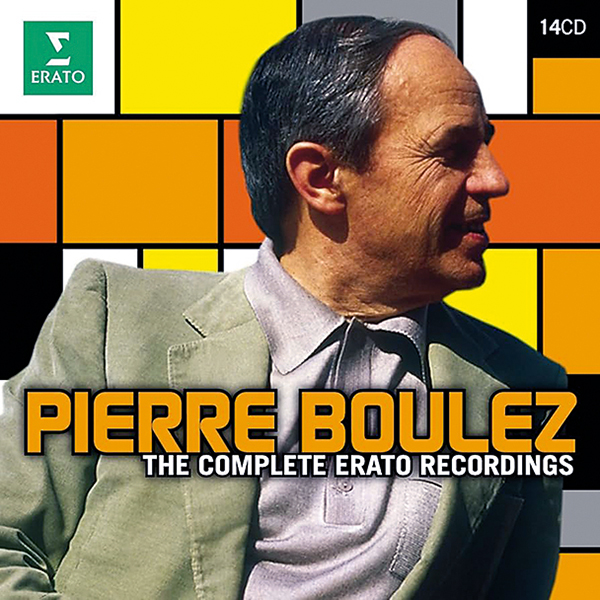
Above: Sleeve of Warner Music’s box set of Pierre Boulez’s recordings for French classical label Erato, from 1966-1992
Their oblique, comic-tragic take on the world seems to have lit the fire in Boulez’s mind, of a music which could translate their images and ideas into sound. He called it ‘Organised Delirium’. This fire was then further fanned by witnessing the elderly Antonin Artaud, inventor of the ‘Theatre of Cruelty’, deliver one of his trademark, spittle-flecked rants against the world.
Fired up
The immediate product of this delirium was Boulez’s Second Piano Sonata (1947-8), which became a byword for uncompromising modernism, especially once Maurizio Pollini had applied his diamond-tipped pianism to it for Deutsche Grammophon in 1976. And if the violence of the Sonata feels like a ne plus ultra of complexity, so it was for Boulez – just as Strauss had to write Elektra and then move on.
It’s true that in Schoenberg and Stravinsky, Boulez found and then rejected new father figures, just as he charmed and befriended John Cage and Karlheinz Stockhausen and then estranged himself from them. He had no shortage of provocative things to say, such as the infamous call to burn down all the opera houses (before conducting Wozzeck at the Paris Opera and Wagner’s Ring at Bayreuth). Composers say this kind of thing. Beethoven and Brahms weren’t exactly pussycats. For every note they select, they reject a hundred others.
In fact, the first decade of Boulez’s career, leading up to Le Marteau Sans Maître in 1955, was his most productive. And in the cantata Le Visage Nuptial of 1946-7 he had already demonstrated a Debussyan ear for poetry and its sensual translation into sound. Even earlier, in 1945, he had written the 12 Notations for piano which compiled musical ideas and influences like diary entries, and to which he would return for the rest of his life, not just in elaborating five of them on an orchestral canvas.

Above: Pianist Tamara Stefanovich recorded Boulez’s Second Sonata for Pentatone’s Organised Delirium, released in 2025
It doesn’t make sense to listen to Le Visage or Le Marteau without engaging with the texts by René Char, just as a full experience of Winterreise requires sitting down with Wilhelm Müller’s poetry. Both Schubert and Boulez have their sights set on more than mere illustration. The mood, the form, the feeling of the text in the moment and the retrospective reflection on its themes, all find their place in the music. Perfecting that fusion of word and sound and idea is what drove Boulez to revise Pli Selon Pli, his ‘Portrait of Mallarmé’, over the course of 40 years, and also what makes it his enduring masterpiece.
Looking back
Listeners new to Pierre Boulez, or nervous of modernism, may find a backwards path easier to follow. Start with Sur Incises (1996-8), and its bewitching stream of consciousness flowing across 40 minutes and an ensemble of pianos, harps, vibraphones and steel drums. Then move back to Explosante-Fixe..., completed in 1993, and its shimmering, flute-led textures which simultaneously capture and expand a moment of pure sensuality like a Debussy Prélude or a Seurat canvas. Also try Anthèmes II from 1995, and its electroacoustic expansion and multiplication of a single violin line dancing across and around the entire soundstage.
Go back a little farther, to the 1980s, for Répons – another immersive large-ensemble work – and for another spatially realised solo instrumental piece, Dialogue de L’Ombre Double for solo clarinet. Themes begin to reveal themselves: not just musical ones, though Boulez certainly wrote with more and more concern for melody through his life, but rhetorical ones, such as trills, which become not mere decoration but the very substance of the music as they do in late Beethoven. All the while, he is conjuring visions of space, seeking to make music that fills the air around the listener and envelops them in clouds of sensation like the images of a poem.
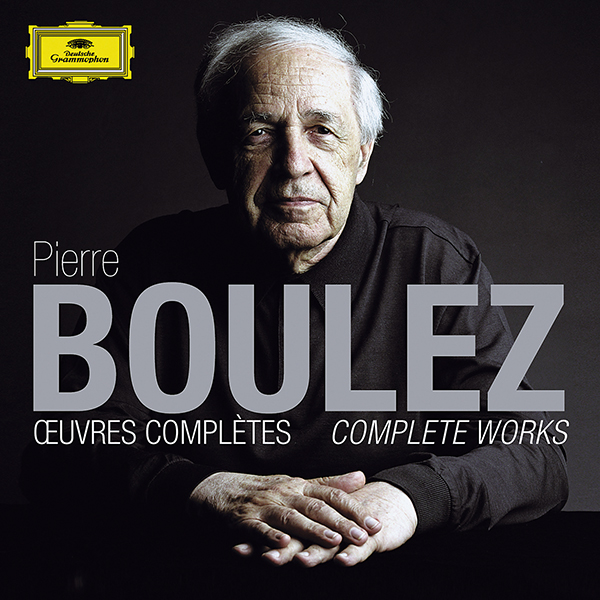
Above: Original cover of DG’s 13CD collection of Boulez compositions, recently reissued as The Composer
As for themes beyond the music, in reworking his compositions Boulez is not just rewriting earlier versions of himself, but layering acts of tribute to the memory of others dear to him. Explosante-Fixe... began life as Mémoriale, composed after the death of Stravinsky in 1971, and the final version ends with the whole of the early work. Yet the piece also encodes his tribute to the late flautist of Ensemble Intercontemporain, Lawrence Beauregard, and earlier still, his tender memory of a young flautist he admired from afar while staying in a Scottish castle.
Memory music
Just as with Mallarmé, in Pli Selon Pli, Boulez gathers up his memories and feelings like a casket of ashes, and creates a musical tombeau in the tradition of French composers from Marin Marais to Maurice Ravel. He does this most touchingly of all, I think, in the Rituel (1975) he wrote in memory of his friend and colleague Bruno Maderna.
Boulez had taken the fugue of Beethoven’s Hammerklavier Sonata as a model for the finale of the Second Sonata, and the Funeral March of Beethoven’s Eroica surely lies behind the steady tread and grave accumulation of feeling in the Rituel. No doubt too exalted a comparison for some, but Boulez, in both his conducting and his music, has trained my ear and taught me how to listen, no less than Bach and Bruckner and Beethoven.
Essential Recordings
Pli Selon Pli
Deutsche Grammophon 4713442
A definitive recording of Boulez’s masterpiece, with ‘his’ Ensemble Intercontemporain and soprano Christine Schäfer.
Rituel in Memoriam Maderna, Mahler 9
Hänssler 93098 (2CD)
Michael Gielen shrewdly pairs Boulez’s most immediately affecting work in the context of Mahler’s symphonic farewell to life.
‘Organised Delirium’ – Piano Sonata 2, etc
Pentatone PTC5187358
Tamara Stefanovich is superb in the Second Sonata as the curtain-raiser to sonatas by Bartók, Shostakovich, Scarlatti, et al.
Pierre Boulez – The Composer
Deutsche Grammophon 4847513 (13CD)
One for the converts – (almost) all of Boulez’s music, in modern composer-authorised accounts, lovingly curated and documented.
Complete Erato Recordings
Warner Classics 2564 619048-5 (14CD)
A compact survey of Boulez the composer and interpreter, featuring an earlier version of Pli, plus Carter, Stravinsky, and more.
Yvonne Loriod – Complete Vega Albums
Decca 4817069 (13CD)
A musical partner to Boulez from their student days, capturing the exhilarating spirit of the Domaine Musical and Paris in the ’50s.























 SPONSORED VIDEO






| Equipment Reviews |  |
Music Reviews Awards | |
Latest News Features | |
Resources Newsletters | |
Subscriptions |
WHERE TECHNOLOGY BECOMES ENTERTAINMENT
 © 2026 Hi-Fi News
AVTech Media Ltd
All rights reserved