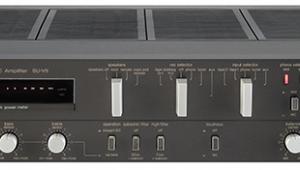
Technics SU-V5 amplifier

The maturing design of amplifiers in the late 1970s created a problem for the marketing departments of large hi-fi manufacturers. Selling hi-fi was a technology-led process with new features and improved performance being the hooks upon which new sales were hung. But with solid-state circuitry, low-noise integrated circuits and complementary output stages already in place, the basic problems of amplification had been solved – so what was to be next?
One idea concerned various approaches to Class A, reviving the technique of altering the power amplifier’s operating conditions depending on the level and content of the signal passing through it. Technics called its system ‘New Class A’, although in detail there was little that was new about it. Rival Japanese brand JVC had a similar technique, named Super A, and there were many others besides.
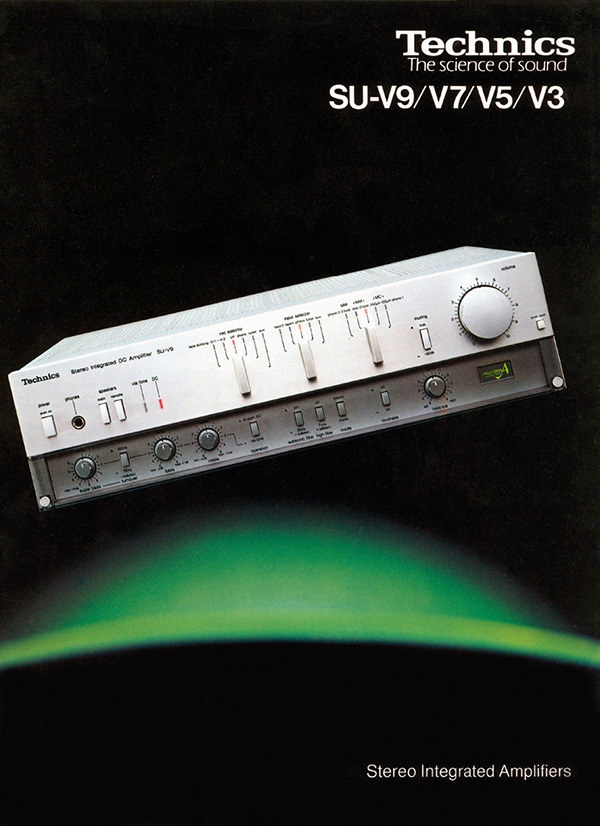
The early ’80s SU-V5 auditioned here is an early example of a practical New Class A amplifier. The idea was later expanded in models like the SU-V303 [HFN Sep ’25], which added a small ‘computer’ (logic circuit) to control the amplifier’s performance by taking account of long-term changes, such as the drift in the value of some key components.
Problem solving
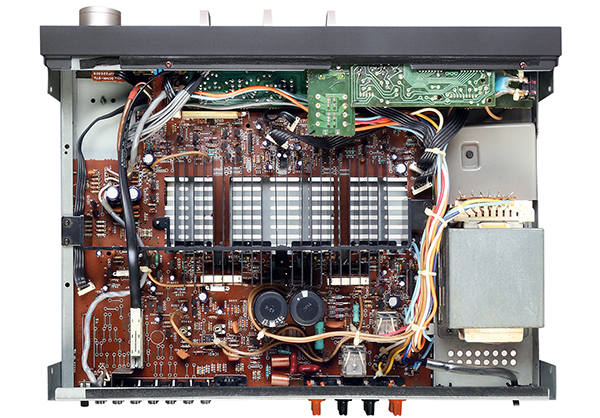
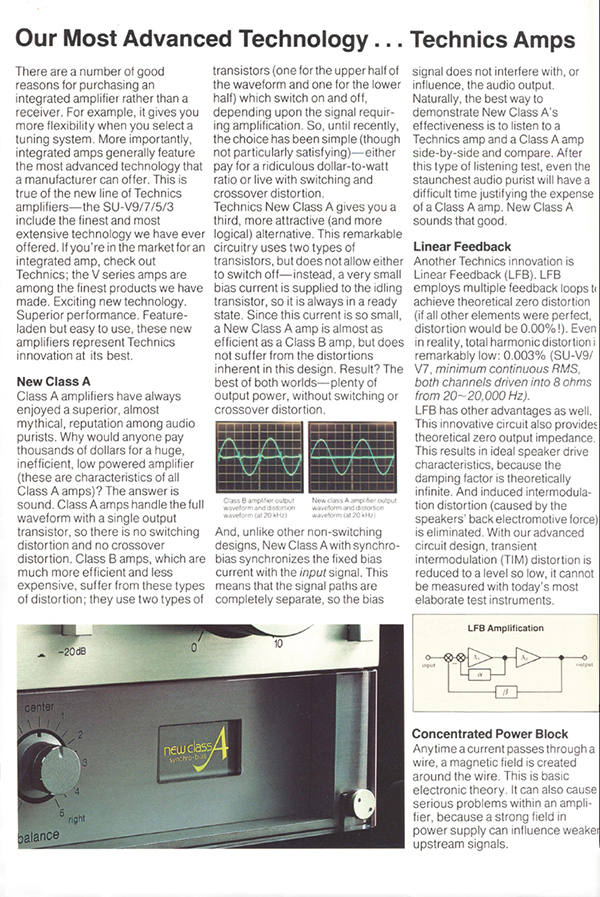
As with the SU-V303 integrated, a key feature of Technics’ SU-V5 was the biasing arrangement of the output stage. By way of a quick refresh, bias is the applied flow of current through the amplifier’s output transistors, which keeps them conducting as the music signal crosses between the NPN and PNP types of the complementary pair. In a conventional amplifier the bias level is a compromise. Too little results in crossover distortion, but too much and energy is wasted as heat, something which limits the available performance and lifespan of both output transistors and power supply.
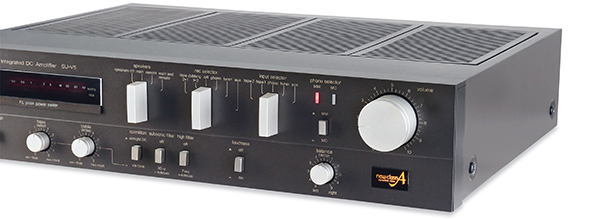
Technics’ New Class A technique, as fitted to the SU-V5, aimed to solve this problem by varying the amount of bias applied. It called this refinement ‘Synchro Bias’, even adding it in tiny writing on the illuminated New Class A badge (the ‘Computer Drive’ part of New Class A, seen in the SU-V303, was still in the future when the SU-V5 was produced, so the illumination of the logo here indicates nothing other than power being on).
As well as Synchro Bias, Technics was eager to pursue the idea of DC coupling throughout the SU-V5’s signal path. All capacitors and transformers degrade the music signal slightly, so why not remove them? It didn’t approach this task half-heartedly – there is only one capacitor in the forward signal path when using the amplifier’s phono input, and none at all with the line connections. And while the design of tone controls usually implies some form of capacitor coupling, in the SU-V5 they acted within the power amp’s feedback loop (a practice usually confined to affordable low-power models) to keep the main signal path clear.
Correct and serve
The pursuit of full DC coupling is not without risk, as any DC offset present on the input (eg, from an errant source component), would be amplified along with the music signal and be present at the speaker outputs, putting both amplifier and speakers at risk. The solution Technics employed in the SU-V5 was both clever and creative. An accurate servo amplifier was used to sense any DC content at the output and then cancel it by applying a corrective voltage to the input. By this method, DC continuity was maintained right through the main amplifier.
In addition, both voltage and current sensing protection systems were included, using a relay to disconnect the loudspeakers automatically if abnormal conditions were detected. The SU-V5’s current sensing circuit was also used to limit its output power, by reducing the internal supply voltages, if excessively low impedance loads were connected, though this amplifier proved very beefy in practice [see PM's Lab Report]. It was details like this which contributed to the reputation for reliability which Technics amplifiers of this era generally enjoyed.
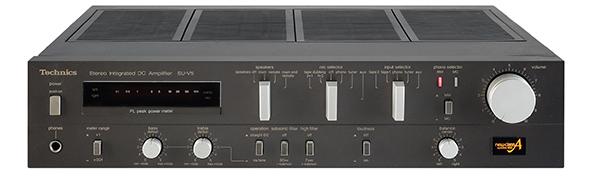
The SU-V5 is a good-looking, sturdy unit with an aesthetic that makes it difficult to date, especially in the case of the dark bronze version seen here. Even though its size, shape and distribution of controls are generic, the excellent finish and attention to detail that Technics was (and remains) famous for lift it to the realm of a more ‘desirable object’ – Sony was also very good at smart industrial design.
No surprises
All the front-panel controls are pleasing to operate and everything does exactly what one would expect – there are no surprises or ergonomic quirks. There are a few features of note though, one of which is that changing the setting of the loudspeaker selector mutes the main amplifier for a short period, so when you arrive at your chosen position it takes a brief moment for the sound to reappear.
Secondly, selecting the ‘DC/straight’ mode to bypass the SU-V5’s tone controls doesn’t disable the amplifier’s loudness function. You have to ensure that button is left ‘out’ if you want the desired flat response. The good news is the tone controls themselves (and the subsonic filter) have a more subtle effect than they do on the later SU-V303 model. The scales around the ‘Bass’ and ‘Treble’ rotaries are marked as a 10dB lift and cut, which in practice feels about right.
The indicator for the SU-V5’s MM/MC cartridge input is arguably too prominent. I don’t need a large and bright LED burning away to constantly remind me of the status of this minor setting. On the subject of unnecessary illumination, the ‘peak power’ meters fitted to the SU-V5 are not entirely reflective of how hard the amplifier is working [see PM's Lab Report]. Few such displays on hi-fi amplifiers are useful since they only reflect the signal voltage across an assumed resistive load, something which isn’t representative for the vast majority of loudspeakers.
The same meters calibrated with the remaining percentage of voltage headroom would be of some use, but Technics’ design is still too small and coarse in scale to show anything of value. A simple indicator light to show the onset of clipping – rarely encountered but fitted to B&O’s Beomaster 4400 [HFN Jun ’12] – would be more beneficial. It is notable that the two more expensive versions in this V series (the SU-V7 and the SU-V9) both dispense with the output power meters, suggesting that their appeal was limited to the lower sectors of the market.
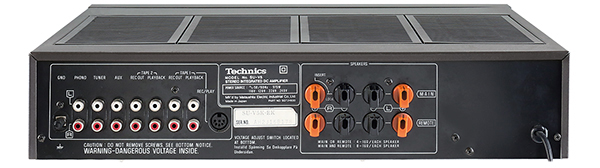
Unlike some vintage equipment the SU-V5 has plenty of inputs, all of which are made through sensibly sized and spaced RCA sockets. The usual phono (MM or MC), tuner and auxiliary (CD) inputs are present, along with two independent tape loops which can both be used for off-tape monitoring. The ‘listen’ and ‘record’ selectors allow for great operational flexibility, including cross-dubbing in either direction. Two pairs of loudspeakers can be tethered to the amplifier, the connections being via Technics’ own ‘twist to lock’ clips. These accept bare wire ends only and are not the easiest of things to use. Making short pigtail adaptors with 4mm sockets on the end is one potential answer if you want to use modern cables.
 Tim listens
Regular readers will recall that although the SU-V303 was nicely designed and well-engineered, it failed to fully win me over due to its rather uninvolving performance. As the SU-V5 is clearly cut from a similar cloth, initial concerns were that it would also be unexciting, despite the increase of output power over the SU-V303, which was rated at 2x45W (re. 1kHz/8ohm).
I need not have worried – this New Class A amplifier is a very different proposition. The SU-V5 sounds powerful and lively, the impression of drive and punch bringing music to life. When playing at high volumes, the amplifier doesn’t so much drive the loudspeakers as tear into them, conjuring a fast and dynamic sound. It hits harder than any similarly-scaled integrated amplifier that I can recall, and all this – remarkably – from a suggested 65W per channel.
Helping here is the way the sound retains its integrity right up to the point of clipping. The SU-V5 is an amplifier that wrings every drop of music out of the source. With tone controls and filters out of circuit it sounds transparent and uncoloured, offering good upper midrange and treble focus. At low listening levels the bass is dry and subjectively less extended than some rivals, but it comes alive with a bit more level, an effect that’s at least partly psychoacoustical.
Listening to New Order’s ‘Vanishing Point’ on CD [Technique; Factory FACT 275] brought the glory days of the Haçienda nightclub in Manchester to my listening room. Technics’ amp appeared unrelenting, pounding along in complete control. Lots of units can do this, of course, but the SU-V5 is less ordinary in how it retains the polish and shimmer of treble detail. Upper-band smoothness is retained, avoiding grain or harshness, without the SU-V5 sounding the least bit dull or soft. Pushing the loudspeakers a little further into the corners of my listening room also prevented the sound from being too sterile – I find this is often the best way to resolve issues of space and tone.
Orchestral manoeuvres
It would be easy to dismiss Technics’ SU-V5 as an amplifier best suited to headbangers, but that would be unfair. The trumpets and organ that play off each other in Alessandro Scarlatti’s Toccata In D Major [Awake The Trumpet’s Lofty Sound; Deutsche Grammophon 419 245-2] were deftly handled – smooth and relaxing, but with the brass retaining a subtle metallic edge.
This is an element which can go astray in an amplifier with a rolled-off treble response, so it was reassuring to hear it reproduced in full. Further revealing its more refined side, the SU-V5 crafted a broad soundstage with plenty of space around the performers, although it couldn’t manage to fully evoke the recording’s concert hall ambience.
It’s difficult to ascribe a particular aspect of the SU-V5’s enjoyable performance directly to Technics’ New Class A circuit design, although arguably it contributes to the compact chassis dimensions (430x97x340mm, whd) and relatively low operating temperature for its robust power output. Using vintage equipment instead of the latest hardware usually involves accepting some sort of compromise, but that’s not really the case here. This is a viable alternative to a modern unit, and a model that’s been well looked after should have at least the same life expectancy going forward, even taking the existing 40-plus years of use into account. I’d have no hesitation in building a system around the SU-V5 for my own use.
Buying secondhand
The combination of a sturdy build, high-quality components and effective protection circuitry means that SU-V5s have survived in large numbers – good examples are not difficult to find. Be wary, however, of any unit where large numbers of components (especially the capacitors) have been replaced – the original components in these units were either custom-made or carefully selected from parent-company Matsushita’s extensive in-house catalogue, and should not be substituted without good reason.
Otherwise, common faults encountered with a secondhand SU-V5 include broken loudspeaker terminals and tarnished relay contacts, the latter being easy to clean once the relays are removed. One fault that is becoming more common is the loss of one or both channels from the phono stage. There is a large electrolytic capacitor in each channel of the circuit which is operated at only a fraction of a volt – not enough to maintain its oxide layer in good condition indefinitely. Thankfully, replacement is seldom necessary. You can instead remove each one and connect it to a 6V bench supply for a few minutes. Original performance will then be restored.
Hi-Fi News Verdict
While most Technics amplifiers of the vintage era are well designed and well made, some of them have ended up being less than an enthralling listen. But not this one – the SU-V5 sounds full of life and really grabs the attention. If you are able to source a well cared-for example then it will prove easy to build a system around, while delivering years of pleasure. Buy one now while they are still relatively inexpensive!Sound Quality: 80%
 | |||||||||||

|
|
| |||||||||















 SPONSORED VIDEO






| Equipment Reviews | |
Music Reviews Awards | |
Latest News Features | |
Resources Newsletters | |
Subscriptions |
WHERE TECHNOLOGY BECOMES ENTERTAINMENT
 © 2026 Hi-Fi News
AVTech Media Ltd
All rights reserved