Marantz CD-94/CDA-94 CD player/DAC

While Compact Disc’s 1982 promise of ‘Perfect Sound Forever’ was largely aimed at the silver discs themselves, hardware engineers were not sitting back and thinking ‘job done’. Disc transport, error-correction, digital audio processing and DAC technology progressed at pace with players becoming bigger and more feature-laden. It was around the middle of the decade that ‘proper’ flagship players arrived, often in multiple enclosures.
Early examples of the multi-box players included the Cambridge Audio CD1 [HFN Apr ’86 and May ’14] and Sony’s CDP-552ES/DAS-702ES [HFN Jun ’85]. Although their designs were very different, both brands identified that the sensitive DAC and analogue circuitry would benefit from being kept away from the player’s transport and digital sections.
Double Dutch
Philips and Sony were the co-inventors of the format, but the former lagged its Japanese partner in developing a ‘high-end’ player. Enthusiasts had to wait until 1986 to get their hands on Philips’ first range-topping twin-box unit in the form of the CD960 [HFN Jul ’20] and DAC960. The story is not so straightforward, either, as this wasn’t strictly an ‘Eindhoven’ product, being manufactured in Japan by Marantz, a subsidiary of Philips at the time.

The two companies had a strong history of releasing seemingly identical players under their own branding – think of the Philips CD100/Marantz CD-63 [HFN Apr ’83 and Oct ’11] and the Philips CD300/Marantz CD-73 [HFN Apr ’84 and Mar ’19]. Surely there would be a ‘Marantz version’ of the CD960? There was indeed, and it arrived in the form of the CD-94.
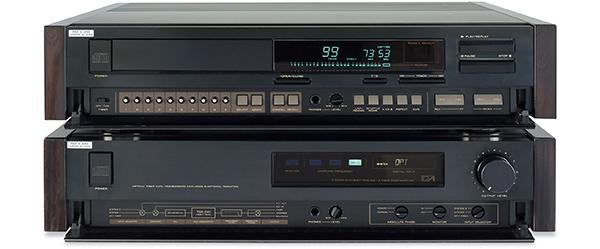
From the outside, Marantz’s CD-94 was no obvious clone of the CD960 – it had its own diecast alloy chassis and control layout, with a Philips CDM-1 transport resiliently mounted on large rubber dampers to ensure the minimum of vibrational interference. Its heavy aluminium top cover was ‘designed to reduce distortion caused by acoustic feedback and eddy current coupling’, and in traditional Marantz style, the rear plate of the main chassis and all the screws used in its assembly were copper plated.
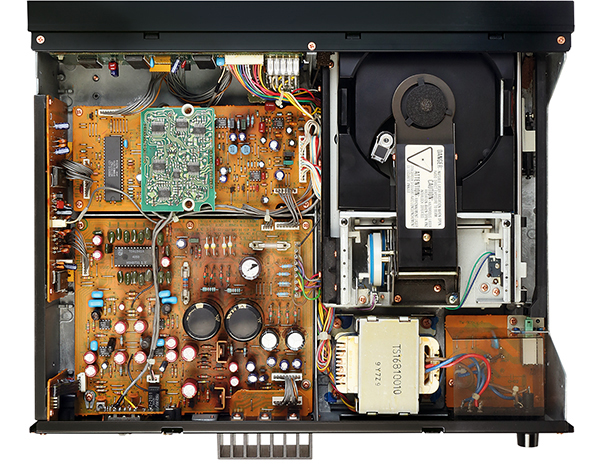
The heatsink at the rear of the CD-94 was also damped and the high power mains transformer contained four separate windings – one each for the CD transport, digital circuits, analogue circuits and the display. In addition, all mains circuits and wiring were confined to one corner of the enclosure. Even the power switch is there, connected to the front-panel button by a polycarbonate rod.
At the heart of the analogue circuit was a 16-bit Philips TDA1541A DAC running with 4x oversampled data [see PM's Lab Report]. All other components were equally high specification items, including ELNA power supply capacitors. These had the Marantz ‘audiophile treatment’, being firmly mounted to the PCBs using a special resin, to reduce microphony and other potential sources of noise.
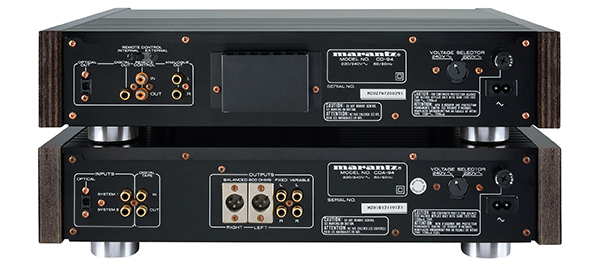
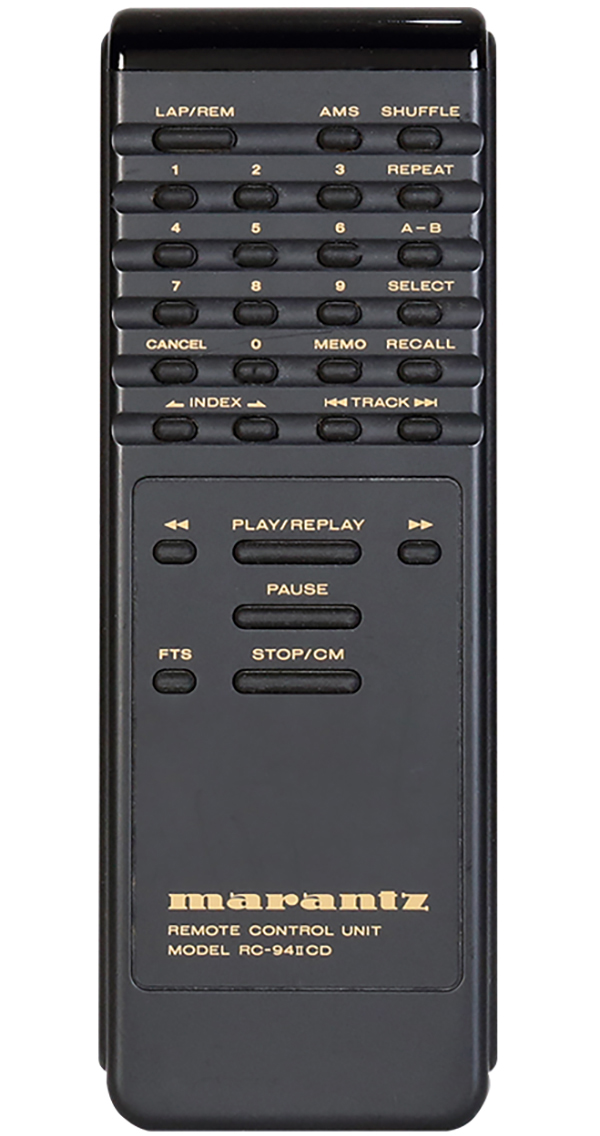
The CD-94 offered unbalanced analogue phono outputs on RCAs plus digital outputs in both coaxial and optical formats. Either of those digital outs could be used to connect the unit to the matching CDA-94 DAC, which had one optical and two coaxial digital inputs, plus a further coaxial digital input and output for a digital tape source. Marantz’s DT-84 DAT machine was a fine visual and technical partner but the rumoured DT-94 never materialised. It would have made quite a stack alongside these two, plus the company’s PM-94 amplifier [HFN Feb ’87].
Going for gold
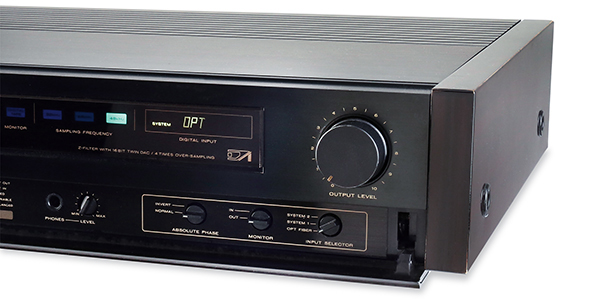
The CDA-94 DAC automatically selected sampling frequencies of 32kHz, 44.1kHz or 48kHz from the input signal. Absolute phase switching was also offered while the digital-to-analogue conversion set-up was largely the same as that of the CD-94, albeit with a choice of (fixed and variable) RCA and balanced XLR line outputs [see PM's Lab Report].
Marantz made no changes to this model for the duration of its production, apart from the release of a champagne gold ‘Limited’ version to pair with the equivalent CD-94 Limited player. The CD-94, however, was further developed during its lifetime. It was updated to the CD-94II [HFN Feb ’90] with alterations to the DAC stage – a pair of the S1 ‘Single Crown’ versions of the TDA1541A converter configured here in differential mode, reducing noise, distortion and improving low-level linearity.
A CD-94 Limited in champagne gold was released in the Far East that had a thicker 3mm baseplate and fixed mains lead. Also exclusively for the Asian market was the CD-95 of 1988, which came in silver or champagne gold finish only, had the twin TDA1541A S1 DACs, the 3mm baseplate, and additional internal case bracing and shielding. Marantz also released a CD-95 Limited as well as the CD-95DR, which was a CD transport variant with no analogue output circuitry.
The design’s final outing was in the CD-99SE of 1990, with a CD-99SE Limited and a CD-99DR appearing later in the year. This was one of the last players to use the original Philips CDM-1 mechanism, with the replacement CD-80 [HFN May ’90] using the CDM-1MkII, before subsequent models moved to the CDM-4.
Wild woodOne leftfield offshoot of the CD-94’s DNA came in 1987 in the form of Micro Seiki’s second CD player, the CD-M2 [HFN Jun ’88], which used Marantz’s player by way of a donor chassis. For this, the carpentry department went wild, encasing most of the lower half of the player in a block of Brazilian rosewood, and even setting the remote control handset in a lump of it as well. A massive alloy top panel helped push the unit’s weight from 10kg to 22kg!
 Adam listens
The appeal of the CD-94 is easy to discern, even after just a limited auditioning. A friend summed it up years ago, turning to me while listening to it and saying ‘That’s one of the most “analogue-sounding” CD players I’ve ever heard’. He was not wrong – the CD-94 has an ease and warmth to its nature that really does bring to mind fine analogue reproduction, and ensures it is a captivating listen.
That’s not to say this Marantz player is in any way soft or woolly. It has superb detail retrieval and an ability to really capture the emotion of a performance. ‘Laura’, from Bat For Lashes’ The Haunted Man [EMI P915 5402], sent shivers down my spine. Natasha Khan’s haunting vocals were a delight, and the backing piano shimmering behind her was well rendered in both character and surrounding ambience.
Helping to give the CD-94 its near-analogue vibe is its treble, which is a thing of wonder. Many early CD players impressed initially with their clarity, but after a while it became apparent they were adding a ‘sheen’ that made things sound comparatively hard and brittle. The CD-94 has no such character flaws – its top end is clean and open, but is also natural and realistic.
In terms of soundstaging, this player throws images both wide and deep, and offers a performance scale that escaped many early models. Image placement is excellent too, the CD-94 again banishing all memory of some of those rather two-dimensional early CD spinners.
As a result, I could well have been in a smoky jazz club as Diana Krall strutted her stuff on ‘Peel Me A Grape’ from her Love Scenes album [Impulse! IMP12342]. Vocals were husky, the piano sultry and the double bass warm, woody and lifelike. Most notable, though, was the sense of atmosphere around each instrument.
Depth charge
This second generation of CD players really wrought improvements as regards low-end performance. This is proven by the CD-94, which can deliver deep, impactful bass that’s also blessed with detail.
When Bakithi Kumalo was really going for it on the fretless bass during the ‘Alternative’ version of Paul Simon’s ‘Diamonds On The Soles Of Her Shoes’ [Graceland 25th Anniversary Edition; Legacy 8691-98412-2], the CD-94 pounded it out with incredible gusto. Each note was deep and rich, and the pace of the bassline was difficult to fault. If I’m being ultra-picky, there was not quite the level of iron-fist control in the bottom octaves that I’m used to from my regular Naim CD5 XS/Flatcap XS system – but there wasn’t much in it.

Introducing the CDA-94 DAC unit didn’t initially seem to offer much of a change, especially when using the electrical coaxial digital connection. However, via the optical connection, listening carefully revealed that Marantz’s outboard DAC sharpens up everything across the frequency range. Treble became a touch cleaner and performers within the soundstage gained better positional definition. The CDA-94 also added that last ounce of bottom-end control.
Heart beat
With the two units in play, the drum beats during the introduction to ‘Cannibals’ from Mark Knopfler’s Golden Heart [Vertigo 514732-2] acquired an extra level of realism and snap. Listening to this Walk Of Life-esque rocker had been a very fine experience through the CD-94 flying solo, but the CDA-94 tightened up Chad Cromwell’s drum skins and moved the microphone a touch closer. The basic character was unchanged, but the overall sound seemed to have more of everything.
From a quick audition, therefore, it would be easy to say that the CDA-94 doesn’t make a huge difference. But live with it for a while, and then go back to using the CD-94 on its own, and there’s definitely something missing. It’s not a ‘must-have’ to hear what the CD-94 is capable of, but if you do add one, I’d wager that it will stay.
Buying secondhand
Used CD-94s are relatively plentiful as they were surprisingly popular for a range-topping product. That said, if you are keen on one of the champagne-coloured Limited models, these are harder to track down as they were not sold in all markets.
In terms of reliability, Marantz’s player is engineered to a very high standard and has proven to be largely trouble-free. The CDM-1 mechanism is built like the proverbial tank, its Achilles’ heel in the CD-94 being that no fewer than four belts are used to open and close the tray, load the CD and position the laser. As that mechanism is made from hefty lumps of metal, these belts have a hard life and can wear out much faster than on other players. Replacement is fiddly but belt kits are readily available – just don’t be tempted to purchase cheap ones, as these don’t last as long as the quality items.
Most other problems in the CD-94 tend to stem from one of the aforementioned ‘audiophile tweaks’ – namely, the resin holding the main PSU capacitors to the PCB. After more than 20 years, this resin has an unfortunate tendency to become both conductive and corrosive as it degrades. It can therefore start to short out the PCB tracks, which makes the player behave oddly, and then eat the tracks away, which typically brings everything to a grinding halt.
If your CD-94 starts to play up, then removal of the resin as part of the repair is a very wise move. This is a tedious and messy job but will potentially save a lot of heartache in the long run.
The CDA-94, by contrast, has proven to be largely indestructible, save for the odd connector woes, where too tight a cable can actually pull off the outer shell of the analogue output RCAs.
This is an issue that can also affect the Marantz CD-94, although the longevity of the latter’s laser seems extraordinary. The review sample came our way in its retirement from a UK-based speaker manufacturer. It had been its reference player for over ten years, then spent a further five years in a test laboratory playing pink- and white-noise test CDs, 24 hours a day, five days a week! Not only is this sample still on its original laser, but it still spins up and reads discs faster than any other player I’ve used.
Hi-Fi News Verdict
The Marantz CD-94 was one of the first flagship Compact Disc players and it has an appeal that is still obvious today, marking the point when CD reproduction really matured. Even by modern sonic standards, it is a stellar performer – a joy to both use and audition. The addition of the matching CDA-94 DAC doesn’t make earth-shattering changes but definitely adds a further final polish to the sound.
Sound Quality: 90%
 | |||||||||||

|
|
| |||||||||










 SPONSORED VIDEO






| Equipment Reviews | |
Music Reviews Awards | |
Latest News Features | |
Resources Newsletters | |
Subscriptions |
WHERE TECHNOLOGY BECOMES ENTERTAINMENT
 © 2026 Hi-Fi News
AVTech Media Ltd
All rights reserved