Michell Gyro turntable/arm
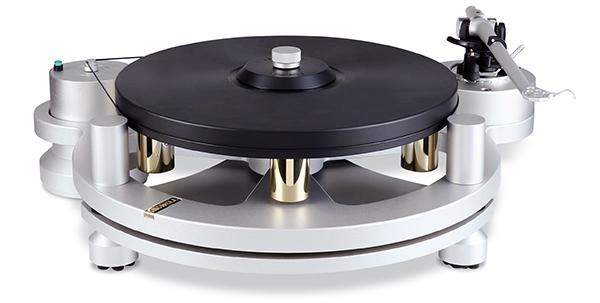

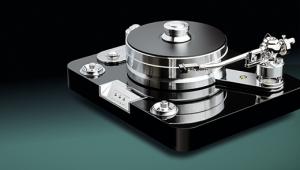
Updating or replacing any iconic design is not without risk, so when Michell Engineering announced that production of its famous GyroDec and Gyro SE turntables was to come to an end, it begged the question ‘what next?’. In practice the GyroDec’s replacement, the £5995 Michell Gyro, looks very similar indeed – it’s an evolution that, according to Michell’s MD, Jonathan Nye, is a result of the company wanting to take the deck ‘to the next level’.
Over its more than 40 years in production, the GyroDec went through many manufacturing updates but it was felt that the limits of its original design had been reached. Michell Engineering insists that, despite appearances, the Gyro is a ‘completely new turntable’ with only three parts in common – the DC motor, the belt and the on/off switch.
Making space
According to Nye, the new Gyro platform can be developed ‘up and down’. The newly released £3995 Revolv turntable is clearly a ‘low-profile’ version of the Gyro, but this leaves a space for a new flagship model to replace the Orbe. While Michell remains tight-lipped about any change at the top, the new Gyro costs £500 more than the Orbe SE which, tellingly, no longer appears on the company website.
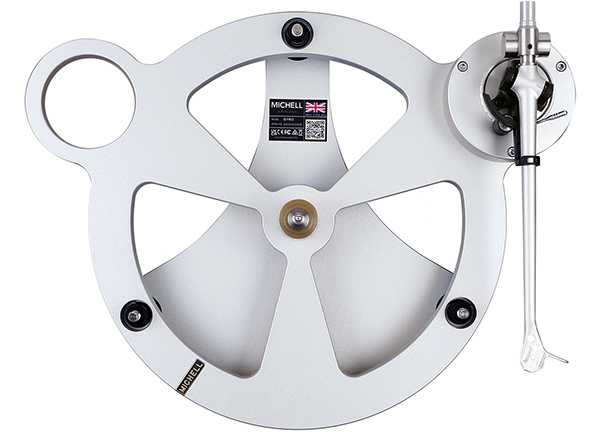
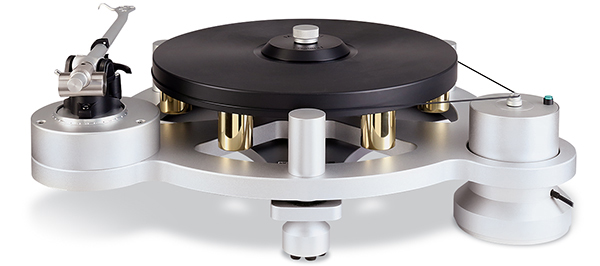
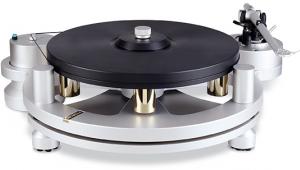
The detail changes to the deck are comprehensive, for while the footprint is largely unchanged at 495x180x385mm (whd), the Gyro weighs in at around 15.5kg, compared to the 10.5kg or so for the old SE. The feet, for example, are new and incorporate Sorbothane isolation pads, while the old acrylic ‘spider’ baseplate has been replaced by a piece of precision-machined aluminium. Above this floats a completely new subchassis, no longer cast but again machined from aircraft-grade 19mm aluminium tooling plate.
Good vibrations
Inserted into the subchassis is a series of brass weights with size, mass and position determined by mechanical modelling. This distributed mass not only counterbalances the tonearm but is intended to disperse vibration within the Gyro’s subchassis in a controlled manner, aided by additional damping near the arm mount.
The frequency of the suspension system has been reduced from 4.5Hz to 3.5Hz, and Michell claims full and effective isolation from 5Hz upwards. In addition, the bottoms of the springs incorporate the company’s new ‘Equilibria’ lateral damping – essentially three small horizontal springs, rods and tension screws that centre the vertical suspension posts in their mounting holes. This minimises lateral movement and keeps everything centred correctly. Certainly, sitting beside my Gyro SE, the new Gyro’s suspension feels more solid with a slightly stiffer, and arguably more controlled, ‘bounce’.
The bearing is still Michell’s usual inverted type, but now has two internal helical grooves in its self-pumping set-up rather than just one. The 3.7kg Delrin platter is slightly thicker than that of the older model and has a layer of cork damping set into its underside to absorb noise from the bearing [see PM’s Lab Report, p49]. Its outer edge is now smooth with no locating grooves for the belt, which finds its optimum location on start-up. Of course, the deck’s signature gold-plated brass weights are still present and correct!
Enclosure upgrade
While the DC motor is carried over from the Gyro SE, it is now housed in a sturdier enclosure that is fully shielded and earthed. The partnering DC PSU, with 33.3/45rpm speed switching, is also fitted into a neat case that matches Michell’s Apollo/Muse phono stage [see pic and boxout, below]. Internal trimpots allow for fine speed adjustment at the factory, but these are not currently accessible to the user. DC motors can drift over time and an occasional ‘tweak’ is sometimes required, so perhaps Michell will look at this... Otherwise, platter start and stop is controlled by the switch on the motor pod.
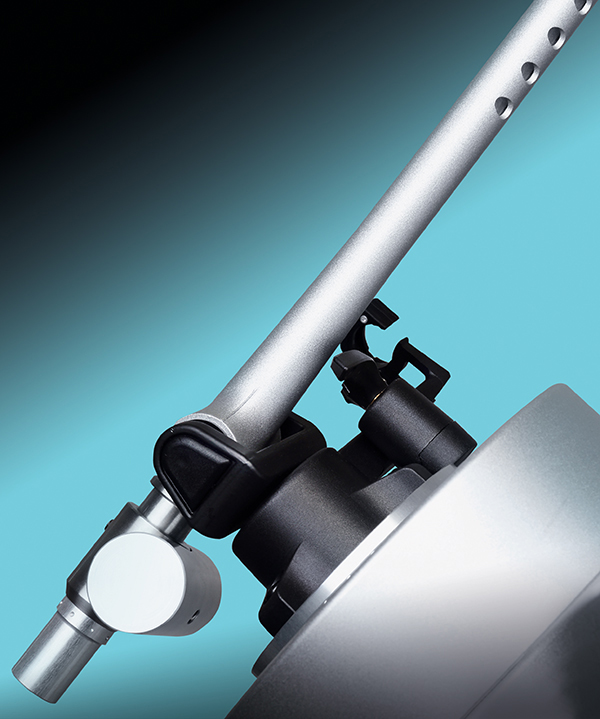
The deck comes with a Michell Unicover and one arm plate with a Rega, Linn, SME or Mørch cut-out. Additional arm plates are £110 each. Finally, fans of acrylic might be sad to hear that the Gyro is only available in the configuration shown – there is no longer a fully plinthed, ‘non SE’ variant.
For review, our Gyro was fitted with the latest Michell TecnoArm 2. Retailing for £1300, and offered in black and silver colourways, this is possibly the best-known modified Rega tonearm. Under Michell’s care, Rega’s armtube is shot-blasted, has 22 holes drilled into it, and the headshell’s underside is machined perfectly flat. The arm is then painted and re-wired with 6N silver litz wire in a continuous run from cartridge tags to phono plugs. The Michell Tecnoweight is standard and hangs below the rear arm stud, lowering the centre of gravity for improved stability.
 Voice of approval
Michell is marketing the deck as ‘The best Gyro we’ve ever made’ and as a Gyro SE has been part of my reference system for many years, I clearly had a very keen interest in the outcome. Right out of the gate, it’s evident that Michell has not sought to ‘revoice’ the character of this turntable, resisting the temptation to make the new Gyro sound like the flagship Orbe, which has its own distinct character. So if you loved the old GyroDec, you’ll adore the new one.
With an Ortofon 2M Black MM cartridge [HFN Mar ’11] installed in the TecnoArm 2, and the Gyro connected to my Yamaha C-5000/M-5000 pre/power [HFN Aug ’20], it served up its forebear’s traditionally grand sweep of a soundstage that, to my ears, has rarely been matched. However, the new Gyro has a better sense of central focus and depth. The SE turntable would always establish a solid central image for a track’s main performers, but here they were better projected into the room.
Kacey Musgraves’ country-tinged vocals on ‘Everybody Wants To Be A Cowboy’, from her new album Middle Of Nowhere [Lost Highway 00199957220422], stood proud of the accompanying instrumentation and made her performance come alive. Two acoustic guitars were spread wide within the soundstage, with one ranged to the left stepping forward to deliver the mid-song solo, before dropping back again – when a shift of instrumental focus occurred in any piece of music, Michell’s Gyro seemed to highlight it with ease.
Let it rip
The turntable’s insightful nature pays dividends with most genres of music. Be it spotlighting a solo instrument within an orchestra, or capturing the full bombast when all performers let rip together, the Gyro takes it all in its stride. I’m struggling to recall the last time the difference between the gentle start and the thunderous climax of Ravel’s Bolero, in this instance played by the Netherlands Philharmonic Orchestra conducted by Carlo Rizzi [Tacet L207], was so vividly presented.
The Gyro seemingly reveals a vast dynamic range, helped by notably low levels of background noise. You’ll still know if your vinyl’s cleanliness isn’t up to scratch, but with due attention paid, playback through this new Michell deck comes with a notable lack of groove roar. Background nasties are all but absent. When things are quiet and soft, there’s an almost CD-like silence beneath.
Moreover, the Gyro marries this dynamic ability with superb bass control. Again, the SE model was already near the top of the tree in this respect – and coming from someone with more direct-drive and idler turntables than I care to admit, I can’t offer much higher praise than that. The bassline on Donald Fagen’s ‘Snowbound’ [Kamakiriad; Reprise Records 9362-45230-1] sounded deep, flowing and rich as I expected, but the new Gyro brought more accentuation, more leading-edge precision, to every note.
On the edge
This was a performance of remarkable low-end precision, the taut, focused impact making the most of the track’s production. At the same time, I noted an occasional touch of splashiness to the cymbals, as the new Gyro/TecnoArm 2 system fully uncovered the character of this early 1990s digital recording. Michell’s tonearm is a fine partner for the turntable but it has an incisive edge, which can occasionally creep into over-exuberance.
Still, the TecnoArm 2 contributes to this deck’s low-end prowess, so the drum strikes on the Eagles’ ‘One Of These Nights’, from the album One Of These Nights [Asylum K53014], thundered from my speakers with punch and immediacy. And when a more measured hand was required to capture the faster and more intricate bass on the title track of Jessie Ware’s 2026 Superbloom LP [EMI Records EMIV 2152], the Gyro skipped along with delicacy and insight. Additionally, the high-frequency information here was crisp, detailed and sparkling.
Ready for prime time
In a nutshell, this Michell turntable is focused on making the best of what’s in your vinyl’s grooves. If there are big performances to be heard then it revels in them, but it can still bring a welcome feeling of openness to denser recordings. ‘Prime Time’, from the recent reissue of The Alan Parsons Project’s Ammonia Avenue [Cooking Vinyl COOKLP864XX], was rendered as a huge wall of sound across the front of the listening room, packed full of musical details but with air and space to savour. Michell’s Gyro has evolved in style.
Hi-Fi News Verdict
Michell has brought the Gyro effortlessly into the 21st century. While retaining its famous looks, the new deck’s engineering includes improvements to the bearing, platter, subchassis and suspension design, to obvious ‘musical’ effect. It’s also now easier to set up and use, with a sound that is poised, dynamic and spacious. The Gyro still has the heart and soul of the original but is definitely ‘the best yet’.Sound Quality: 89%
 | |||||||||||

|
|
| |||||||||







 SPONSORED VIDEO






| Equipment Reviews | |
Music Reviews Awards | |
Latest News Features | |
Resources Newsletters | |
Subscriptions |
WHERE TECHNOLOGY BECOMES ENTERTAINMENT
 © 2026 Hi-Fi News
AVTech Media Ltd
All rights reserved