GEC loudspeaker and Connoisseur cartridge

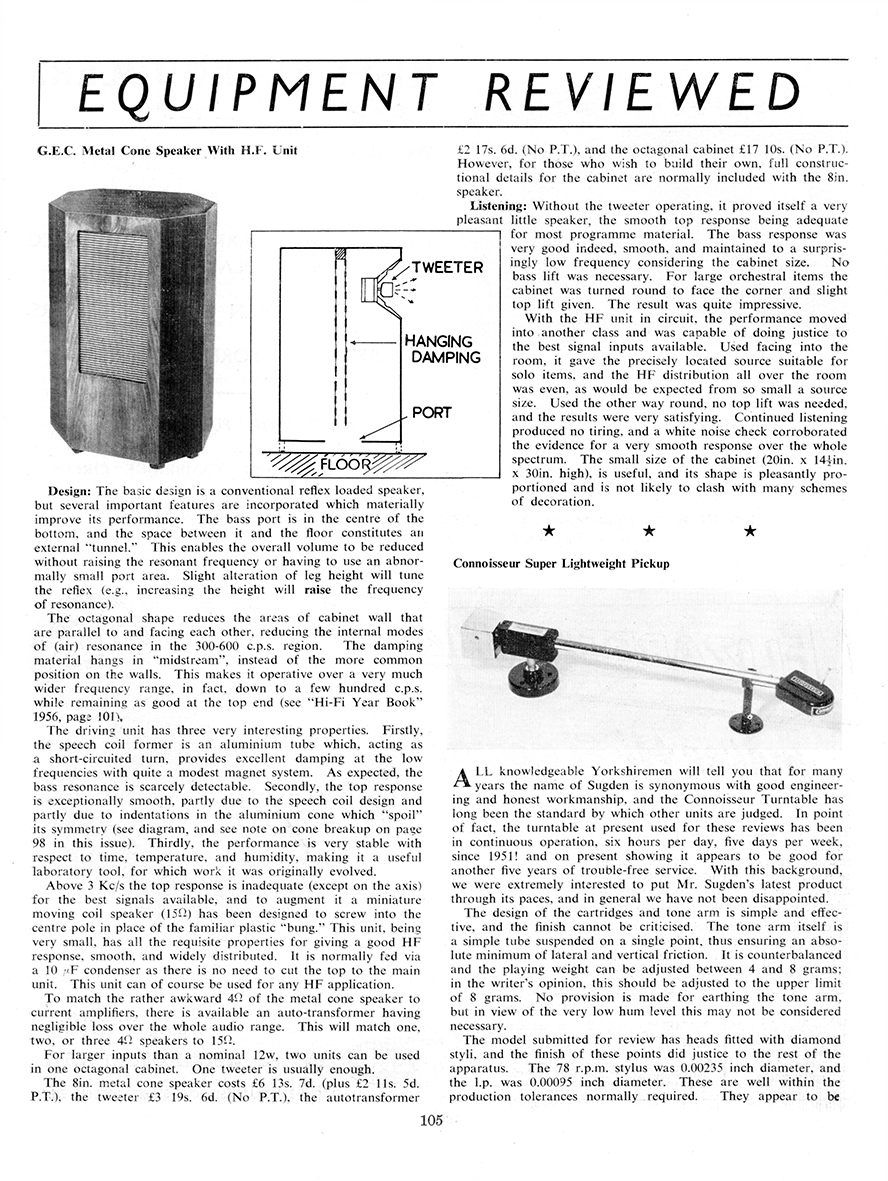
The basic design of the G.E.C. model is a conventional reflex-loaded speaker, but several important features are incorporated which materially improve its performance.
The bass port is in the centre of the bottom, and the space between it and the floor constitutes an external ‘tunnel’. This enables the overall volume to be reduced without raising the resonant frequency or having to use an abnormally small port area. Slight alteration of leg height will tune the reflex (eg, increasing the height will raise the frequency of resonance).
The octagonal shape reduces the areas of cabinet wall that are parallel to and facing each other, reducing the internal modes of (air) resonance in the 300-600 c.p.s [Hz] region. The damping material hangs in ‘midstream’, instead of the common position on the walls. This makes it operative over a very much wider frequency range, in fact, down to a few hundred c.p.s while remaining just as good at the top end.
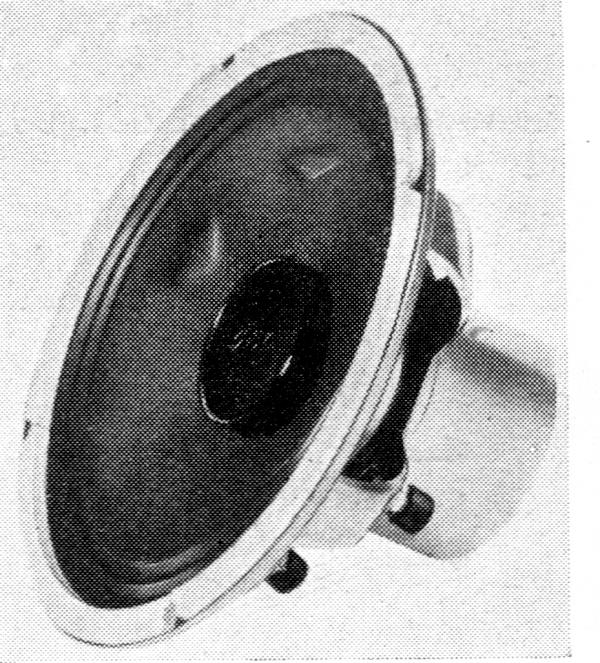
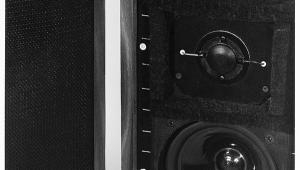
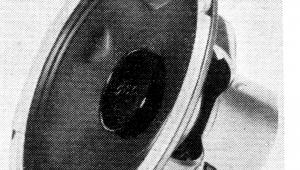
The driving unit has three very interesting properties. Firstly, the speech coil former is an aluminium tube which, acting as a short-circuited turn, provides excellent damping at the low frequencies with quite a modest magnet system. As expected, the bass resonance is scarcely detectable. Secondly, the top response is exceptionally smooth, partly due to the speech coil design and partly due to indentations in the aluminium cone which ‘spoil’ its symmetry [see pic, right]. Thirdly, the performance is very stable with respect to time, temperature, and humidity, making it a useful laboratory tool, for which work it was originally evolved.
Above three Kc/s [kHz] the top response is inadequate (except on the axis) for the best signals, and to augment it a miniature moving coil speaker (15ohm) has been designed to screw into the centre pole in place of the familiar plastic ‘bung’. This unit, being very small, has all the requisite properties for giving a good HF response, smooth, and widely distributed. It is normally fed via a 10µF condenser as there is no need to cut the top to the main unit. This unit can of course be used for any HF application.
To match the rather awkward 4ohm of the metal cone speaker to current amplifiers, there is available an autotransformer having negligible loss over the whole audio range. This will match one, two, or three 4ohm speakers to 15ohm. For larger inputs than a nominal 12W, two units can be used in one octagonal cabinet. One tweeter is usually enough.
A little goes a long way
The 8in metal cone speaker costs £6 13s. 7d., the tweeter £3 19s. 6d., the autotransformer £2 17s. 6d., and the octagonal cabinet £17 10s. For those who wish to build their own, full constructional details for the cabinet are normally included with the 8in speaker.
Without the tweeter, it proved itself a very pleasant little speaker, the smooth top response being adequate for most programme material. The bass response was very good indeed, smooth, and maintained to a surprisingly low frequency considering the cabinet size. No bass lift was necessary. For large orchestral items the cabinet was turned round to face the corner and a slight top lift given. The result was quite impressive.
With the HF unit in circuit, the performance moved into another class and was capable of doing justice to the best signal inputs available. Used facing into the room, it gave the precisely located source suitable for solo items, and the HF distribution all over the room was even, as would be expected from so small a source size. Used the other way round, no top lift was needed, and the results were very satisfying.
Continued listening produced no tiring, and a white noise check corroborated the evidence for a very smooth response over the whole spectrum. The small size of the cabinet (20x14x30in, wdh), is useful, and its shape is pleasantly proportioned and not likely to clash with many schemes of decoration.
Connoisseur cart
All knowledgeable Yorkshiremen will tell you that for many years the name of Sugden is synonymous with good engineering and honest workmanship, and the Connoisseur Turntable has long been the standard by which other units are judged. In point of fact, the turntable at present used for these reviews has been in continuous operation, six hours per day, five days per week, since 1951! And on present showing it appears to be good for another five years of trouble-free service.
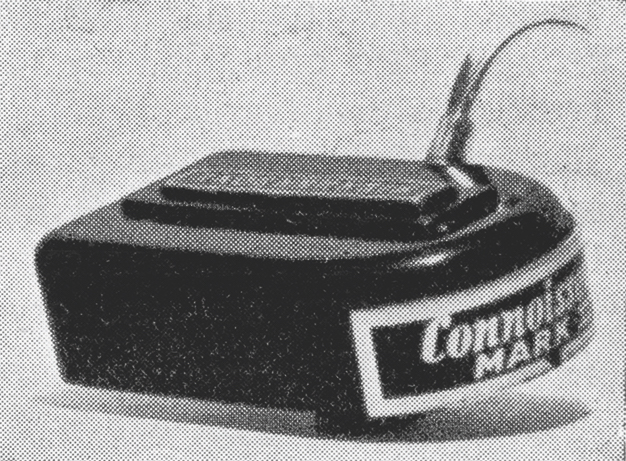
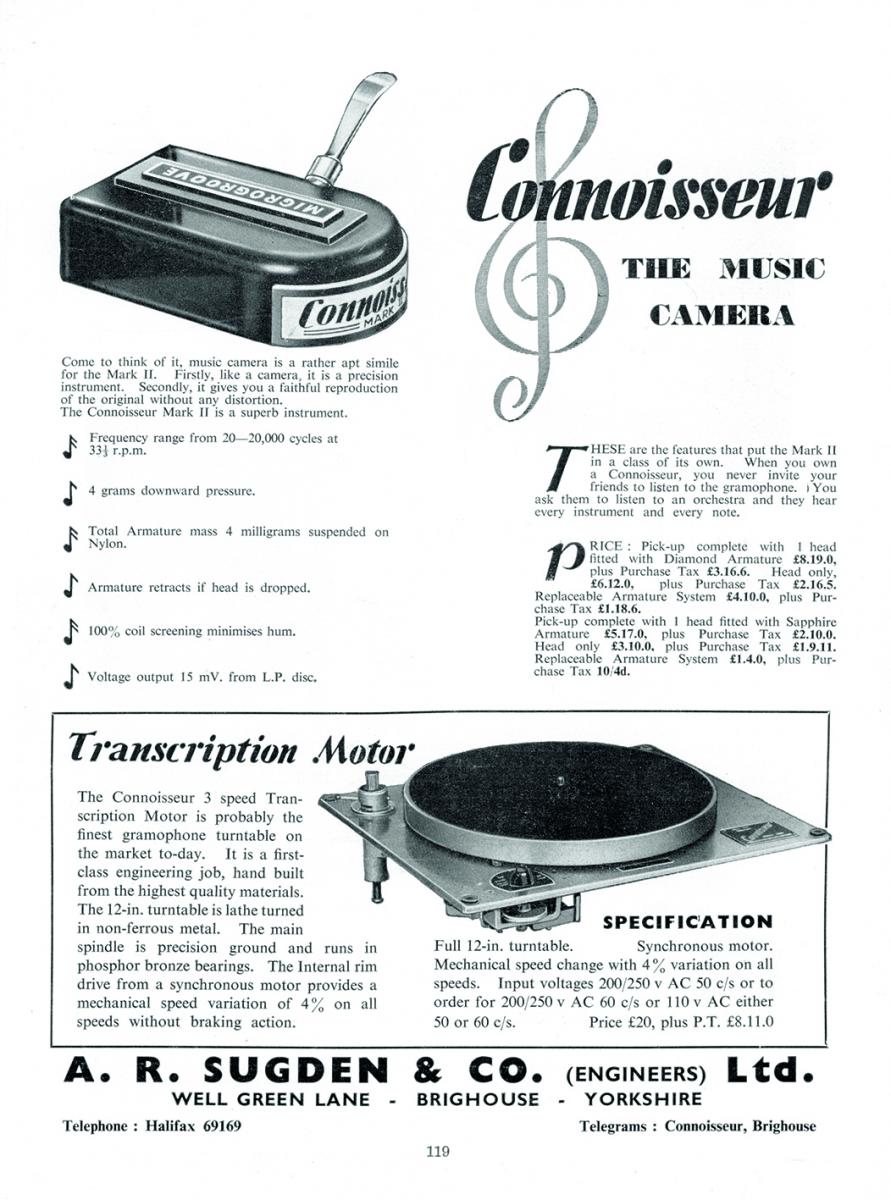
With this background we were extremely interested to put Mr. Sugden’s latest product, the Connoisseur Super Lightweight Mk2, through its paces, and in general we have not been disappointed. The design of the cartridge and tonearm is simple and effective, and the finish cannot be criticised. The tonearm itself is a simple tube suspended on a single point, thus ensuring an absolute minimum of lateral and vertical friction. It is counterbalanced and the playing weight can be adjusted between 4g and 8g; in the writer’s opinion, this should be adjusted to the upper limit of 8g. No provision has been made for earthing the tonearm, but in view of the very low hum level this may not be considered necessary.
The model submitted for review has cartridge heads fitted with diamond styli, and the finish of these points did justice to the rest of the apparatus. The 78rpm stylus was 0.00235in diameter, and the LP stylus was 0.00095in diameter. These are well within the production tolerances normally required. They appear to be truly spherical within the limits of our apparatus (magnification x500), and the polish was excellent.
Magnetic pick-ups are tending to fall into two distinct classes, according to the particular arguments their designer subscribes to. One group using the cantilever stylus tends towards the variable reluctance type of pick-up, while the other concentrates the whole of the effective armature mass in a vertical plane pivoting it at the end remote from the stylus. Both types have their advantages and disadvantages.
The Connoisseur Super Lightweight is based on this latter design and appears to have been carried towards the ultimate as far as practical. Because the whole of the moving armature is concentrated in the magnetic field, the efficiency is extremely high, and is in fact the most efficient pick-up (in terms of electrical power output/mechanical power input) we have yet investigated.
Because of this high efficiency, the electrical impedance for a given voltage output can be correspondingly reduced, and this contributes in no small measure to a high signal-to-noise ratio and exceptionally low hum pick-up: we measured about 20 microvolts at any position over the turntable.
The armature itself is a small tube of magnetic material, about 1/32in in diameter, just over 1/8in long, and with its wall only a few thou. thick. It is supported at the remote end in such a manner that there is no possibility of forward motion. It is not generally realised that if there is appreciable motion of the armature in the direction of the groove, considerable distortion can take place on music passages, which is not apparent when measured on a sinusoidal groove, and with the increasing use of wide range equipment this particular form of insidious distortion can be most distressing.
Smooth grooves
The low effective lateral mass of the armature system results in the high frequency resonance being outside the recorded band on both 78 and microgroove test discs, and in the samples measured was of the order of 25kHz. As this value was obtained by speeding up a normal record it is not strictly accurate but gives a reasonable indication as to its probable whereabouts.
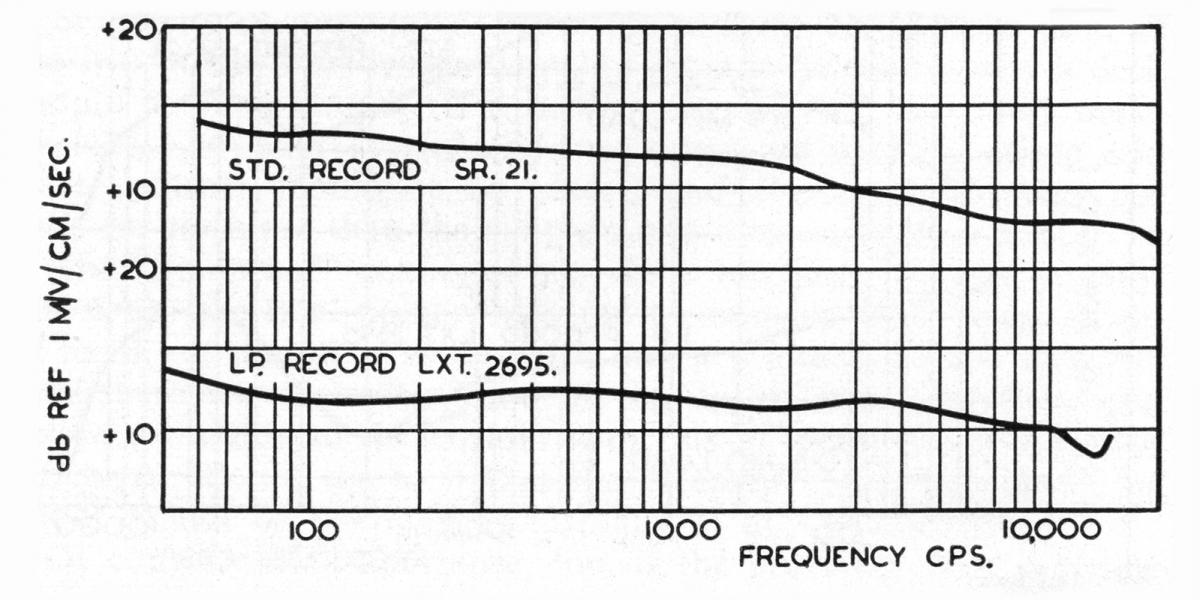
The frequency response shown in the accompanying graph [see above] is extremely smooth and resonance free. A tendency towards third harmonic distortion was noted on the 8kHz and 9kHz bands of the SR21 test record appearing cyclically once per revolution. Careful examination showed that the record was not exactly flat, lifting about 0.02in on one side. As the stylus started ‘climbing the hill’ the distortion became apparent, whilst over the rest of the circle distortion was inappreciable.
Increasing the playing weight from the normal 5g to 8g completely eliminated this tendency. It is thought that this is caused by the vertical compliance being a little below optimum, especially when it is realised that the effective vertical dynamic mass of this type of structure will be approximately three times that of the lateral dynamic mass. However, exact analysis of the HF vibrational modes of even simple structures such as this is extremely difficult, and one should therefore not be tempted to prognosticate.
The low frequency compliance was 3.5x10⁻⁶ cm/dyne, and this should result in adequate tracking capabilities with playing weights down to 3g-4g. We also found it necessary to increase the downward pressure to track the outer band of the JH 138 intermodulation test record. This again, we think, points to insufficient vertical compliance. Needle chatter was not obtrusive, and we were gratified to find an Allen screw wrench provided for fixing the set screw on the counterbalance weight.
To summarise, the Super Lightweight is a soundly constructed and beautifully finished piece of equipment. The frequency response was beyond suspicion, and the performance more than adequate for all normal requirements.
 | |||||||||
|

| ||||||||









 SPONSORED VIDEO






| Equipment Reviews | |
Music Reviews Awards | |
Latest News Features | |
Resources Newsletters | |
Subscriptions |
WHERE TECHNOLOGY BECOMES ENTERTAINMENT
 © 2026 Hi-Fi News
AVTech Media Ltd
All rights reserved