Meracus Imago transport
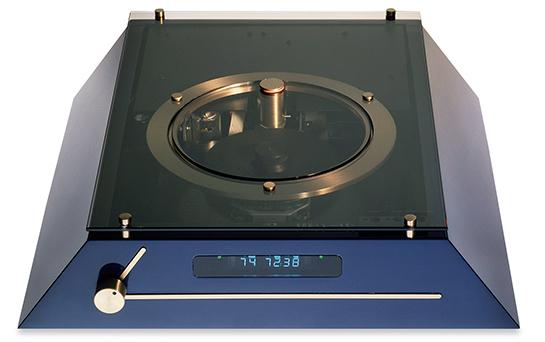

No, I don’t know what ‘Meracus’ means, and I stopped playing around with anagrams after I reached ‘rum case’. How about ‘US Cream’? No way: Meracus is so decidedly, unabashedly a German company that it couldn’t possibly apply. If you’ve ever studied a hi-fi magazine from the Fatherland or visited the Frankfurt or Berlin audio shows, you’ll know what I mean: staggering build quality, weird shapes, bold colours, lots of glass, wholly unique operational procedures. And the £4000 Meracus Imago is almost deliberately ‘unexportable’, because the customer has to be on some Teutonic wavelength to get to grips with it. Study the photos. You’ve never seen another CD transport like it, right?
The Imago is certainly unlike any CD spinner I can recall. It uses the same case as the larger Meracus components, what the manufacturer labels a trapezium but what I’d call a box with sloped sides. The chassis is made from varnished 12mm-thick MDF, mounted to a 2mm-thick steel sheet, and is available in myriad colours if you’re prepared to pay extra to banish the basic black. Our review sample was a gorgeous blue designed to soften the hearts of Bugatti fanciers. The finish is superb, the paintwork so smooth and glossy that you could mistake it for an automotive body part. Porsche, of course.
Space saver
The Imago is huge, too. You’ll need a lot of de-e-ep shelf space to house this sucker, possessing as it does a serious 420x405mm (wd) footprint. The sloping sides reduce the top surface to 295x405mm (wd) – this area is covered with a 4mm-thick sheet of bronze-coloured glass, which ‘floats’ above the chassis courtesy of a spacer in each corner and must be installed by the user during the setup process. Amusingly, the oddball glass lid in the middle actually saves space compared to a rear-hinged lid; the Imago is 100mm tall, but you only need 20mm clearance for the lid itself. What you do have to allow on top of that, though, is enough space for your hand clutching a disc to enter the area above the opening.

Above: Original cover of the HFN Jul ’96 issue featured Audio Note’s Conquest mono tube amps
The way the aperture cover works is reason enough to buy an Imago, especially if you’re the type who covets things like cameras with clear bodies so you can see the works, or wristwatches with skeleton backs. That large round disc is fitted to a barrel at the back of the opening for access to the CD transport itself. Press ‘open’ and the glass disc lifts up and swings out of the way, with the smoothness of a Japanese autofocus camera lens. It took a long while before I grew tired of watching the Imago open and close. Then again, I was in a pretty stupid, easily amused mood the day it arrived. Eventually, the novelty will wear off and it will be reduced to a party trick for entertaining friends that have audiophile/gimmick tendencies. And let’s face it: all this hydraulic hoo-hah really isn’t necessary when you consider that the world’s most costly transports feature slide-back doors... usually manual. But it is a lot of fun. Not, I hasten to add, something usually expected of German goods.
Meracus has also had fun with the controls. The front panel contains only the on/off switch, the large machined-brass rotary control to the left of the comprehensive display. The basic controls themselves are ranged along the front edge of the glass top plate, ‘non-switches’ which operate in contact-less fashion via ‘light barrier’ methods. Touch the glass lid in the appropriate place and the CD aperture cover lifts and lowers, or play commences or stops. Green or red LEDs shine through the lid to tell you what’s been activated, too. Every other operation is accessed via a remote control which also performs all of the functions for other Meracus components.
Secret weapon
But it’s not just novel ergonomics which motivate the Meracus designers. The secret weapon is a floppy internal suspension designed to isolate the transport from external interference, vibration, resonance, ad nauseam. The mechanism itself is the well-respected Philips CDM-9, mounted with its servo board to the 1.3kg sub-chassis. Within the main chassis itself is a screened and cased toroidal transformer with three separate secondary windings for feeding the relevant stages.
The sub-chassis is machined from a synthetic material with high damping characteristics, which is further damped by mats glued to its underside. It is then decoupled by eight rubber ‘absorbers’, and attached to the main cabinet through a lever mechanism. Since the Imago is a top-loader without an integral clamp in the lid, a stabiliser disc is supplied which locks the CD to the hub. This clamp covers the CD entirely, avoiding the current fashion for ‘spoked’ clamps.
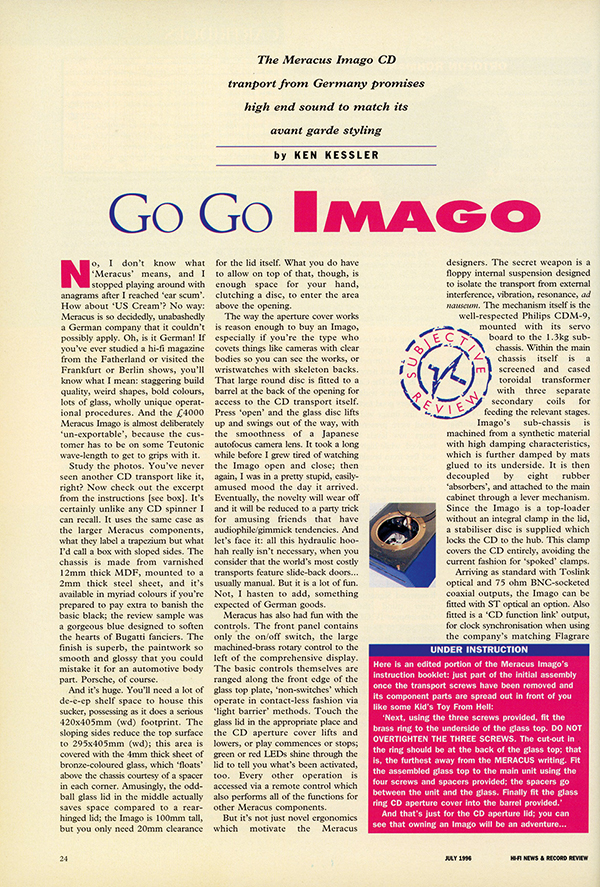
Above: Original pages from Ken Kessler’s review of the Meracus Imago CD transport in HFN Jul ’96
Arriving as standard with Toslink optical and 75ohm BNC-socketed coaxial outputs, the Imago can be fitted with ST optical as an option. Also fitted is a ‘CD function link’ output, for clock synchronisation when using the company’s matching Flagrare converter, which I didn’t have access to at the time.
Instead, I used the Marantz DA-12, which was designed to work with a top-end Philips-based transport; the Theta Pro Gen V; and a herd of affordable Audio Alchemy DACs, which seem to be breeding and multiplying behind my hi-fi rack. The Imago confirmed every pro-digital bore’s worst fears: separate, highly tweaked transports do sound different. I compared the Imago (always using identical leads and comparing like-with-like as regards optical or coaxial transmission) with the Theta Data III, the Marantz CD-12 and the Marantz CD-63SE, even though the latter is not in the same price category.
 Quiet, please!
It soon emerged that the Imago liked the Ken Ishiwata-tuned DA-12 better than any of the other DACs in my arsenal (ain’t it marvellous what a little isolation can do?), so I stuck with it throughout the listening sessions, with the other transports wired in for A/B comparisons.
The Imago somehow endowed CD playback with blacker, more velvety silences, a cleaner landscape against which to position the musical events. However pretentious that may sound, I can’t think of any other way to describe the presentation the Meracus Imago produces, almost making the Marantz CD-12 transport sound ‘romantic’ in comparison. And because the Imago gives the musical event such a quiet background against which to occur, there are myriad other benefits.
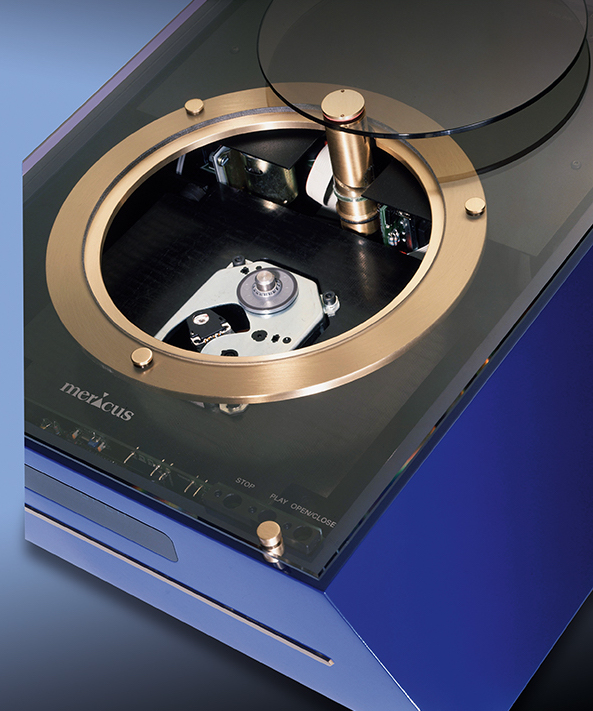
Above: Press 'open' and the glass disc lifts up and swings out of the way
Link them in whatever way you prefer, or discard them as wholly accidental/coincidental, but the impression of a quieter background improved three areas in particular.
The first was a greater sense of dynamic contrasts – and not necessarily the actual speed at which dynamic events take place. Rather, it was the relationship between the softest and loudest sounds in a recording, the apparently lower noise floor making it that much easier to discern the softer sounds during raucous or complex passages.
Allied to this was the second benefit, a sense of greater clarity or transparency. Maybe I’m being simplistic, but the ease with which the softer sounds and the finer details could be detected through the Imago suggested a cleaner window into the soundstage.
And... relax
Amusingly, this effect wasn’t overly hygienic or clinical, two accusations often levelled at German-made transistorware. Instead, it was simply a case of more information breaking free of the system. Which leads to the third apparent bonus.
At no time did the Imago demonstrate any digital ‘edge’, however crisp the transients or vivid and energetic the highs. Partly, I’m sure, this was down to the simply sensational DA-12 DAC, which has its own method of reassembling the parts into an analogue whole. But, and I’m staggered to see myself writing it, the Meracus Imago makes music which is positively relaxed.
Selecting a repertoire to test these findings involved use of Willy DeVille’s hyper-dynamic ‘Assassin Of Love’, with more sonic contrasts than any single track deserves; Lou Rawls’ ‘At Last’, which offers a duet (with Dianne Reeves) of utterly opposing vocal textures; the pseudo Anita Kerr Singers on Big Daddy’s ‘With A Little Help From My Friends’ to assess the smoothness; and Keb’ Mo’s ‘Am I Wrong’ because it’s so vicious. Oh, and The Chordettes’ ‘Sandman’ just because it gives me a chuckle. The Imago passed my listening tests with flying colours.
Conclusion
Because it contains such a comprehensive suspension system, this Meracus machine is easy to site, bar the size considerations. You don’t have to spend a fortune on bombproof platforms, and experimenting with trick feet yielded no audible gains. It’s fussy enough about converters to demand an audition with precisely the DAC that the potential owner will be using. The ergonomics? You’ll quickly get used to its operational quirks.
The only reservation I have is about the looks. We’re talking real love/hate here, because components this individualistically styled usually preclude happy visual marriages with other products. In which case, some intending purchasers could be better off considering the Imago in its standalone CD player form. At least then one needn’t worry about it looking stupid on top of any other less pyramidal device.













 SPONSORED VIDEO






| Equipment Reviews |  |
Music Reviews Awards | |
Latest News Features | |
Resources Newsletters | |
Subscriptions |
WHERE TECHNOLOGY BECOMES ENTERTAINMENT
 © 2026 Hi-Fi News
AVTech Media Ltd
All rights reserved