Canary Audio CA-300 power amp

If there’s one subject which arouses the ire of what designer and HFN contributor Ben Duncan calls the HLOs, it’s hi-fi cables. And if there’s another, it’s the single-ended triode amplifier.
All amps were once low-powered, single-ended, directly-heated triode types with no external negative feedback, but that was in the 1920s.
So, from the Hard-Line Objectivist point of view, today’s advocates of the single-ended triode amplifier are telling us there has been no progress since then. They perversely refuse to accept the merit in any subsequent developments, up to and including the transistor.
You might agree that the SET brigade are just Luddites trying to go back to a simpler place and time. On the other hand, you may have heard a single-ended triode produce sounds that seemingly can’t be got in any other way.
Pure and simple
If you’ve already been seduced into the latter camp, you will be interested in what Canary has to offer. For less dedicated hi-fi pilgrims, the company makes push-pull amplifiers too, but the subject of this review is the 300B-based monoblock, single-ended triode amplification in pure and simple form.
Based in Fremont, California, Canary Audio is yet another small-but-dedicated American company, and is one that seems able to offer solid-looking, well-crafted valve amplifiers at prices which are not unreasonable – even when they’ve been shipped across the Atlantic.
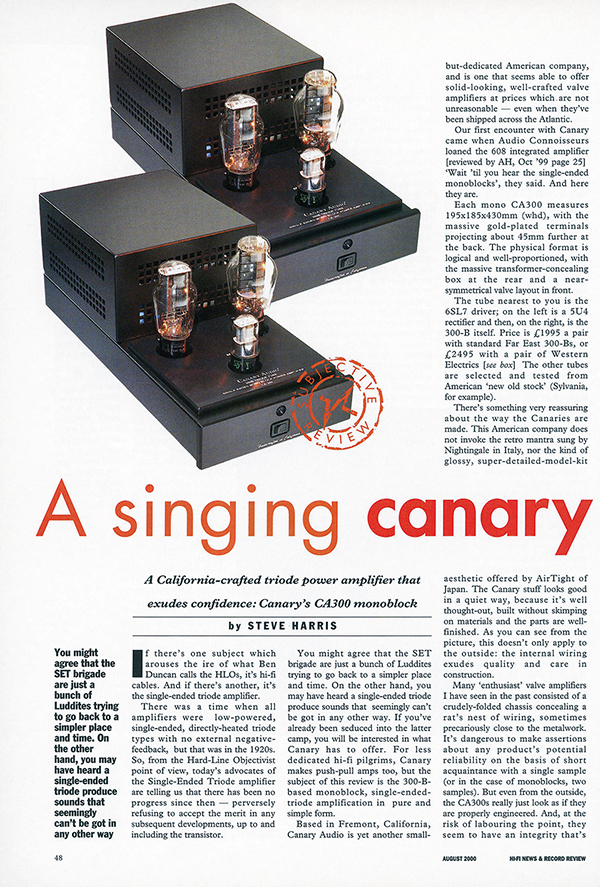
Our first encounter with the brand came when UK distributor Audio Connoisseurs sent us a sample of Canary’s 608 integrated amplifier [HFN Oct ’99]. ‘Wait till you hear the single-ended monoblocks’, it said. And here they are.
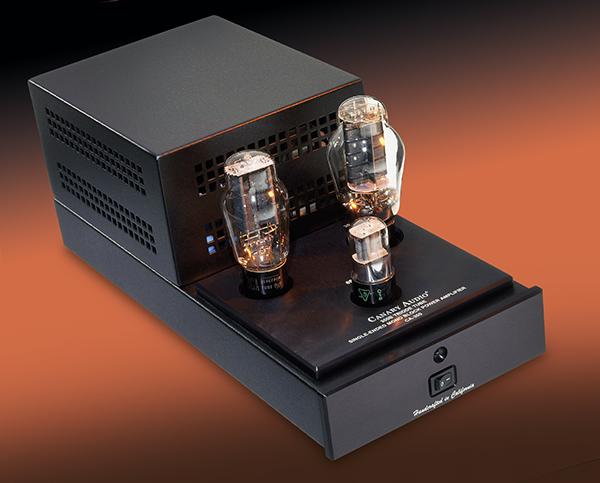
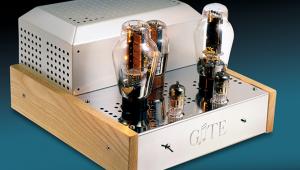
Each mono CA-300 measures 195x185x430mm (whd), with the massive gold-plated terminals projecting about 45mm further out at the back. The physical format is logical and well-proportioned, with the transformer-concealing box at the rear and a near-symmetrical valve layout in front.
The tube nearest to you is the 6SL7 driver; on the left is a 504 rectifier and then, on the right, is the 300B itself. Price is £1995 a pair with standard Far East 300Bs, but you can pay £2495 for a set with Western Electric tubes. These are painstakingly made to the original standards, carefully calibrated, and come in incredible retro packaging [see p167] that will strike a chord with anyone who ever owned a Hornby train set (and with the recent announcement of Western Electric’s own amplifier designs, it looks as if the re-introduction of this classic tube could be just the start). The other tubes are selected and tested from American ‘new old stock’ (Sylvania, for example).
There’s something very reassuring about the way the Canary amplifiers are made. This American company does not invoke the retro mantra sung by Nightingale in Italy, nor the kind of glossy, super-detailed-model-kit aesthetic offered by AirTight of Japan. The Canary hardware looks good in a quiet way, because it’s well thought-out, built without skimping on materials and the parts are well-finished.
This doesn’t only apply to the outside, either: the internal wiring exudes quality and care in construction. Many ‘enthusiast’ valve amplifiers I have seen in the past consisted of a crudely folded chassis concealing a rat’s nest of wiring, sometimes precariously close to the metalwork.

It’s dangerous to make assertions about any product’s potential reliability on the basis of short acquaintance with a single sample (or, in this case, two). But even from the outside, the CA-300s really just look as if they are properly engineered. And, at the risk of labouring the point, seem to have an integrity that’s absent from many valve products. It’s hard to imagine, for example, that Canary would ever supply a product carrying a control that didn’t do anything.
 Classy canary
Most of my critical listening was done with the Avantgarde Uno horn loudspeakers [HFN May ’00], with a system that also included an SME Model 10 turntable [HFN Dec ’99], Exposure CD player and Vidmar Viking preamplifier. The Avantgarde Uno’s quoted sensitivity is around 99dB for 1W, far beyond what can be achieved with conventional cone-speaker boxes. Although the Unos don’t quite match the 100dB-plus sensitivity figures claimed by Lowther horn proponents, or indeed by the biggest Avantgarde models, they certainly will produce adequate levels and fine dynamics from the single-figure power output of a SET. The Uno is in fact a hybrid speaker design, since below 200Hz the sounds come not from the horn but from a sealed-box low-frequency unit, driven by its own solid-state amplification.
This is in a sense a compromise, but it works far better than some so-called full-range horn systems. While it does make life easier for the amplifier, it won’t conceal any shortcomings in bass response.
Anyway, I certainly enjoyed the sound of the Canary amps. It was a sound you could relax with and listen to without strain. The mid and treble character was just what you’d hope for, alive and vibrant on vocals and solo instruments. Bass quality via the Unos was fair, but not really comparable with what they can produce from a solid-state amplifier.
So, the moment came when I was ready to try out the Western Electric tubes. At this point I have to confess that I’d never before had the chance to compare different 300Bs in this way. I was eager to know the truth, but had no idea what (if anything) to expect. I switched off, and, burning my fingers, pulled out the standard 300Bs from the amps and inserted The Real Things.
Best western
How long does it take a tube to warm up? In this case, it seemed to be no time at all. The comparison of hot versus recently switched on could hardly be fair, but I was astonished by the sound I heard.
There was absolutely no doubt that the Western Electric tubes transformed the Canary amps – or, should I say, unlocked their full potential – with a far greater sense of solid realism. I switched the hot tubes over again to make sure I wasn’t mistaken. But it was true.
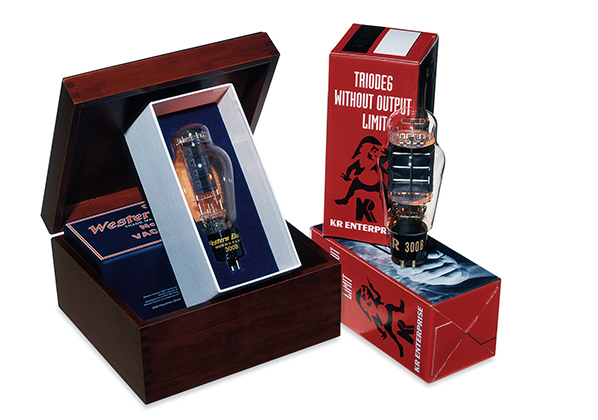
Now, I found I was really being drawn into the music, on the edge of my seat to hear some subtlety unfold, or swept away by the performer’s emotion. There were times, as I listened, when the thought crossed my mind that it didn’t get much better than this. The performance was very good with the standard tubes. It’s just that with the Western Electric 300B, it became something special.
Mains gains
If the CA-300s do have an Achilles’ heel, it is the one you’d perhaps expect with this type of amplifier. On classical music, or quieter music generally, the sound was marred by a discernible level of hum through the speakers. How serious this is will depend on how fussy you are, what kind of music you like, the size of your room and the ambient noise level you normally live with. In this case, I suspect that the problem might not have arisen with a US market version running on its native 110V mains, and may well be to do with the adaptation to UK mains voltage. American designers are not helped here by the fact that UK mains can and does go up to 10% above the nominal, supposedly Euro-standardised 230V – in which case, Canary can probably improve on the result I got. In the meantime, it’s probably worth making sure you try the amplifier for yourself with the intended loudspeakers (the more sensitive the speakers, the higher the noise level will be).
Set to stun
Single-ended hi-fi valve amps have tended to be made by enthusiasts for enthusiasts. In the past this has often meant they were built with no regard for sane or normal considerations of safety, reliability or durability. The end user, infatuated with the idea of hi-fi that glowed, would put up with almost any amount of danger, inconvenience and abuse – not to mention hum, hiss and distortion.
I think those days are gone. It’s still true that the SET amp is a specialist product, aimed at a niche market of dedicated enthusiasts, who, in order to get closer to the music, are also willing to suffer the foibles of horn speakers. But Canary seems to have joined the band of small, craft-based makers who work to high standards. The result is a product you can enjoy listening to – and owning. And if you can afford the Western Electrics, get them. You won’t get your fingers burnt.











 SPONSORED VIDEO






| Equipment Reviews |  |
Music Reviews Awards | |
Latest News Features | |
Resources Newsletters | |
Subscriptions |
WHERE TECHNOLOGY BECOMES ENTERTAINMENT
 © 2026 Hi-Fi News
AVTech Media Ltd
All rights reserved