Aavik I-188 integrated amplifier
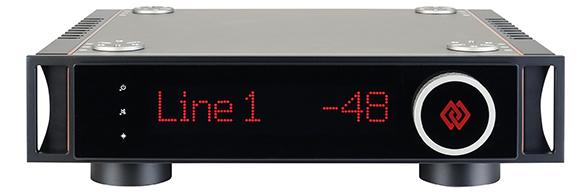

Two disparate thoughts crossed my mind after a mere two minutes with Aavik’s I-188 integrated amplifier. The first was a whiff of familiarity when I saw that Flemming E. Rasmussen, the semi-retired founder of Gryphon Audio, was involved in Aavik. The other was seeing reports from the AXPONA show in Chicago suggesting there was a discernible boom in high-end integrated amps, especially among older audiophiles who are downsizing, rather than post-Gen-Xers who shun clutter.
One of the family
Aavik’s I-188 is the least expensive of a trio, at £15,000. The I-288 (£20,000) and I-588 (£25,000) increase the number of ‘Tesla coils’ – Aavik’s proprietary noise-reduction scheme [see boxout] – while the I-588 adds an extra, larger power supply for the line stage. The latter’s volume control/output driver is based on Aavik’s own discrete op-amps while the I-188 and I-288 use IC op-amps for that section. Otherwise, all look identical and offer the same number of connections and features.
As for the ‘Danishness’ of the I-188, hi-fi veteran Lars Kristensen founded Aavik after 20 years with Nordost and time with Raidho, along with engineer Michael Børresen. They established four brands to develop the entire panoply of hi-fi: Ansuz (cables), Aavik (amps, streamers, phono stages and DACs), Børresen (speakers), and Axxess (pretty much everything). Audio Group Denmark is the umbrella company.
Part of what I learned about the Aavik I-188 confused me into thinking I was writing about watches: you don’t often hear the word ‘titanium’ in conjunction with amplifiers. For some years a popular material for wristwatch cases, titanium is prized by watchmakers for a number of virtues, among them strength, light weight, freedom from corrosion and especially resistance to magnetism, the last of which is death to a timepiece.
Quiet please
These qualities have their roles in the chassis of the I-188, the titanium and thick copper sheets with a laminated fibreboard ‘filling’ forming a ‘sandwich’ for the top plate. The rest of the case features anodised alloy heatsinks and front panel – the impressive-looking heatsinks, however, are largely decorative as the I-188’s cool-running Pascal Class D amplifier module sits on the bottom plate.
Aavik has designed the entire structure to deliver maximum EMI/RF screening. The unit’s ghostly quietness and resistance to external interference might also be due to the unusual componentry. Inside the I-188 and its integrated siblings are various quantities of those aforementioned Tesla coils, the I-188 containing 36 ‘active’ coils and 96 active square coils. These increase, respectively, to 72/168 for the I-288 and 108/240 in the I-588.
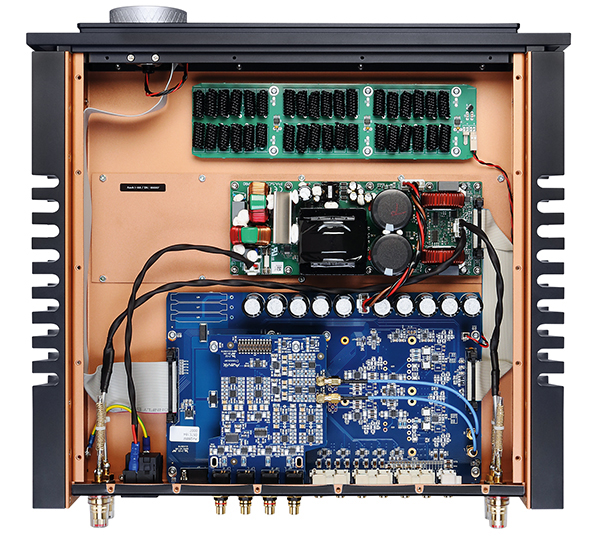
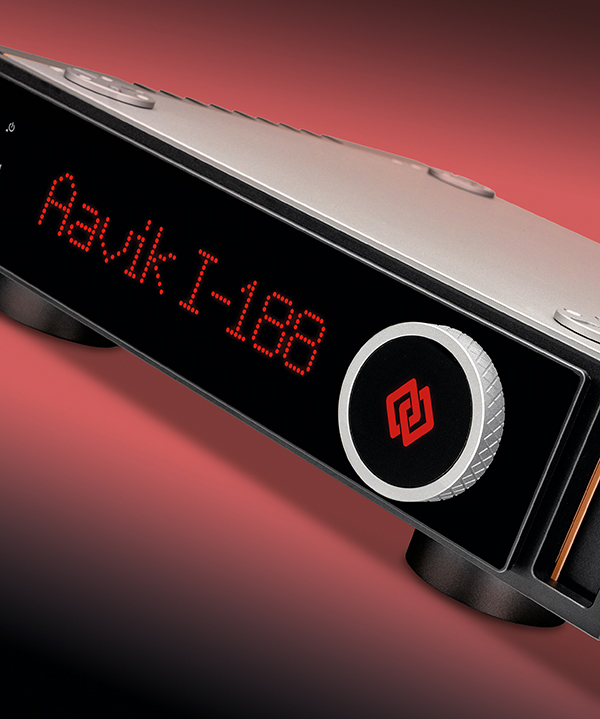
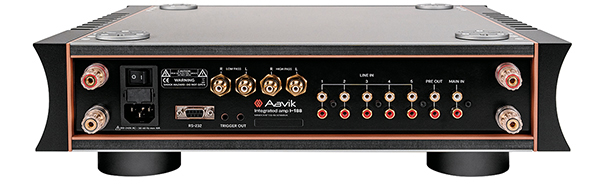
While the I-188 boasts a glass front panel with touch operation for power-on from standby, mute and input/menu selection, and a rotary control far right, it is surprisingly minimalist – so no onboard DAC, phono stage, streamer, etc, and no balanced inputs. Instead, you get a rear panel that could have come from 1977 – seen from the back, each end contains multi-way binding posts, and between them are five pairs of line-level RCA inputs and pairs for pre-in or main-out operation. There are also 12V DC triggers and RS-232 sockets for system integration.
Above these are two pairs of RCA outputs marked ‘Low Pass’ and ‘High Pass’, but as there is no fully variable internal crossover we asked Aavik for further detail. Mikkel C. Simonsen, from Aavik’s R&D department, explained that their ‘main use is for connecting a subwoofer. The internal power amp can then be used for either the high-pass or low-pass drive. In some use cases you can get better results by using the 1st-order high-pass in the line stage with the options of 25Hz, 40Hz and 70Hz to drive the main speakers, and then use the low pass outputs for driving an active subwoofer, or subwoofer plus an external amplifier’.
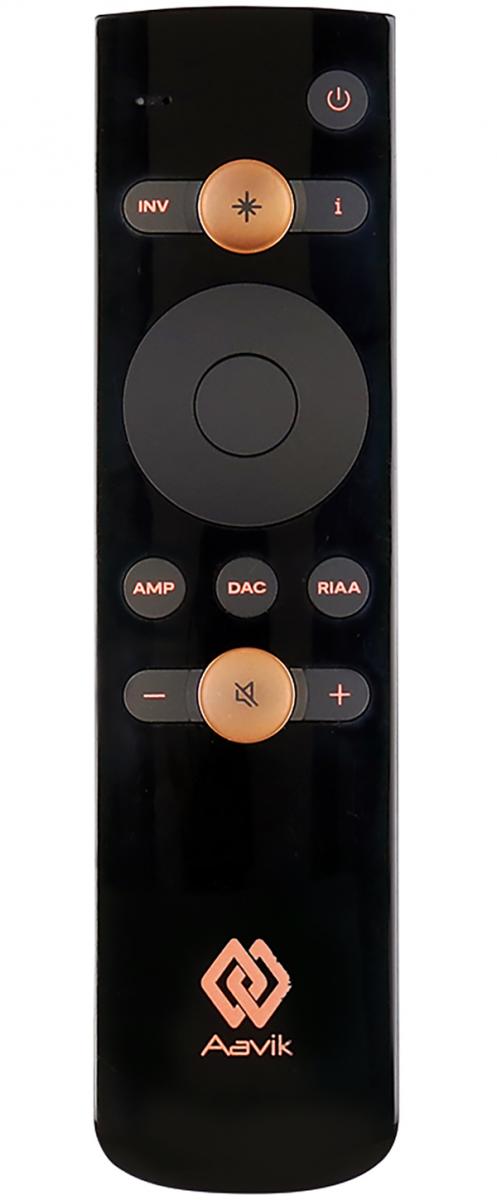
I used the I-188 ‘straight’, so setup took minutes, everything self-explanatory, while the supplied remote [p65] handles all operations. The menu provides access to altering the preamp gain – I used the +9dB setting set by PM in his [see PM's Lab Report] – plus balance, pre-out mute, display brightness/dimming, display of the operating temperature, home theatre settings, crossover for the high-pass and low-pass outputs, and other functions. If you mess up, there’s a factory reset button.
 Great dane
Using Super Audio CD and CD, open-reel tape, and vinyl, I wasn’t bothered by – no, make that I was relieved by – the I-188’s absence of any internally fitted source intrusions. I revelled in the fact that this was purely a line-level affair, its quietness allowing me to flip from source to source to isolate its own sound, of which there is little to discern. Careful level matching of all the sources, with copies of albums on two or more formats, made assessing the Aavik I-188 a breeze to accomplish.
It was a reel-to-reel tape of sibilance-free strings which also revealed only one small area to criticise. When hammered (and I do mean hammered), the amplifier exhibited a slight rawness or roughness in the mid-to-upper reaches. But let’s get real. I’m referring to levels so far above anything approaching normal or healthy listening that it’s academic. It wasn’t quite the same as clipping, merely a reduction in the sweetness of and rasp added to the Melachrino Strings and Orchestra’s The Music Of Jerome Kern [RCA Living Stereo FTP-1053]. But I repeat: the levels were so excruciatingly high that I worried for my loudspeakers.
From grit to grace
Now that’s out of the way, I had to marvel at the way Class D amplifiers have evolved from the harsher-sounding products that were foisted on us a few decades ago. While nobody would mistake this for a quartet of KT-88s per channel, the I-188 exhibited air, sufficient warmth, enormous scale and – aside from when emulating Motörhead concerts – fatigue-free treble. The massed strings on the Melachrino tape formed a wide, lush wall of sound, with superb front-to-back depth.
While I realise aural memory lags way behind sight and smell, I was taken by a flash of recall. It’s been 40 years since I first heard Gryphon electronics, but a near-perfect balance between tubes and transistors was a characteristic of the I-188’s indirect ancestor. This was made even clearer when comparing Joni Mitchell’s 1976 album Hejira on Mobile Fidelity’s SACD [UDSACD 2275] and One-Step vinyl [UD1S 2-053] releases.
Okay, there were other variables, in that one of my phono stages was all-valve, so I changed to a solid-state alternative, while the SACD player was clearly not tubed. Rather, I was listening for the way the Aavik I-188 would expose the resolution between the two formats. Again matching levels as precisely as I could, I heard the album’s gorgeous, lush title track oozing ‘liquidity’ from both sources.
Crystal clear
Did one format slaughter the other? Absolutely not. The differences were so subjective that I could imagine fights breaking out at hi-fi shows among audiophiles with biases. In either case, it was the I-188 amplifier revealing all, with crystal clarity and utter transparency.
True, it showed the LP to have warmer bass, with the SACD marginally cleaner and deeper, but neither cancelling out the other as personal preferences come into play. And that voice? Clean, distortion-free and sounding, well, real. Similar battles between two formats produced the same results, attesting as much to the sheer brilliance of SACD and the supremacy of tape, as well as to the continuance of vinyl as the preferred format for a great swathe of audiophiles.
Using a plain ol’ ‘Red Book’ CD, and satisfying my need to hear mono as well as stereo, the title track from The Door Is Still Open by ’50s R&B group The Cardinals [Collectibles COL-CD-9977] provides the listener with not one but two peerless performances. The first is the exceptional voice of Ernie Warren – a god among doo-wop singers – while the second is the absolutely remarkable saxophone solo from jazz legend Johnny Griffin. You know the drill: the sax seemed to leap from the speakers, while the detail was borderline clinical.
For a 70-year-old recording, the sound quality is almost embarrassing. Hearing it through a no-holds-barred amplifier of such pellucidity, even if from the CD rather than the rare, original 45rpm single, should be mandatory for those who deem anything non-digital (in origin) as prehistoric. Through the I-188, the playback was as vivid as I have heard it, and this song is played to death in my listening diet.
Cashing in
Still, I needed a dose of another mono gem and it was the ‘redneck’ bass on Johnny Cash’s Hot And Blue Guitar [Intervention IT-039] that captured my attention with its solid central image, and no ‘mono’ button to push. As for his voice, the textures were enough to make even a stereo-only enthusiast nod in admiration.
And the inevitable moment of revelation, the clincher? I don’t have a drop of Irish blood, nor a penchant for folk music, but the harmonies, banjo, and harmonica on The Clancy Brothers and Tommy Makem’s Isn’t It Grand Boys [Columbia CQ813 open-reel tape] had me craving a Guinness. And a Danish pastry.
Hi-Fi News Verdict
Though a beguiling example of an ultra-modern, high-end integrated, Aavik’s I-188 defies convention not just in its left-field circuitry, but in eschewing an onboard DAC, balanced inputs, etc. Instead, it’s a lean, mean machine with immense power, bank-vault construction and gorgeous looks where minimalism meets the future – a product poised in the vanguard of the ‘integrated amplifier renaissance’.Sound Quality: 86%
 | |||||||||||

|
|
| |||||||||








 SPONSORED VIDEO






| Equipment Reviews | |
Music Reviews Awards | |
Latest News Features | |
Resources Newsletters | |
Subscriptions |
WHERE TECHNOLOGY BECOMES ENTERTAINMENT
 © 2026 Hi-Fi News
AVTech Media Ltd
All rights reserved