Hegel H150 ‘The Prodigy’ streaming amplifier
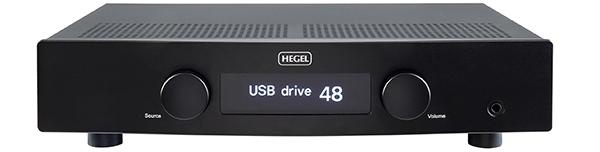

There’s an easy way to understand the hierarchy of amps in the Hegel catalogue, be they pre, power or integrated. The higher the number, the ‘better’ the specification (you might think this would be the only way to go about it, but some rival companies – I’m looking at you, HiFi Rose – beg to differ). And so it is that the Norwegian manufacturer’s new H150 integrated, priced £2750, takes up a middle-of-the-range position, above the entry-level H95 [HFN Oct ’20], and below the H190v, H400 [HFN Oct ’24] and H600 [HFN Oct ’23].
These amplifiers share technologies and features, including a uniform styling that can make it hard to tell some of them apart. But there are enough differences in specification, be it the claimed power output or the level of connectivity on offer, to make the lineup feel well constructed. It’s hard to imagine any audiophile seeking a Hegel integrated amplifier and not finding one that fits the bill.
USB uplift
Nicknamed ‘The Prodigy’, thereby following Hegel’s recent trend that’s also given us the ‘The Raven’ D50 DAC [HFN May ’25] and ‘The Orchestra’ H30A power amp [HFN Jun ’23], the H150 is positioned as an upgrade on the company’s H120. It effectively replaces that model, although the Class AB amplification, with ‘SoundEngine2 error-correction circuitry’, is once again rated at 2x75W/8ohm [see PM's Lab Report] and they outwardly look identical. The aluminium chassis is the same 435x100x350mm (whd), again offered in a black or white finish, and the front panel sports the same arrangement of source and volume rotaries, 6.35mm headphone out, and OLED text display.
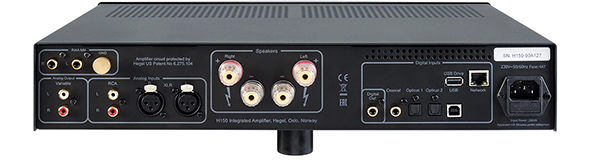
It’s around the back of the H150 where its upgraded nature becomes apparent, because there are three new connections. One is a set of RCA ins that feed an MM phono stage, as Hegel expands on a strategy, beginning with the H190v, of adding vinyl playback to its mid-level integrated amps. Owners of the H400 and H600 are pointed in the direction of the company’s standalone V10 MM/MC phono preamp [HFN Mar ’21]. A BNC digital output, meanwhile, facilitates the DAC Loop functionality seen on other Hegel models, and this enables the user to bypass the H150’s internal D/A conversion in favour of an outboard DAC.
The third new connection is a USB-A socket for music playback from an external drive. This is a first for Hegel, and its inclusion here is maybe surprising given the H150 also provides for network file playback through its streaming platform. The latter, leveraged from the H400 and H600, also supports Qobuz, Tidal, Spotify [see boxout] and Airable Internet radio, with these sources managed through the partnering Hegel Control app. Apple AirPlay, Google Chromecast, and – pending certification – Roon are also onboard.
Custom conversion
Other physical connections on the H150 are a variable line-level output, enabling use with a subwoofer or secondary power amp; one set each of unbalanced RCA and balanced XLR analogue inputs; USB-B; a trio of S/PDIF ins (2x optical, 1x coaxial); and Ethernet. Handling digital sources is a custom-designed DAC stage incorporating AKM’s AK4493SEQ chip. Sample rates to 192kHz/24-bit are supported, but DSD files and higher-res PCM files are off the menu.
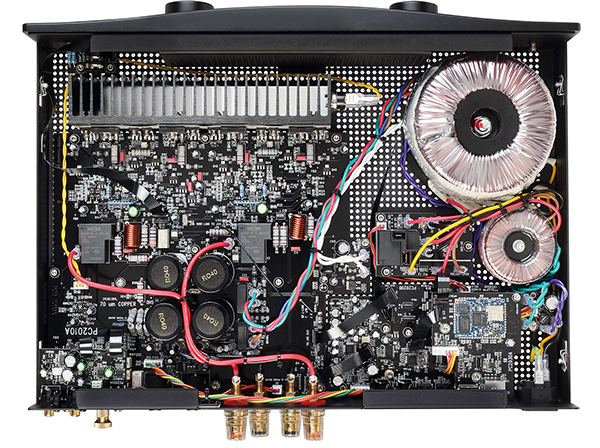
There’s no built-in Wi-Fi or Bluetooth, which is par for the course for Hegel hardware as the brand pursues a performance-first ethos. There’s also no HDMI ARC on the H150, so for TV audio you must use one of the amp’s optical inputs. Hegel says the unit is preloaded with popular remote codes ‘for seamless volume and power control’ using your TV’s handset (if it uses IR rather than Bluetooth). This will suit many users, but considering the H150’s otherwise modern feature set, and ARC being part of HDMI since 2009, its omission still surprises. And if your TV is wall-mounted with in-wall wiring – as mine is – adding an optical cable is a real faff…
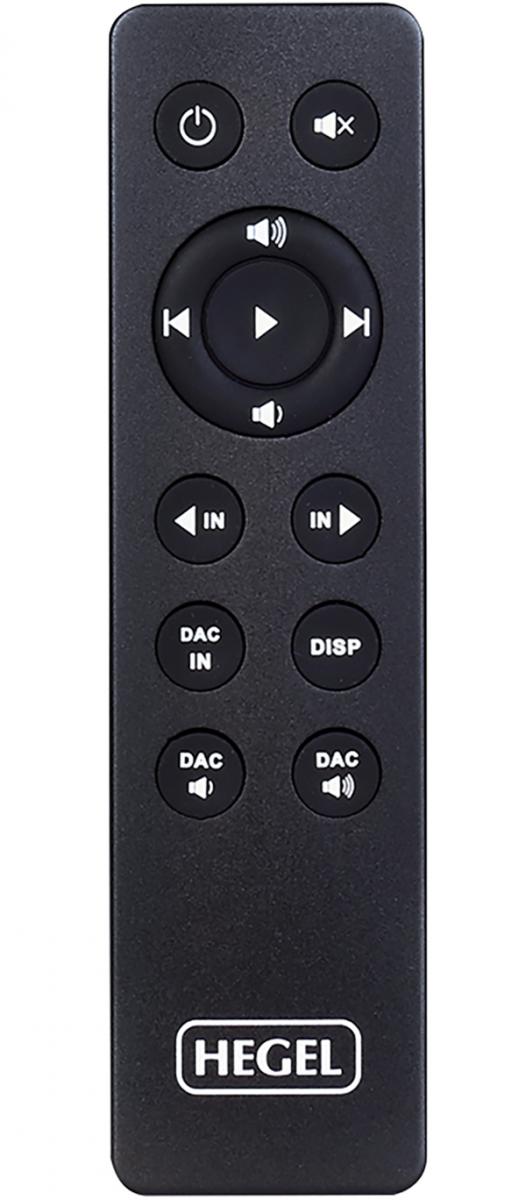
The remote control bundled with the H150 [see below] is refreshingly compact and not overloaded with buttons. Better still, the volume and play/pause/skip controls are located exactly where they should be, meaning you can operate the amp without even looking. These functions are also covered by Hegel’s app, but the remote is needed for making changes to the amplifier’s settings, which are shown on the front panel display. It’s only here, and not on the app, where the H150 can be put into DAC Loop mode, or have any of its inputs set to a fixed volume level (for use with sources with their own volume control). You can also change Sleep (standby) and automatic wake-up/input settings. Tone controls, balance or DAC filters? There are none.
On the money
Used with both my regular B&W 705 S3 Signature loudspeakers [HFN Aug ’24] and, for variety, the compact AE1 40th Anniversary standmounts from Acoustic Energy, Hegel’s H150 lived up to its value-for-money billing. Right from the off there was the impression of plenty of clean power and dynamic heft, and that didn’t change regardless of source or input. It also aped the brand’s other hardware by sounding as mature and unflashy as it looks. The H150 goes about its business with quiet authority, unconcerned with adding its own sheen to the music.
This makes it easy to sit back with a playlist or CD and not have your enjoyment interrupted by something sounding ‘out of place’. The Traveling Wilburys’ self-titled debut album [2016 remastered edition, Concord Records; 192kHz/24-bit], streamed through a Matrix Element X2 Pure [HFN Dec ’23] and connected to the amp’s balanced XLR inputs, arrived with its warm tones and gentle rock rhythms fully on show. George Harrison’s vocals on ‘Handle With Care’ were clear and well detailed, followed by the instantly recognisable angelic voice of Roy Orbison, but both were always well integrated with the accompanying instruments. Later, this cohesive sound ensured Jeff Lynne’s keyboards on ‘Margarita’ (where Bob Dylan takes lead vocal duty) blended perfectly with the various shades of guitar.
Stereo swagger
Making use of the H150’s internal DAC and streaming the same album – again at 192kHz/24-bit – via Qobuz Connect, the sound acquired a slightly darker overall presentation, with a little less treble clarity and separation. Such differences are to be expected from DAC to DAC, and it’s worth noting that Matrix Audio’s streamer/DAC sells for considerably more than Hegel’s streaming integrated amplifier.
Besides which, the H150’s custom DAC stage still did a good job with the bombastic glam rock of Def Leppard’s ‘Die Hard The Hunter’ [Pyromania, Universal Music Recordings; 4868055]. Produced by OTT knob twiddler Mutt Lange, this war-inspired track begins with helicopter rotor blades and machine gunfire panning across the stereo spread, an effect slickly rendered here. Then came the multitracked vocals and trademark drum sound, everything sounding robust and full of energy.
This sense of good speaker-driving power, and a punchy bottom end, was also apparent on Def Leppard’s more recent ‘Take What You Want’ [Diamond Star Halos; UMC 48kHz/24-bit], where the main riff carried tremendous weight, but the bassline remained distinct. The title track from Boris Blank’s Electrified album [Polydor; 88.2kHz/24-bit] put even more pressure on the H150 to dig deep, this time into washes of electronic effects. Upping the volume to really appreciate this track’s large, atmospheric production, I soon reached a point where my ears – rather than the H150 – felt ready to pop.
Key differences
With intimate, uncluttered pieces, the amplifier’s near entry-level position in Hegel’s catalogue becomes more apparent. Pianist Vikingur Ólafsson’s recital of the aria from Bach’s Goldberg Variations [Deutsche Grammophon; 192kHz/24-bit] was easy to focus on, the H150 communicating the different weight and pace of the key presses. Yet it missed out on the sense of space around the instrument, that feeling of the music cutting through air. On the other hand, the sheer texture the H150 found in the lower tones of a cello on Katja Maria Werker’s beautifully recorded ‘Carried The Cross’ [Contact Myself; BMG 74321 75126 2] was remarkable.
Further down the audio band, the scale of the drum track on Black Sabbath’s ‘A National Acrobat’ [Sabbath Bloody Sabbath; Rhino/Warner 96kHz/24-bit], and the tightness of the snare hits, wasn’t quite met with the out-and-out slam a more powerful, forward-sounding amplifier might deliver. But again, this plays into the H150’s ease-of-listening, as does its well-behaved treble that keeps percussion elements crisp but not edgy.
Drama delivered
Once again, Hegel has deployed its custom upsampling filter in the H150, rather than leave the listener to choose from the AKM DAC’s six inbuilt filters, and this contributes to the amp’s fuss-free appeal. Beyond my complaints about the lack of HDMI ARC, I found this amplifier a doddle to use. The app, while basic in terms of functionality, is elegantly laid out and stable, and the remote control operates over such a wide ‘window’ I could point it almost in the opposite direction and still pause tracks and set the volume.
All that’s left to do is lap up the H150’s performance, which combines natural, organic-sounding details and tonality with confident power. Listening to Bernard Herrmann’s prelude to The Day The Earth Stood Still [Varèse Sarabande, VSD-6314], its midband packed with flighty theremin and its bottom registers big and dramatic, that £2750 price tag felt like a steal.
Hi-Fi News Verdict
On the face of it, Hegel’s ‘Prodigy’ might look to play second-fiddle to other, feature-rich, streaming amps around this price. But where rival models turn heads with full-colour GUIs, Wi-Fi, user tweaks and exotic file support, the H150 offers thoughtful connectivity and simple operation, which might be just what the hi-fi doctor ordered. Its superlative sound is very much in keeping with the brand too – refined, but packing a punch.Sound Quality: 88%
 | |||||||||||

|
|
| |||||||||






 SPONSORED VIDEO






| Equipment Reviews | |
Music Reviews Awards | |
Latest News Features | |
Resources Newsletters | |
Subscriptions |
WHERE TECHNOLOGY BECOMES ENTERTAINMENT
 © 2026 Hi-Fi News
AVTech Media Ltd
All rights reserved