Pye Black Box record player
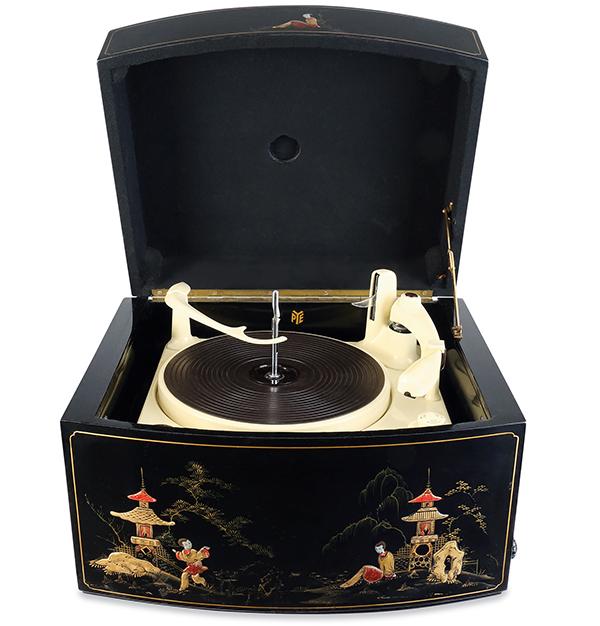

The Pye Black Box hi-fi record player was a milestone design which seems to have touched the lives of everyone involved in audio from the mid-1950s to the mid-’60s. It arrived at a time when quality listening was becoming a pursuit in itself but much of the equipment on the market was too complicated for the non-technically minded user. The Black Box, on the other hand, made everything simple – all you had to do was to put it somewhere, plug it in and off it went. At a time when even FM radio was a thing of the future its performance was a revelation. If you were a music lover who wanted something small and neat you simply had to have one.
The life of Pye
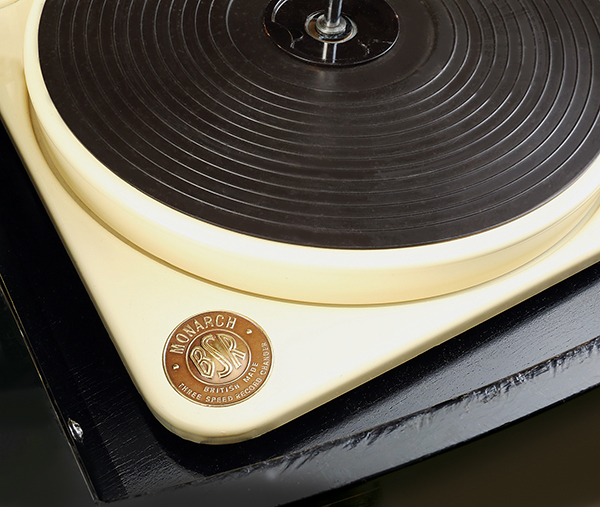
The Black Box story started in May 1954 when the original models were introduced. There were four versions, combinations of either a single-play Collaro turntable or a BSR autochanger with a choice of two cabinet finishes, plain varnished wood or black lacquer decorated with traditional Chinese scenes. It was this version that gave the model its name, and throughout the Black Box’s life the manufacturer frequently chose an oriental style font when mentioning it in sales/service literature.
There were significant price differences between the models, the most affordable being the single-play wooden version (type BBHS) at £29 8s. 3d. The auto-changing BBH cost under £2 more at £31 0s. 1d., but if you wanted it in black lacquer (type BBHC) the cost jumped to £50 1s. 8d. The first few automatic units were fitted with UA4 changers (BSR’s first) but this was soon replaced by the similar UA6. After that, the popular UA8 became the supplied deck for a long period.
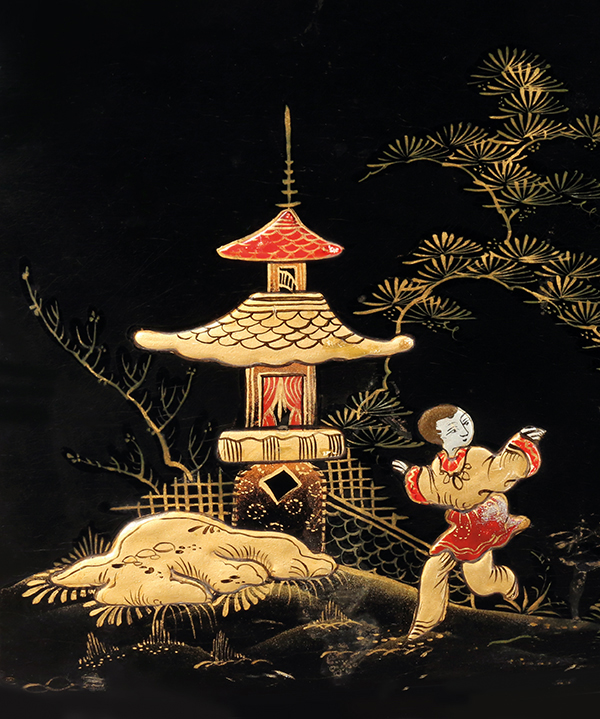
The offering of the highly ornate luxury model at such a considerable extra cost is at first difficult to understand. The Festival of Britain in 1951 had introduced to the mainstream a more stark and European look to contemporary British furniture, inspired by the likes of Le Corbusier and The Bauhaus. Pye itself engaged the services of industrial designer Robin Day to give its products a more modern and geometric appearance, starting with the striking PE60 table radio of 1952. This had concealed knobs, plus a black glass dial and contrasting white resin loudspeaker grille both running the full width of the cabinet. But bold as it was, this new aesthetic did not suit the Black Box player, whose marketing position was all about de-mystifying the new field of high-fidelity.
Art attack
The Chinoiserie style was making a comeback in the post-war period as a more luxurious alternative to the harder, colder appearance of some interiors. It was also deemed perfect for turning the perception of Pye’s new model from a jet-age technological marvel into a mystical music box full of hidden powers. Although the Chinoiserie option was quietly dropped from the later Black Box models it helped to bring fame and recognition to what may have otherwise been dismissed as just another record player. Meanwhile, Robin Day continued to design cabinets in the modern style for Pye right up until the end of its time as an independent company in the late 1960s.
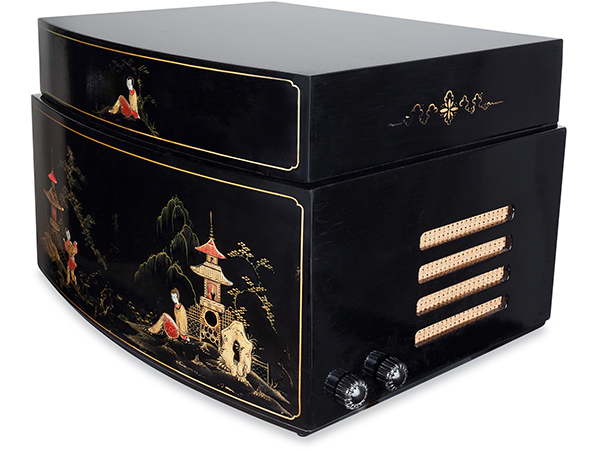
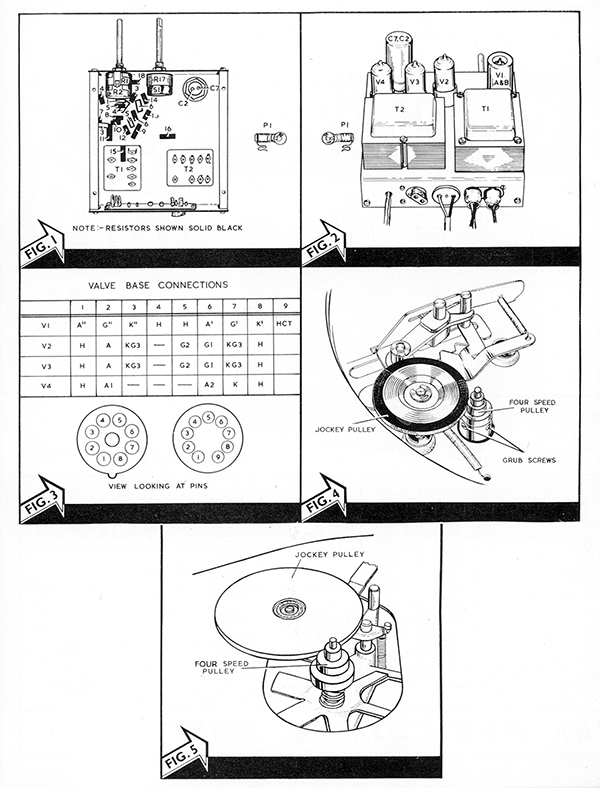
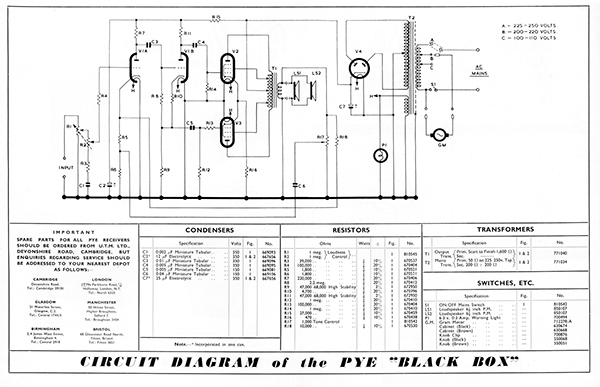
The original version of the amplifier unit used four valves. These were an ECC83, two EL42s and an EZ41 as the preamplifier, push-pull output stage and PSU rectifier, respectively. Initially the circuit had the EL42s strapped for triode operation and produced a claimed 3W. The design was revised for the MkII Black Box which retained the same valve lineup but abandoned the triode connection in favour of ultra-linear operation, thereby raising the power output to 4W [see PM's Lab Report]. Other changes were made at the same time, including the fitting of a volume control with two ganged sections which kept the loading on the amplifier input constant at all settings.
All change
The next version of the Pye player was released in 1958. Called the BB/A, from the outside it looked nearly identical but everything within was new. The turntable had been changed to a Garrard RC209 with a GC8 cartridge, and even though the Black Box was still mono, four loudspeakers were now fitted with an extra high-frequency unit on each side. The amplifier, now rated at 5W, had a new valve lineup: an ECC82 and two PCL83s. These valves were more often seen in TV sets and their odd heater requirements meant that a special mains transformer was needed.
Separate treble and bass controls replaced the original ‘tone’ adjustment. Pye experimented with a novel positive feedback technique in this model to reduce the amplifier’s output impedance to near zero. The BB/A lasted until 1961 with the final examples being fitted with cheaper Garrard Autoslim turntable units. Black Box collectors today rank the BB/A as the best-performing variant.
The final version of the classic Black Box appeared in 1964, ten years after its debut. Known as model 1004, it still looked much the same but inside there was a new solid-state amplifier using transistors from Pye’s subsidiary company, Newmarket. Two twin-cone Philips loudspeakers of modest size were used, the turntable being a BSR UA15 with a Ronette cartridge. The position of the controls had changed a little and the loudspeaker grilles were slightly different, but the 1004 was still very much recognisable as a ‘Black Box’.
So successful was the name that Pye could not resist using it on other equipment. The Super Black Box of 1957 looked nothing like the standard model and used two high-quality bass loudspeakers at the sides of the cabinet and an electrostatic tweeter on the front. The amplifier was similar to the Pye ‘Mozart’ hi-fi model and used a single-ended EL34 in an ultra-linear configuration. The deck was a top-of-the-range Collaro autochanger – a very ambitious overall specification for what was still essentially a box record player.
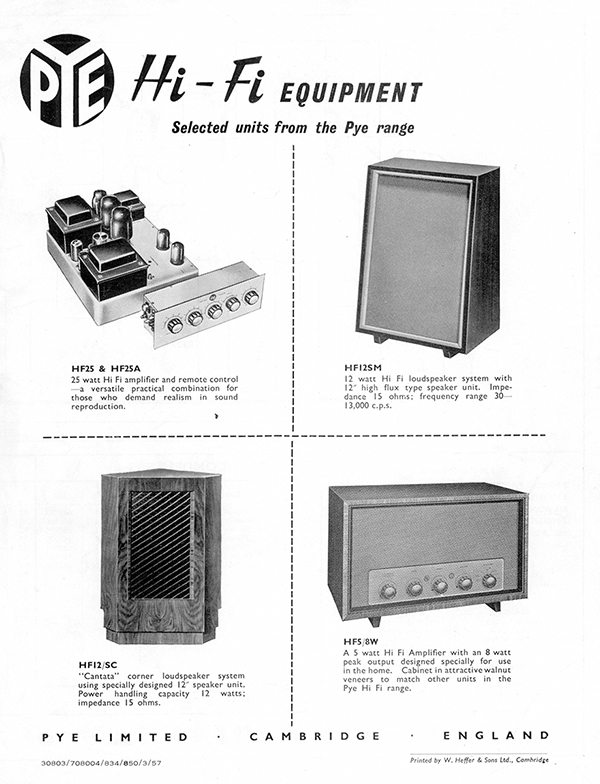
All the models mentioned so far were mono but 1960 saw the release of the Stereo Black Box (type G63). In contrast to the previous styles the G63 was housed in a low, wide cabinet on legs, much like a small radiogram. It used two ECL82s in each channel fed by a single EZ81 and with fresh valves could just about manage 7W per channel. A Garrard turntable unit was fitted. During the 1970s Pye released two stereo systems with separate loudspeakers under the Black Box name, models 1022 and 1600. Neither could be considered a true Black Box, though.
Radio upgrade
Early on in the life of the original Black Box, Pye offered an add-on FM tuner (type BBFM) which took the form of a plinth on which the main unit could be stood. It was made in both standard wood and black lacquer to match the main cabinet, whose amplifier and loudspeakers it made use of. The limited choice of FM programming in the 1950s meant the manufacturer could make this a fixed tuned unit with just three selections available. To avoid drift the frequencies were set by special quartz crystals – the owner could not adjust the tuning at all. Pye’s circuit was complicated and used eight valves, and had the distinction of being the first ‘quartz locked’ audio unit to be offered on the UK market.
Our Black Box, a lacquered BBHC, really is a beautiful thing. We have been conditioned to accept hi-fi in square metal and plastic boxes so to see something other than a loudspeaker housed in furniture-quality woodwork is a treat – I’d happily own one of these on the basis of its appearance alone. Just like a vintage car every part of Pye’s Black Box has a solid and everlasting feel to it, which modern equipment, regardless of price, often does not have.
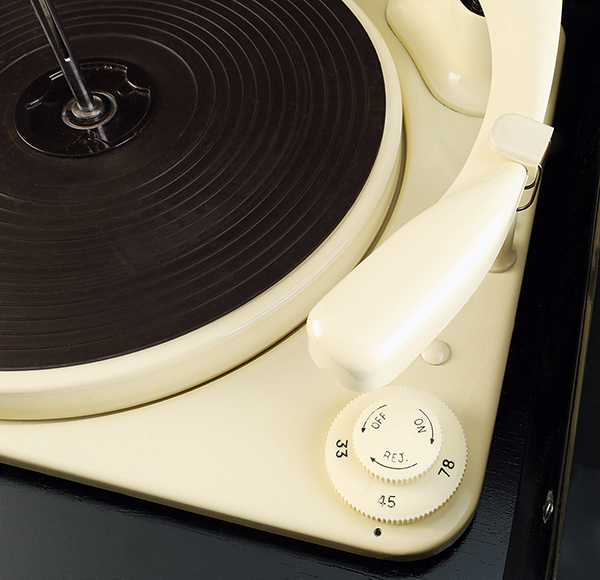
The BSR UA6 changer in our Black Box is its usual clanky, grinding self. While it lacks the fluid sophistication of the Philips GA 209 automatic [HFN Apr ’26] it does manage to land the stylus correctly into the lead-in groove every time – size selection is automatic for 7in, 10in and 12in records. For this to work the record must be placed on the step of the extended spindle and the overarm moved over to support it – if you are precious about your records then you are unlikely to enjoy this.
The BSR ceramic cartridge (a stereo-compatible replacement in our example) tracking at 7g is unlikely to amuse you either. Turning the little knob from ‘off’ past ‘on’ to ‘reject’ sets it going. The platter is idler-driven and has a bearing which looks like something from a bicycle wheel, so the rotation is far from silent.
 Tim listens
Using the Black Box in a room setup for stereo doesn’t make a great deal of sense – to get the best out of this vintage beauty you must think about the kind of places that the designers would have optimised it for. For example, when placed across a room corner the Pye player gives a good spread of sound. Of course, it can’t conjure a coherent and structured stereo soundstage but used like this an engaging musical experience can be enjoyed from more or less anywhere in the room. The unit’s side-mounted speakers don’t project a ‘beam’ of hard, strident sound like the front-mounted basic units in lesser (and smaller) record players of this era do.
For this application the power of the amplifier is more than adequate (and there is a limit to how much is useful in models where the loudspeaker and the cartridge share the same enclosure). There is a noticeable bass lift that comes from closing the lid, although this can exacerbate the problem of acoustic feedback with some recordings. This feedback, when it occurs, blurs and smudges the bass so that notes lose their form and character.
It would be easy to dismiss the sound of the Black Box as being, well, boxy, coloured and lacking in any real treble extension. Yes, it is all those things, which is why it is important to remember that the records of the period were mixed to sound ‘right’ on hardware such as this.
Fluid frank
Listening to A Swingin’ Affair! [Capitol LCT 6135], a Frank Sinatra mono release from 1957, shows we may not have progressed quite as far as we think. Ol’ Blue Eyes’ voice was fluid and perfectly projected, and set against a band whose richness of tone could put some more recent equipment to shame.
The basic cartridge employed in the Black Box is probably the limiting factor to its performance, and the simple top-cut tone control needs to be set to its highest position to obtain an adequate treble response. But what this little Cantabrigian music box creates is without a doubt a genuinely musical experience.
Efficiency drive
Simple mono can’t quite take you to a front row seat at the concert but it’s surprising how close it gets. Bizet’s ‘Jeux D’Enfants’, from a 1961 collection of Paris Conservatoire Orchestra performances [Decca LXT 5612], lost little of its drama when enjoyed on the Black Box. Again, the curtailed top-end limited the sparkle of the percussion but the power and energy of the orchestra was there. The amplification has limited grunt for music of this nature but the efficient loudspeakers (no losses in cables and crossovers, remember – there aren’t any) mean that it goes a long way. I heard the occasional pitch warble from the turntable too, but not enough to be distracting.
In many ways the Pye Black Box marks the starting point of hi-fi as a consumer product. It gave above average reproduction quality but was no more demanding to use than a normal radio. In absolute terms it is outmoded in every possible respect, but it is still a very satisfying way to enjoy music in the home. You may baulk at letting your precious LPs near that heavy arm, but a duplicate set of your favourites, which need not be pristine, does not have to be expensive. As I write this I’m giving the whole idea serious consideration!
Buying secondhand
If you are in the market for a Black Box there are some important points to look out for, whichever the model. Obviously, they are now all very old and if original will certainly need some form of restoration. Many have been restored already, some perhaps several times, and in this case the quality of the work (which can vary dramatically) needs to be assessed.
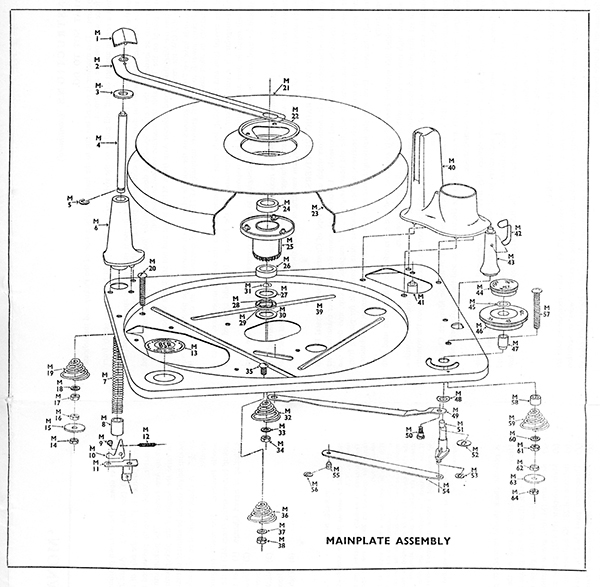
The next thing to ensure is that a cartridge compatible with stereo records has been fitted. The original mono cartridges will rapidly destroy stereo recordings if they are used to play them since the stylus won’t be compliant in the necessary directions. In any case, even if you only want to play mono LPs it is doubtful the cartridge will work properly, as the piezoelectric materials inside deteriorate with age. The mechanism of the turntable will need work too, usually confined to ‘freeing’ seized mechanisms and re-lubrication. The metal parts are sturdy and last for ever. The only things which may be required are a new platter mat or idler wheel.
The amplifiers vary a lot in detail but the work required to make them operational is generally similar. The valve models will need to be carefully checked – the wax and paper capacitors used are now all suspect. A more sinister problem is that the output transformer can go open-circuit in one or more of its windings, and the unusual circuit means that a replacement must be chosen carefully. The transistor version of the Black Box is simpler to deal with, although the germanium devices used are no longer easy to source. Lastly, excess noise is usually caused by a faulty transistor or resistor but finding the faulty component can be time consuming. Good luck!
 | |||||||||||

|
|
| |||||||||








 SPONSORED VIDEO






| Equipment Reviews | |
Music Reviews Awards | |
Latest News Features | |
Resources Newsletters | |
Subscriptions |
WHERE TECHNOLOGY BECOMES ENTERTAINMENT
 © 2026 Hi-Fi News
AVTech Media Ltd
All rights reserved