Technics SU-V303 amplifier
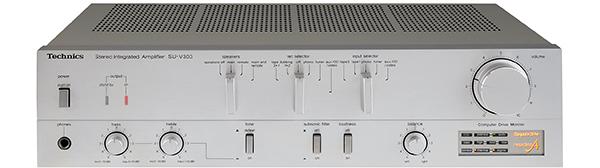

Consumer Electronics products are traditionally marketed on the basis of progress and technological improvement, and the hi-fi scene is no exception. Amplifiers were already a mature technology in the early 1980s, following big advances in low noise circuitry, robust complementary power transistors, DC coupling and high-speed operation. With these fundamentals in place the larger manufacturers turned their attention to exotic power supplies, remote controls and system integration, equalisers and frequency spectrum displays, special inputs for CD players and, of course, ever more output power to entice customers to upgrade.
The approach of Technics was characteristically more abstract and cerebral, focusing instead on optimising the biasing of the amplifier’s output stage. The SU-V303 of 1982 was one of the first models to include this ‘Computer Drive New Class A’ refinement – it was rated at 40W per channel and cost a modest £130.
The respective Class A, AB, B (and Class D, G and H) output stage topologies are regularly discussed in [HFN] reviews, but the former specifically refer to the ‘richness’ of the output stage bias current. In Class A amplifiers this standing current ensures the output transistors are held in a state of conduction over the entire period of the audio waveform, including the zero-crossing point as it transitions from positive- to negative-going, and vice-versa.

Class A amplifiers use the highest bias, with over 50% of the power dissipated as heat – low distortion is achieved at the expense of efficiency. The Sugden A48 [HFN Aug ’74] and Musical Fidelity A1 [HFN Jan ’24] are two famous Class A amplifiers. Class B designs like the Sony TA-88 [HFN Apr ’12] and Creek’s CAS 4040 [HFN Mar ’18] use very low bias and are efficient but would produce a lot of distortion were it not for the copious application of negative feedback by way of compensation.
As neither Class A nor B are ideal, the majority of amplifier designers settle on a compromise known as Class AB. This uses just enough bias to smooth out low-level distortion but not so much as to be wasteful. Negative feedback is still required but not to such a great degree.
The A-Team
The trick is knowing the amount of bias to apply. Because of this, various schemes were dreamed up in the 1970s and ’80s to allow the bias to change depending on what the amp was being asked to do. The aim of most was to give Class A performance without the disadvantages of bulky power supplies, hot running circuitry and low output. This was reflected in the names given to the various methods – JVC’s ‘Super-A’, for example, as used in its A-X4 amplifier [HFN Oct ’17] and Technics’ ‘Computer Drive New Class A’ seen here.
The design of the SU-V303 approached the problem of output stage biasing in several different ways. At its heart the output stage was largely conventional, using a matched pair of complementary bipolar transistors that were DC-coupled to the loudspeaker load. These were arranged in what Technics called a ‘Concentrated Power Block’ with the major components mounted in close proximity to each other and with short connections between them. This was made possible by the use of a compact heatsink which was cooled by a heat pipe radiator.
In the first instance, Technics’ circuit allowed output stage bias to increase along with large peaks in the programme signal. This allowed for a more moderate level of bias at normal listening levels, meaning that the circuit ran cooler and the power supply output was used more efficiently. Technics called this ‘Synchro-Bias’ but it was not a new idea – sliding bias arrangements like this were quite common in transistor amplifiers in the early 1960s when the thermal stability of the early Germanium devices was relatively poor.
Call me biased
The second part of Technics’ arrangement was genuinely novel. The Synchro-Bias circuit could make instantaneous but brief corrections, but to regulate the operating point of the amplifier’s output stages over the long term, a small 4-bit computer was used to calculate the ideal value, based on the parameters of signal level and operating temperature. This operational flexibility made it possible to run the bias level at an artificially high level just after switch-on, bringing the output transistors up to full working temperature within a few minutes.
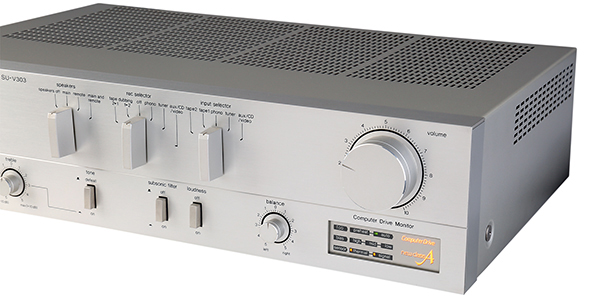
The term ‘Computer’ was a powerful selling point in the early 1980s and to make the most of this the SU-V303 had on its fascia what Technics called a ‘Computer Drive Monitor’ [see pics, p122 and above]. This group of indicator lights showed what the system was doing, although it was not as comprehensive as appearances suggested. The bias level (high, mid and low) was only shown during the warm-up period, after which the bias indicator was dimmed and replaced with an illuminated ‘Computer Drive New Class A’ logo.
Indicators also showed that the temperature and signal level sensors were working and whether the system was in pre-heat or automatic mode. In practice, while it was difficult to read much into what was being shown, and it would be easy to dismiss the whole arrangement as a gimmick, this would not do justice to the quantity of circuitry involved or the care with which it had been implemented.
Another intriguing feature of the SU-V303 was the application of ‘Linear Feedback’ to the preamplifier stages. This was built into an IC that was proprietary to Matsushita/Technics and was claimed to be more effective at reducing distortion than conventional feedback methods.
In control
Without the Computer Drive Monitor the SU-V303 could, at a glance, be just another small Japanese amplifier of the early ’80s. It is a cut above that though, thanks to the fine production engineering and finish that characterises many Technics products. The major controls have a well-made feel and work smoothly and precisely, the larger knobs being made from solid aluminium. There are plenty of facilities too, including an auxiliary input for a CD player and two tape loops with an independent recording selector and cross-dubbing.
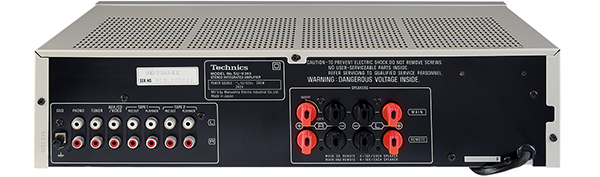
The treble and bass controls have a defeat switch which cancels their function and there is also a loudness contour and a subsonic filter (more on that later). Two pairs of loudspeakers can be connected (albeit via Technics’ horrible twist-to-lock spring clips which are a struggle to use) as well as a pair of headphones. The three main selectors – for source, recording output and loudspeakers – look good initially but unless you plan to use the amplifier only set to ‘phono’, ‘record off’ and ‘speakers main’ they soon become irritatingly untidy. If you ever wondered why most knobs on hi-fi equipment are round, this might be the reason!
The subsonic filter brings about an easily discernible bass cut. This is hardly ‘subsonic’, and as the SU-V303’s built-in phono stage already includes something quite close to the IEC LF roll-off, perhaps it’ll rarely be required. The tone controls (which operate in the power amplifier’s negative feedback loop) have quite an aggressive action too.
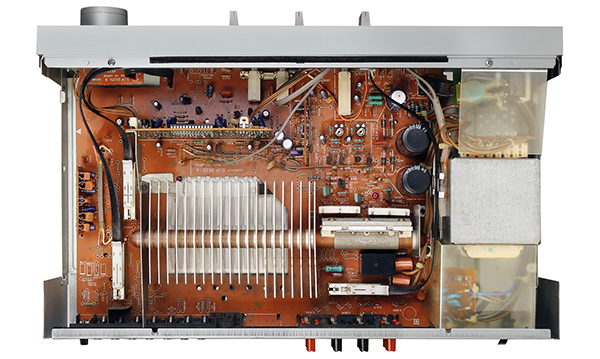
As well as regulating the amplifier’s bias current the Computer Drive system also takes care of loudspeaker protection. This includes bipolar DC offset sensors for each channel as well as temperature monitoring. A pair of LEDs on the front panel show the status of the protection circuit – unlike some vintage amplifiers, this is a model with which rare or expensive loudspeakers can be used with confidence.
 Tim listens
What effect does computer-controlled bias have on sound quality? Ideally very little, other than consistency and long-term stability. The SU-V303 is certainly a powerful amplifier for its size and weight, another advantage of the efficient use of bias, and the signature ‘Technics sound’ of this era appears to have been applied here. It has that familiar character, which links many of the company’s models both large and small. Central to this is a rigid, dry presentation which is full of detail but a little light in mid-bass richness. This could lead to an unengaging sound if the other system components were not selected carefully but remember that loudspeaker choice and positioning are usually the final arbiters when it comes to tonality.
What the SU-V303 really is, is consistent. Its character changes very little as the volume is advanced, providing a lot of very clean sound for what is really just a basic 40W model. Push it too far and it becomes hard and unpleasant (as most amps do) but this comes at a point well beyond where you think you’ve had your money’s worth.
While it was difficult to fault the SU-V303 technically I did find the sound rather sterile and difficult to connect with when listening to music that I know to be well recorded. Elton John’s ‘Original Sin’, from the 2001 album Songs From The West Coast [Rocket 586 330-2], normally has a rich, warm glow around it but this Technics amplifier took a cooler perspective. The sense of vocal clarity remained excellent and the stereo image well formed but the bass drum and the piano’s low notes failed to resonate as I know they should.
A beautiful recording of the Chicago Symphony Orchestra/Alfred Brendel playing Beethoven’s piano Concertos 4 and 5 [Philips 446 193-2] showed that the SU-V303 had no difficulty in communicating the spaciousness and scale of the original performance, lifting out the fine detail in many of the instrumental sounds even at high listening levels. In this respect it was admirable but somehow it wasn’t quite able to jump the gap from mere reproduction to providing a convincing musical experience.
Old Faithful
This Technics amplifier did get pretty close, however, and in the end it is difficult not to admire a unit which does so much remarkably well despite its unpretentious positioning within the range. The SU-V303 is clearly a well engineered product, designed and built to give decades of faithful service to music lovers.
I have no doubt that it functions exactly as its designers intended but their tastes are a little different to mine. If you like a hard, explicit sound then this could be just the thing but I found it a bit too strait-laced. Maybe Technics’ substantial SB-7000 loudspeakers [HFN Jan ’21], or something similar, would help despite being a bit over the top to perk up a modest unit like this.
Buying secondhand
The SU-V303 comes from a family of strong-selling amps. This, combined with high quality components and sturdy construction, means examples are not difficult to find.
The Computer Drive system has proven reliable in service and creates few problems. If the system appears not to work then capacitor C410 in the reset circuit is the most likely suspect – leave all others alone though! Similarly, if the Computer Drive Monitor doesn’t seem to function, be aware that if the main lamp (located behind the New Class A logo) fails then the bias level LED indicators won’t light up either.
This aside, the rest of the circuit is conventional, so the muting relay and cracked soldering around the input and speaker outlets are often the main suspects for a missing/weak/erratic output. Note also that despite the ‘Computer Drive’ system, bias must still be set manually during overhaul. Follow the exact procedure in the service sheet!
Hi-Fi News Verdict
The SU-V303 is a technically superb amplifier which includes genuinely novel solutions to longstanding problems around efficiency and distortion. It is also generously equipped, solidly made and ergonomically sound. Reservations, therefore, concern how Technics’ designers chose to voice it – the sound is clear and detailed but veers towards ‘bland.’ It’s worth an audition, though, and easy to find.
Sound Quality: 75%
 | |||||||||||

|
|
| |||||||||












 SPONSORED VIDEO






| Equipment Reviews | |
Music Reviews Awards | |
Latest News Features | |
Resources Newsletters | |
Subscriptions |
WHERE TECHNOLOGY BECOMES ENTERTAINMENT
 © 2026 Hi-Fi News
AVTech Media Ltd
All rights reserved