Quad 3 amplifier

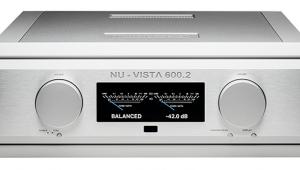
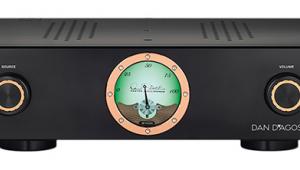
Many moons ago I learned about the lack of sense in making predictions, as they usually prove wrong. Despite this I’m happy to posit that we are entering two ‘Golden Ages’. The first appears to be that of superb integrated amps appearing in a flood, including the Marantz Model 10 [HFN Jun ’25], D’Agostino’s Pendulum [HFN Jul ’25] and the Musical Fidelity Nu-Vista 600.2 [HFN Aug ’25]. But they are all high-end units. By contrast, the Quad 3 has a list price of only £1249, and it blew me away.
Which leads me to the second ‘Golden Age’, and that’s Quad’s renaissance. Following cool lifestyle products like the Vena II Play [HFN May ’20] and the S-1 hybrid ‘ribbon’ speaker for a paltry £479 came the reborn 33 preamp/303 power amp [HFN Jan ’25] at an unbelievable £1199 apiece. Here we are, nine months later and the Quad 3 integrated is an even bigger surprise… and another bargain.
A family affair
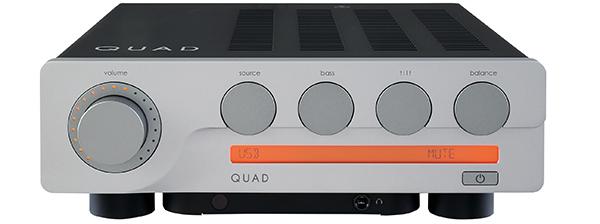
Clearly, the price alone is enough to make me stand up and perform a jig. But that’s validated by how fully equipped this wonderful device is. The icing on the cake? A look that tickles my penchant for retro styling, and which answers the question no one has asked – what would have happened if a Quad 22 [see boxout] and Quad 33 had a baby?
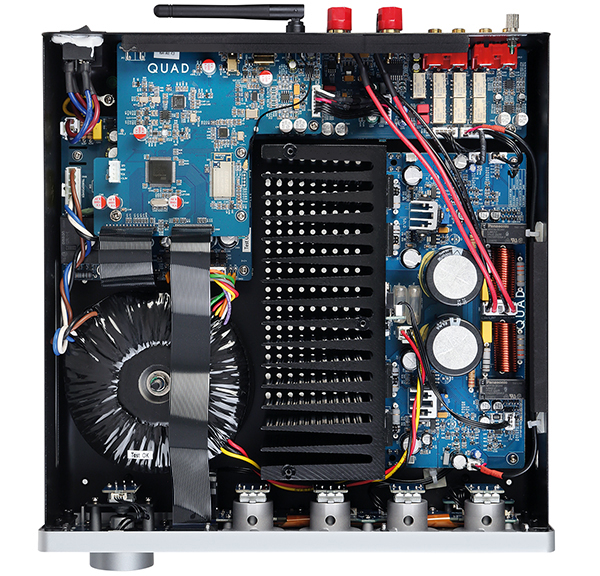
It starts with the dimensions of only 300x101x332mm (whd), a footprint smaller than an LP sleeve. Lift the Quad 3 and it’s clear there’s a lot of engineering in this baby, thanks to internal heatsinking and a toroidal transformer accounting for its 8kg heft [see inside pic, right]. And yet it is deliciously compact and self-contained, sacrificing nothing save for balanced XLR inputs. Working through its facilities, it was a case of surprise after surprise.
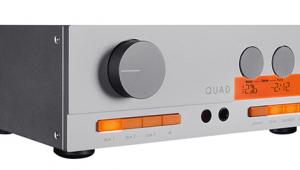
While the front panel seems no more feature-laden than its 1950s forebear, and it lacks the 22’s row of push-buttons, the control element is actually as deceptively loaded as the new 33’s equally clever, equally clean fascia. Five rotary controls dominate, the largest being the volume control. This is surrounded by an illuminated arc of orange-coloured dots that can show you where the control is set from across the room. Press it for mute and it flashes. To the right are dials for source, bass, tilt and balance. Those steeped in Quad-lore will recall the tilt control – a ‘see-saw’ that pivots at 700Hz to bring a broad but subtler change in tone than typically offered by higher-Q bass/treble tone settings.
Below these controls, where the 22 had buttons, is an orange-lit display that indicates the selected source, and changes to address each function such as balance, tone/tilt, etc. Beneath the fascia’s front edge are a 6.35mm headphone socket (which mutes the speaker output) and an ‘eye’ for the amp’s IR remote.
This seemingly minimalist display belies the plethora of features on offer. It provides information for all the Quad 3’s functions, matched in the comprehensively equipped remote control [see pic, below]. This remote will also operate a forthcoming Quad CD transport, so be aware you need to select the ‘A’ button for ‘amplifier’ if the ‘CD’ button has been pressed by accident.
Accessible via the menu, with either the remote or the volume control, are bass and tilt controls; a choice of digital filters [see PM's Lab Report]; adjustment of the digital PLL to accommodate wayward digital sources; and selection of MQA Mode (this must be defeated for the digital filters to work properly). Those with a variety of sources will also appreciate the Quad 3’s sensitivity adjustments for level matching its two line and phono inputs, in 1dB increments to ±6dB.
Digital engine
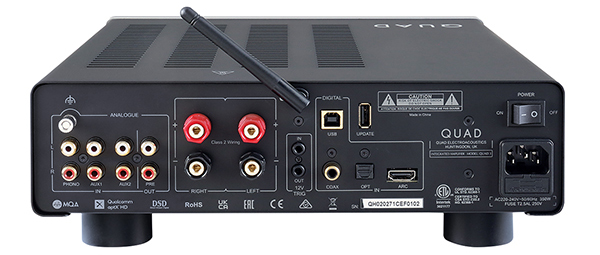
Also menu-based are volume limiting, tone defeat, five levels of display contrast/brightness, configurable auto standby and 12V triggers, turning text on or off, and factory reset. Connections are self-explanatory, but the rear panel [see p53] does have a few extras beyond the basics. Viewed from the back, at far left are RCA sockets for MM phono plus an earthing post, two line-level inputs, and outputs for using the Quad 3 as a preamp. Next are binding posts accepting spade connectors or banana plugs, followed by a centrally mounted Bluetooth aerial. Quad has engineered an ESS DAC-based digital engine into this little amplifier, hence this and other assorted digital inputs – coaxial, Toslink optical, USB-B and HDMI ARC. LPCM files or streams up to 768kHz/32-bit and DSD512 are accommodated via USB.
Quad isn’t simply on a nostalgia trip with the 3’s looks and facilities. It is essential that one absorbs the full import of the bass/tilt features, which do hark back to the early years when Quad was the Acoustical Manufacturing Company. Judiciously used, these controls – like the much-derided ‘loudness’ button of yore – have value if you want to listen late at night and you live in a flat, or if you have odd recordings in need of fine-tuning.
Warm-up to what I would consider optimal performance took between 15 and 30 minutes if switched on from cold using the rear panel on/off switch. If left in standby overnight, warm-up is near-instantaneous. My smart meter showed hardly any cost penalty, the front panel light switching off after a few moments.
 Hat trick?
Few suitable plays on words with or reference to the number ‘3’ spring to mind, other than this is the third product following the 33 and the 303 which Quad has delivered in under 12 months, all of which are sensational. PM confirmed that the Quad 3 certainly isn’t lacking in power, and it proved a beast when driving stacked LS3/5As. Luckily, LS3/5As cannot survive hammering, so wattage wasn’t an issue. Conversely, it drove Wilson Audio’s The WATT/Puppys [HFN Sep ’24] to ear-worrying levels, exhibiting more than enough slam to make me back off the SPLs. Seriously, there was no obvious break-up when pushing it to an insane volume.
Why was I playing at settings exceeding my preferred, sane levels? One album in particular was exploiting the utter brilliance of this amplifier, a CD released in 1985 that I fed it because the great Brian Wilson had recently passed away. I had, apropos of mourning him, recalled Papa Doo Run Run’s sublime California Project [Telarc CD-70501], with its selection of note-for-note cover versions of The Beach Boys’ greatest hits.
Okay, it’s an overly dramatic album designed to dazzle people at hi-fi shows, much like the same label’s 1812 Overture, featuring those notorious cannons. But if anything would tax the limits of this beer-budget integrated amplifier, it would be The WATT/Puppys with their prodigious bass capability, especially the album’s on-steroids take on ‘Good Vibrations’. But no, the extreme bass extension was not compromised nor was the ultimate impact, mass or scale. Wow, does this amplifier sound huge!
That’s the spirit
Turning to vinyl and the magnificent new edition of Norman Greenbaum’s Spirit In The Sky [Craft CR00893], the Quad 3’s MM phono stage proved to be clean, fast and eerily quiet, rich in dynamic contrasts and with plenty of gain. I also tried it with my much loved Ortofon T5 transformers (please put them back in production!) for a taste of moving-coil playback. Quad’s new amplifier handled the assorted textures in the LP’s title track more than admirably, exhibiting genuine high-end grace. And it balanced the heavy fuzz bass, celestial backing vocals and the track’s massive scale with aplomb.

A bonus for the digitally inclined is how well the Bluetooth and USB options worked. The former found an Android smartphone in seconds, the latter sounding absolutely staggering when playing high-res downloads. Bluetooth isn’t my preferred means of listening, but I admit to sitting there for three hours, Willie Nelson followed by Linda Ronstadt and then ZZ Top, all free from grain or edginess. And with 768kHz/32-bit PCM and native DSD512 handling on offer via that USB input, there was no impeding the talents of my PS Audio PerfectWave transport.
Value added
Incontestably, the Quad 3 proved sensational from the first notes it played. As dazzled as I am by the manufacturer’s 33/303 pre/power set-up, which certainly outperforms this new arrival in terms of absolute finesse and slam, I was flabbergasted repeatedly by the Quad 3’s amazing value for money. From any other maker this would cost much more.
To sum up for readers past considering entry-level gear, the compact Quad 3 would be ideal as the heart of one’s first music system, or perhaps a second set-up in a study or kitchen. Match it with Quad’s S1 loudspeakers (which it loved), a turntable in the £500-£1000 region, or a similarly-priced CD transport or streamer, and the Quad 3 integrated won’t disappoint. If anything, it will enthral.
Hi-Fi News Verdict
What can I say? Quad’s 3 changes the landscape for integrated amplifiers at this price point. It does everything you could want – for analogue and digital – and it acts like it has twice the power it possesses. It looks fabulous, the build quality is exceptional, and the outlay is exactly the same you’d have paid 60 years ago for a Quad 22/II stereo set-up. Quad doesn’t practice inflation – this amplifier is deflation taken form!
Sound Quality: 89%
 | |||||||||||

|
|
| |||||||||








 SPONSORED VIDEO






| Equipment Reviews | |
Music Reviews Awards | |
Latest News Features | |
Resources Newsletters | |
Subscriptions |
WHERE TECHNOLOGY BECOMES ENTERTAINMENT
 © 2026 Hi-Fi News
AVTech Media Ltd
All rights reserved