Pathos TT Anniversary integrated amplifier
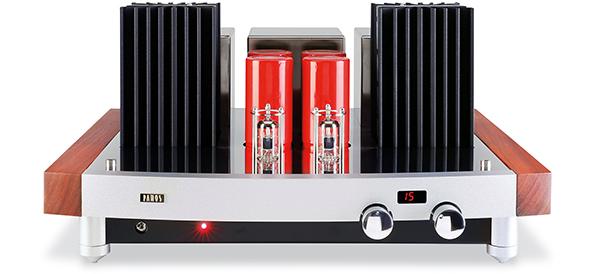

When Italian hi-fi manufacturer Pathos was established in 1994, its first product was an integrated amplifier showcasing co-founder Gianni Borinato’s bespoke ‘InPoL’ circuit design. Named the Twin Towers, because of its large, vertically aligned heatsinks, the amp claimed 2x30W/8ohm and sold for £3250 [see boxout]. Skip ahead some 30-odd years and the model remains a mainstay of the company catalogue, albeit with important running production changes.
One change is the name. For obvious reasons, Pathos retired the Twin Towers moniker post-2001 and replaced it with TT. There are now different flavours of the amplifier too. The TT Anniversary model tested here, for £7195, is joined by the £6795 TT Remote Reference and – in some territories but not the UK – a Classic iteration. Moreover, explains Damiano Zanini, R&D director at Pathos, ‘over the years we have implemented a number of refinements, mainly focused on the tube stage, to further enhance performance’.
Rear gear
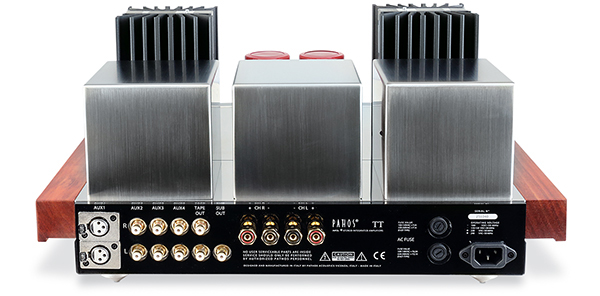
One of two differences between the TT Anniversary and the Remote Reference is connectivity. Both amplifiers offer four line-level analogue inputs, but the former upgrades one unbalanced RCA set to balanced XLR. It also offers a sub out, next to the Remote Reference’s tape loop RCAs. All connections are neatly arranged on one side of a slim rear panel that otherwise accommodates speaker binding posts and an IEC mains socket.
The curved front panel is equally minimalist, with only two controls and a small two-character display. The dial on the left cycles through the amp’s inputs, listed as A1, A2, etc, on the display (there’s no renaming here), while the dial on the right adjusts the unit’s 64-step resistor-network volume control. This motorised control elevates the Remote Reference from the Classic, with its manual, 24-step volume.
Tube-FET tango
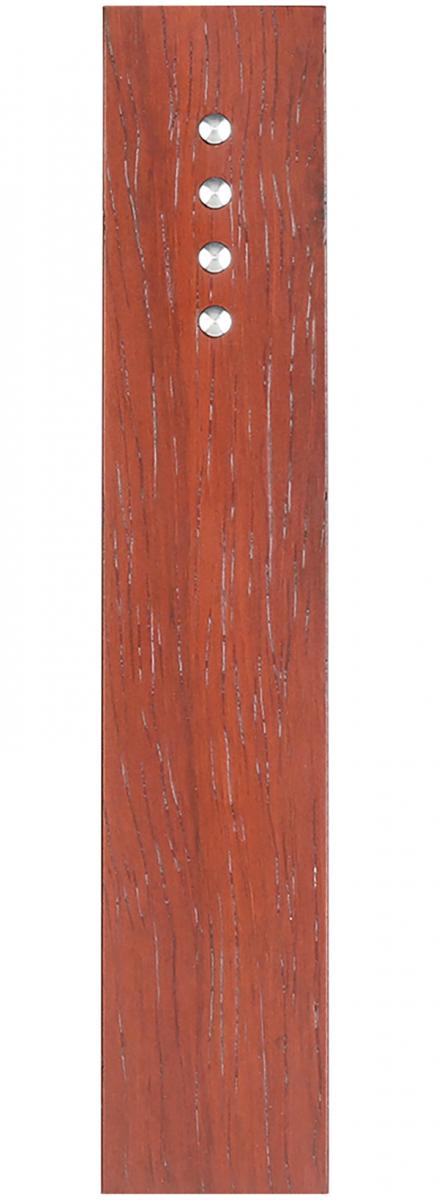
Pathos’ slim, wood-finished remote [pictured below] is quite striking – owners of the Remote Reference get two buttons (for volume), but the Anniversary handset adds a second pair for input scrolling. And that’s your lot as far as user interaction with the InPoL TT is concerned, other than the power toggle switch tucked away under the front panel. This is an amplifier with a genuine plug-and-play ethos.
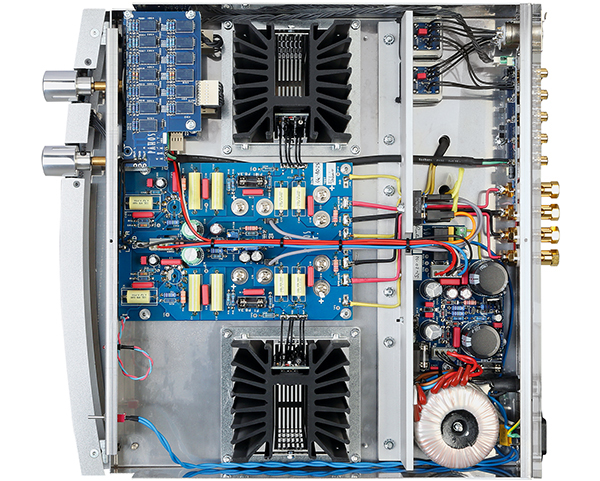
While Pathos’ top-flight InPoL Legacy model [HFN Dec ’25] is so large and heavy that it requires four people to heave it into position (which is likely to always be on the floor), the TT Anniversary is more readily suited to placement on a hi-fi rack – although note the chassis measures 480mm deep and weighs in at a still hefty 42kg. Those black towers run very hot too, so the TT amp will therefore need to be sited somewhere with plenty of ventilation.
The high operating temperature is a by-product of the amp’s novel topology, which combines a tube-based voltage gain stage with FET-based current output. Pathos’ ‘feedback-free’ InPoL (INseguitore a POmpa Lineare, or Linear Pump Follower) circuit amounts to a single FET, necessarily fully Class A biased, and configured in a common source configuration with an inductor between the transistor source and ground. These inductors – the L/R frame transformers at the rear of the amplifier chassis [again, see p73] – store energy, proportional to the inductance and the square of the current, that’s released by the FET as the current falls. This technique almost doubles the efficiency of the single-ended Class A stage from 25% to 50%, so the TT Anniversary’s 280W power consumption does not change regardless of the (audio) signal level [see PM's Lab Report].
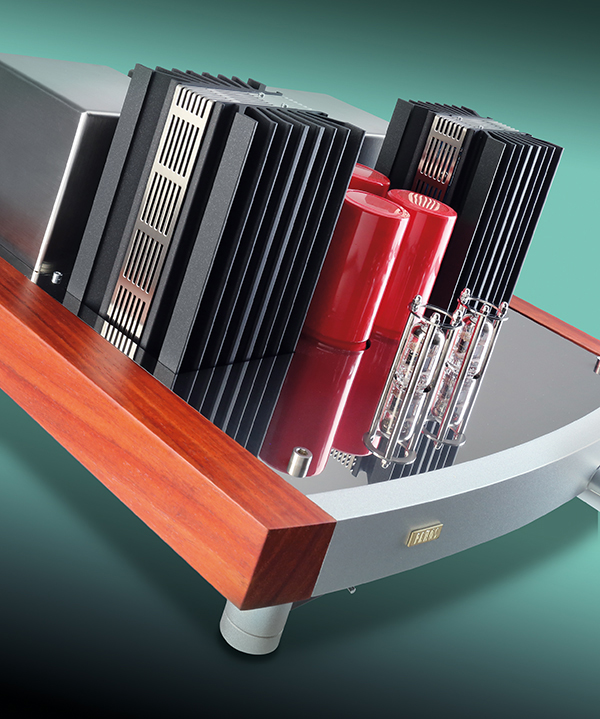
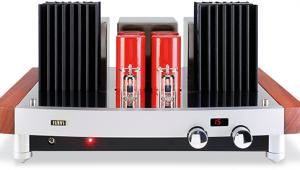
When it comes to looks, you’ll probably find this unit either charming or a little idiosyncratic. Hand-built at Pathos’ facility in the historic city of Vicenza, the TT Anniversary has a chromed top plate out of which sprout three brushed metal transformer housings, those black heatsinks, two ECC803S triode tubes, and four large red PSU capacitors. Capping off a slightly busy design are the amp’s side cheeks, where the buyer can choose between padauk wood or black finishes.
 Grippy grooves
The huge InPoL Legacy was one of the more remarkable-sounding amplifiers I’ve heard, so I was pleased to note that the smaller, more affordable TT Anniversary shares some of its attributes. Chief among them is a fluid, rich and ‘listenable’ midrange that fares as well with rock guitars as it does with the varied tones of the orchestra pit. Vocals, too, are communicated with ease. Bass is warm and robust, perhaps even sounding a little tighter, albeit smaller, than the Legacy flagship. And, despite its lower power output, the TT Anniversary didn’t sound out of its depth playing with Wilson Audio Alexx Vfx and B&W 801 D4 [HFN Nov ’21] floorstanders in the HFN Reference Listening room [HFN Yearbook 25 & p43].
Some tracks and genres proved more up this characterful amplifier’s ‘street’ than others, but nothing was off-limits. An example? I hadn’t planned to listen to nearly half of Orbital’s Orbital 2 album [London Records LMS1725449], but the TT Anniversary’s surprisingly grippy handling of the drums on ‘Impact (The World Is Burning)’, allied to open-sounding synth lines, meant I was happy to let this ten-minute track segue into the more urgent, up-tempo techno of ‘Rewind’.
Next were the ethereal swirls of ‘Halcyon + On’. It’s too easy for these electronic compositions to come across as sterile, but the TT breathed life and nuance into all of them. Meanwhile, the instrumentals of jazz/hip-hop artist Mani Deïz’s Hoods EP [Daoud Music] brought more organic textures to deal with, particularly the smooth brass on ‘Cherokee-Lemp, St Louis’.
Miles ahead
But it was ‘So What’, from Miles Davis’ Kind Of Blue [Columbia; 192kHz/24-bit], that had me raising an eyebrow. The presentation of the three brass solos – Davis on trumpet followed by tenor and alto sax – was superb. Reedy, textured, breathy and attacking when needed, the instruments arrived with authority.
The TT Anniversary offered good midband detail, but there was sometimes a slightly rounded, enriched feel to the music, particularly in the upper frequencies, as opposed to brightly etched. The Akadamie für Alte Musik Berlin’s recital of Handel’s Water Music [Harmonia Mundi; 96kHz/ 24-bit] featured sinewy strings and spry harpsichord, but not the crystalline detail required to open it all up for close inspection.
Hornpipe heroics
On the other hand, this set was a treat of tonal and spatial subtleties, and the Pathos amp handled, er, Handel’s dynamic flourishes with ease. Don’t assume its modest power results in an amplifier with a demure demeanour – the ups and downs of ‘XI. Allegro’ were delivered with enjoyable gusto, as was the orchestra’s somewhat speedy take on the well-known ‘Alla Hornpipe’.
Moments of bass weight also impressed, but again it was the TT Anniversary’s midrange mastery that stood out. Similarly, Daisy Gray’s cover of ‘Wicked Game’ [self-released], a demo favourite, featured silky vocals that could barely have sounded more atmospheric.
Sticking with female singers, the delicate, close-mic’d vocals of Shelby Lynne’s ‘Track 12’ [Suit Yourself; Capitol Records 09463 12057 29] were beyond reproach.
Spinning ‘Flying North’, from Thomas Dolby’s The Golden Age Of Wireless [2009 remaster, Echo; and see p96], both the main keyboard melody and Dolby’s new wave-style vocals showed excellent resonance and focus. True, the rhythm section sounded a bit thin and ‘of its time’, but there was so much else to savour, not least the separation of the track’s multitude of effects.
‘Window’, from The Foo Fighters’ new Your Favourite Toy album [RCA/Sony 19958-44213-2], dovetailed perfectly with the TT Anniversary, the slightly retro-tinged production benefitting from the warmish glow of Pathos’ tube-fed InPoL circuit. Dave Grohl’s guitar was fuzz-laden but still easy on the ear, as was the processed vocal track. What’s more, the amp didn’t fail to convey the thick, full-bodied nature of the song.
Petty persuasion
A clearer male vocal was in evidence on ‘Love Is A Long Road’, one of the deeper cuts on Tom Petty’s Full Moon Fever album [MCA; 96kHz/ 24-bit]. Petty’s instantly recognisable drawl cut through the supporting jittery keyboards and simple, hooky guitar riff. Confirming its value-for-money status, the TT Anniversary made it sound organic, powerful and smooth – a winning combination.
Hi-Fi News Verdict
That Pathos’ debut amplifier has remained in production for over 30 years is testament to its appeal – and a reminder that all-analogue, fuss-free integrateds will surely never go out of fashion. The TT Anniversary doesn’t dazzle with slick features (unless you count its motorised controls) but charms with an addictive sound of warmth, richness and tonal subtlety, underpinned by a hefty, authoritative bass.Sound Quality: 88%
 | |||||||||||

|
|
| |||||||||








 SPONSORED VIDEO






| Equipment Reviews | |
Music Reviews Awards | |
Latest News Features | |
Resources Newsletters | |
Subscriptions |
WHERE TECHNOLOGY BECOMES ENTERTAINMENT
 © 2026 Hi-Fi News
AVTech Media Ltd
All rights reserved