Braun PS 500 turntable
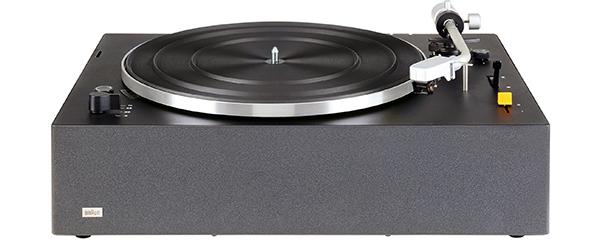

The Braun PS 500 could be the best turntable you’ve never heard of. Introduced in 1968 and styled by Dieter Rams, it was Braun’s top model and the latest in a long line of similar machines which had been slowly developing and improving since the start of the decade. Unlike the later PS 450 [HFN Apr ’25], the PS 500 was very much an in-house affair, entirely designed and produced by Braun itself. This may come as a surprise to those who now mainly associate the manufacturer with alarm clocks, razors and electric toothbrushes.
Back in black
The PS 500 originally came in grey with a silver top plate, as this matched the firm’s amplifiers and tuners of the period. A change came in 1972 when the Regie 510 receiver [HFN Jun ’16] was introduced with its all-black cabinet. The PS 500 was then offered in a slightly darker grey with a black top plate to match, set off perfectly by the power switch lever changing from black to Braun’s signature ‘action yellow’.
Although now eclipsed, the grey and silver iteration was retained for those building a system around Braun’s CSV 300 and CSV 510 integrated amplifiers, but it was the black version seen here, with the Regie 510, that comprised Braun’s top-of-the-range offering. ‘Hi-Fi at the edge of absolute perfection’ was the claim made for this system, backed up by independent German consumer tests which placed both units in the highest category for performance and quality.

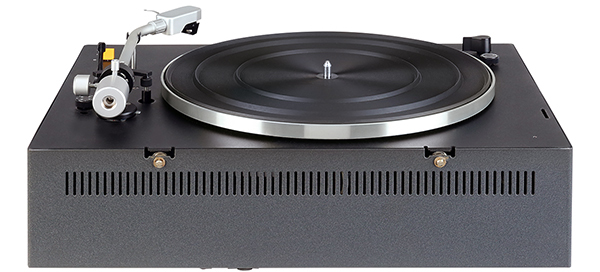
As with previous Braun turntables the PS 500 was constructed on a plinth made from sheet steel. Resilient material was applied at various strategic locations internally to damp structural resonances, inspiring a practice that would become mainstream several decades later. Within the plinth the bulk of the turntable’s structure was built on a substantial three-point alloy casting hung from the top plate. This suspended subchassis approach is common enough but the PS 500 was unusual in having the springs damped within oil-filled dashpots for improved resonance control and isolation.
Stepping up
The motor block was mounted separately and, following in the tradition of earlier Braun turntables, used an intermediate idler drive between the motor and the main belt. A stepped pulley on the motor shaft gave a choice of four speeds, with fine adjustment provided by the driving pulley for the belt being slightly conical in form. Moving the idler up and down the angle allowed for the exact tuning of each speed [see inset pic, p131]. Some previous Braun models had employed an eddy current brake on the motor shaft to do the same task, but this approach precluded the use of a synchronous motor (the most accurate and speed-stable type). The design of the PS 500 allowed it to employ a superior four-pole synchronous AC motor.
The platter was diecast from zinc in two parts, a central hub and an outer disc. In total these weighed 3kg and were dynamically balanced to ensure smooth operation. The outer disc was damped both by the heavy rubber mat on top, and by a rubber ring bonded into a machined groove on its underside.

The PS 500’s tonearm was of Braun’s own design and constructed to the very highest of standards. It used ball bearings throughout and could be balanced in all three axes. Braun offered a choice of Shure moving-magnet cartridges as standard equipment, beginning with the M75MG II and moving to the M75EM II as an upgrade option. In practice, any Shure cartridge could be ordered and to this end the arm was specifically designed to accept the V-15 Type II, tracking at a mere 0.75g.Although largely manual in operation, the turntable did feature an automatic lift at the end of the record. A small lever at the arm base could disconnect this function, something which was recommended for tracking weights under 1g.
Braun briefly offered a quadraphonic version of the PS 500 called the PSQ 500. This was identical apart from the fitting of a JVC 4MD-20X CD-4 compatible cartridge and a low-capacitance signal cable terminated with RCA connectors (the standard model came with a 5-pin DIN plug). The decoder was in a separate unit which matched the rest of the Braun ‘Studio’ series. The PS 500 was Braun’s last heavyweight turntable, remaining in the range until 1975 when it was replaced by the more lightly constructed, direct-drive PDS 550.
Much as I liked the looks of the more affordable PS 450, to my eye the PS 500 is considerably more attractive. It is a perfect example of the philosophy of ‘minimum design’ espoused by Dieter Rams, with a timeless quality about it that means it could easily pass as a new model.
Smooth mover
Although not fussy or over-styled in any way it is very clear that a great deal of attention has been applied to the shape, colour, texture and feel of every single visible part. The finish is exquisite and the arm was more than a match for the contemporary SME 3009 [HFN Jan ’61].
The oil damping gives the subchassis a firm vertical ‘bounce’ just as the damped cueing mechanism for the arm glides up and down with absolute smoothness. Operation is a breeze – one simply places the stylus over the record before pulling the yellow lever towards the front. This starts the motor and lowers the cueing platform. Notches have been provided in the mechanism which cause the arm to click into the correct positions for the starting points of standard-sized records, but this can be disabled by raising a small collar on the lifting post. I did notice some drift as the arm was lowered, however.


Speed can only be set when the motor is switched off – this disengages the drive and prevents damage to the idler wheel. The variable speed control works well but accurate adjustment was difficult on our example as the strobe rings [placed under the platter and viewed via a prism and built-in neon lamp – see p129] had been applied slightly eccentrically. Perhaps a case of am freitagabend gebaut?
Setup is reasonably straightforward, the only tricky part being the three-axis balancing of the arm, which requires the deck to be stood on its back and on its side. This isn’t easy with a heavy (12.6kg) chassis and sticky oil sloshing about inside. The oil is, of course, contained and to avoid damage to the seals you must have the (red) transit screws in place before starting the balancing process. Downforce is set by a simple slide under the arm and the anti-skating by a small dial next to this. The dial must be used with care as it is part of the suspended subchassis.
 Tim listens
Our PS 500 was fitted with a Shure M95, one of the brighter-sounding options in the range, and the result was a startlingly dynamic performance bursting with detail. Drifting off in your armchair is not likely as this Braun turntable puts you in a front row seat. There’s also a level of precision here that other designs miss, a revealing clarity around each sound and note that’s quite addictive. I found myself trying all sorts of familiar recordings, listening for things I’d previously not heard.
Beethoven’s Concerto for Piano and Orchestra No. 1 in C major, performed by the Vienna Philharmonic [Deutsche Grammophon 2532 103] illustrated the PS 500’s insightfulness. The solo piano sections in particular were so clean and well-lit that the individual character of the instrument was easy to appreciate. Some hi-fi equipment falls short in this regard, but the Braun turntable made it sound easy.

Against this excellent resolution, the full weight of the orchestra filled out the rest of the sound with a welcome degree of richness – not something always expected from an arm and cartridge combination that leans toward brightness. Moreover, a deep, broad soundstage helped to create the illusion of a genuine musical experience. Played at high volumes, the PS 500 did a good job of capturing the unique thrill of being at a live performance.
Noise niggle
One complaint, however, is that the motor and idlers are noisier than might be expected from a turntable of this quality. This is not translated into rumble [see PM's Lab Report], but a small amount of mechanical noise was heard from the deck during prolonged lulls in the music and between tracks. Electrical noise was well suppressed though, with no audible hum through the loudspeakers, even when handling the arm. The output of the cartridge is muted when the motor isn’t running, which makes for easy operation while changing the record or turning it over.
Trying another musical strand, the electronica of Depeche Mode’s 1986 album Black Celebration [Mute STUMM 26] had a stark, bright, almost CD-like quality to it when played on the PS 500. I mean this as a compliment, but those looking for the ‘warm sound of vinyl’ may wish to look elsewhere. Despite the weight and bulk of its mechanical parts (or possibly because of it) this vintage Braun deck lent a brisk and propulsive drive to tracks like ‘Stripped’ that are easily smudged by lesser turntables. The metallic percussion effects used throughout the album were powerfully rendered without sounding coarse or grating. The PS 500 strikes a fine balance, and I was left with the impression that any more would have been too much.
Vinyl surprise
Like all parts of the hi-fi chain, a turntable is a personal choice – not everyone will like the same model. Recommendations are therefore not easy but, speaking personally (and setting aside high-quality Japanese direct-drives and big linear-tracking Bang & Olufsen models), this is by some margin the best turntable I’ve heard in a long time. It is also among the most attractive and, for a deck of this stature, can currently be found at relatively low prices.
By the time of the PS 500’s appearance its manufacturer had largely lost interest in selling hi-fi equipment in the UK, although a few of them remain in circulation. The deck is far more common in Germany, so that remains the best place to look. Ours came from German website www.kulthifi.de, which usually has several in stock and can arrange shipping to the UK.
Buying secondhand
The PS 500 is tough and durable but there are a few things to consider when shopping for a secondhand model. Leaks from the seals of the oil-filled dashpots will result in impaired damping and a sticky mess underneath – repairs are difficult so it is vital to inspect this first. The tonearm is sturdy but the bearings will be ruined by mishandling, so check for play in the pivot and swivel.There should be none in either. And if the platter scrapes on the top plate check that the hub hasn’t slipped down its shaft before adjusting the suspension – the weight of these components takes its toll over the years.
Lastly, like a lot of Braun equipment the steel parts of the PS 500’s cabinet will rust and spoil the paint finish if the unit was ever stored in damp conditions. This is also difficult to remedy so it is worth holding out for an example that has been well looked after!
 | |||||||||||

|
|
| |||||||||







 SPONSORED VIDEO







| Equipment Reviews | |
Music Reviews Awards | |
Latest News Features | |
Resources Newsletters | |
Subscriptions |
WHERE TECHNOLOGY BECOMES ENTERTAINMENT
 © 2026 Hi-Fi News
AVTech Media Ltd
All rights reserved