Pathos Acoustics InPoL Legacy integrated amplifier
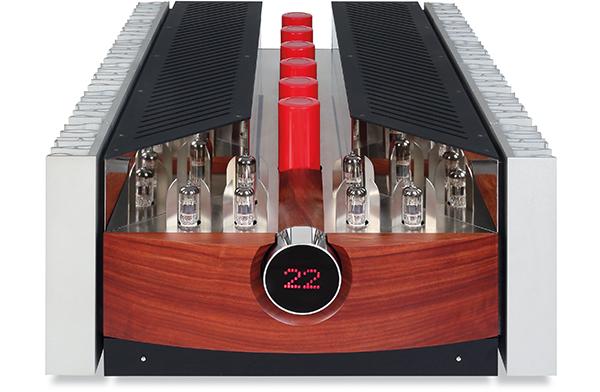

In high-end hi-fi, it’s common to see the phrase ‘two-man lift’ applied to heavyweight loudspeakers, amplifiers and subwoofers. Yet the top-of-the-line InPoL Legacy from Italian manufacturer Pathos goes one (well, two) better. This integrated amplifier, priced £51,995, arrives in a purpose-built wooden crate on wheels, along with two metal ‘pull-up’ bars that slide underneath the chassis once the crate has been disassembled. It’s then a four-person job to lift the bars and manoeuvre this 140kg beast into position.
Amplifiers at this size and weight aren’t unheard of – D’Agostino’s Relentless Epic 800 monoblock [HFN Jun ’24] tips the scales at 146kg, for example – but I’m struggling to think of other integrated models of a similar stature. The InPoL Legacy’s width is a bigger-than-standard 550mm, and it extends back a whopping 890mm, so is clearly not suited to being installed in a rack. We had no trouble accommodating it in the HFN Listening Room of course, positioning it at floor-level between the speakers.
Over the limit
Pathos makes no apologies for its flagship amp, saying, ‘the presence on the market of amps weighing over 100kg made us put aside our qualms for good. We designed a new amp according to the features we wanted, without setting limits’. As for the model name, the amp is intended to represent ‘the ideal legacy’ of owner Gaetano Zanini, who co-founded the company in Vicenza in 1994.

The first release from Pathos was an integrated amplifier devoted to its proprietary ‘InPoL’ Class A topology [see boxout], which it has continued to use and refine in the intervening three decades. During that time, its product line has expanded to include ‘NonPol’ Class AB amplifiers, pre/power systems, an outboard DAC and headphone amps. Nor is everything priced in five-figure territory – the entry-level Classic One MkIII integrated amplifier sells for £3495, while the Aurium headphone amp is £1695.
Manufacture of Pathos’s hardware is by hand at the company’s own facility, which is ‘five times larger than it was in the beginning’ and now includes wood- and metalworking departments. Wood has been a feature of the InPoL range since the debut Twin Towers model (now renamed T.T.) arrived with wooden side-cheeks. On the Legacy, padauk wood is used for the front panel.
This immediately gives the amplifier a striking look, but so do other elements of the design – one being the exposed triode tubes mounted on its top surface in front of a mirror-finished backplate.
Making it big
There are six tubes in total, two ECC803s and one 6H30 per side, in a high-gain totem pole circuit handling the InPoL Legacy’s voltage amplification. Each channel of the tube stage benefits from its own PSU with a separate toroidal transformer [see below].
Two more toroidal transformers (‘the largest we have ever made’) are shielded in black metal casings to power the amplifier’s MOSFET-based power stage. Pathos claims a 2x100W/8ohm ‘pure Class A’ output for the InPoL Legacy [see PM's Lab Report], meaning the amp is potentially outmuscled only by its 120W-rated InPower Mk2 monoblock stablemate.

The dual-mono internal design of the InPoL Legacy is reflected in the layout of its rear panel, which is split into left-channel and right-channel sections. Dual speaker outputs (for bi-wiring), on WBT binding posts, are well spaced and positioned above balanced XLR and unbalanced RCA inputs. There are three sets of each, labelled B1, B2, A1, A2, etc, which will see you well covered for line-level sources.
Taking turns
The company’s HiDac Mk2 module (USB, S/PDIF), which can be fitted to some of its integrated amplifiers, is not an option here. This, says Pathos, is because it wanted the InPoL Legacy to be ‘a pure amplifier’. It’s an approach that has also led to the omission of any form of system integration (12V triggers, etc), or the preamp outputs found on the more affordable InPoL Heritage MkII (£18,995) and InPoL2 MkII (£10,995) integrated designs. Don’t look for any balance/tone controls, either.
Still, being stripped of features means the InPoL Legacy is easy to get to grips with. Two buttons, either end of the metal strip that runs beneath the curved wooden fascia, handle standby/on/off and input selection, while above them is a large, central rotary with a dot-matrix-style LED display. Once the amplifier is switched on, there’s an initial half-minute-or-so bootup period during which this lights up with the letter ‘P’ – after that it shows the selected level of the InPoL Legacy’s 99-step, relay-switched volume control [see PM’s boxout, p54], or the chosen input.
Pathos calls its volume rotary an ‘infinite-turn knob’, which means it takes several full turns to get from 0 to 99 on the display. Handy, then, that the amp will remember its last-used volume setting when it’s put into standby mode. You can also change volume and input using the supplied remote control, which has a useful mute button.
That’s it as far as the ‘user experience’ goes (the menu button on the remote control has no function) but I should mention that this amplifier runs hot. PM measured temperatures up to 60oC from the InPoL Legacy’s sculptured heatsinks, meaning care should be taken with positioning and ventilation. Additionally, be aware that leaving the amp idling isn’t good for your electricity bill…

Buttery beats
In the HFN Listening Room [HFN Yearbook ’25], connected to Wilson Audio’s Alexx Vfx floorstanders via Transparent speaker cable, the InPoL Legacy sounded large, lush and – above all – completely at ease. In the midrange and treble, it offered the kind of performance that almost leaves one lost for words. Vocals were communicated with both vivacity and detail, instrumental textures were exquisitely defined, and the delivery was butter-smooth.

There’s one caveat, or simply an observation, to get out of the way, and that’s a slight softness or looseness in the bass compared to some similarly priced amplifiers. This fits in with the rest of the InPoL Legacy’s sound signature, which is about easy-going, involving listening, and luring you in with nuance and openness rather than gutsiness. Or, as Pathos itself says, its ‘listening philosophy is expressed in […] soft, smooth, fatigue-free sound’.
In other words, don’t come to this amp expecting driving, stomach-churning bass. Instead, be prepared for a low end that’s tuneful, distinct and beautifully integrated, as heard on Led Zeppelin’s ‘Heartbreaker’ [Led Zeppelin II, Atlantic Records; 96kHz/24-bit]. A touch more slam to the rhythm section might have been nice, but that didn’t stop me wallowing in this amp’s cohesive, balanced performance.
‘Bring It On Home’, from the same album, sounded magical, the InPoL Legacy at first setting up a wide stage for Jimmy Page’s boogie riff to the left and Robert Plant’s harmonica and vocals to the right. Then the drums added centre focus, as the stage became almost horseshoe-shaped. The double-tracked, distorted guitars had plenty of bite and warmth.
Sloe cooking
The way this Pathos amp shone a light on Plant’s vocal acrobatics was matched by its handling of Johnny Van Zant’s gravelly tones in Lynyrd Skynyrd’s acoustic version of ‘Sweet Home Alabama’ [Endangered Species; Volcano 82876 55128 2], and the presence and detail given to Norah Jones on ‘Shoot The Moon’ [Come Away With Me, Parlophone; 192kHz/24-bit]. In that vital midband region, the InPoL Legacy is simply thrilling.

So too is the sheer effortlessness of its music making, exemplified by a hypnotic rendition of ‘Sloe Gin’, performed live (and without a fluffed note across its eight minutes) by Joe Bonamassa at the Royal Albert Hall [Provogue PRD 7274-2]. The tone of Bonamassa’s Fender Strat, the shimmer of cymbals, the image of the venue around him – everything sounded wide-open and free of grit or grain. Rim shots on the drum kit were loud, clear and pin-point, basslines were deep and true. Sticking with the same set, ‘Blues Deluxe’ juxtaposes reverbed guitar with drawn-out brass chords and organ lines, and the InPoL Legacy juggled the different tones with ease. Moreover, there’s a moment where a descending bassline drops to the open B on Carmine Rojas’s five-string instrument, and the amp tracked it all the way with ample power.
Watch my chops
Once again, I was startled by the scale of the InPoL Legacy’s soundstage, and how this helped evoke the live feel of the Bonamassa recording. It also worked brilliantly with the studio-bound electronica of ‘The Sea’ by Norwegian singer Ary [Universal/Island; CD res. download], which offered a massive soundscape of different depths and textures, but always with a focus on the main vocal. There were moments where backing singers appeared to be coming from, well… where exactly? Nowhere in relation to the loudspeakers themselves.
Similarly, the ambience, including faintly tweeting birds, in the background of Lalo Schifrin’s ‘The Monk’ [Enter The Dragon Original Soundtrack, Warner/Rhino; CD res.] was sweetly resolved, just as the following slew of brass, strings and percussion had superb dynamic attack. Skip to the main theme and there were precisely placed, screeching karate noises and wah-wah guitar. It’s not every day an amplifier has me grinning from ear to ear.

Indeed, the InPoL Legacy has that knack of eliciting an emotional response. John Carpenter’s ‘Laurie’s Theme’ from Halloween [Anthology II (Movie Themes 1976–1988); Sacred Bones Records SBR-324] begins with solo piano, dead-centre, followed by high-pitched synths. Simple music, but through the InPoL Legacy it sounded terrifying, thanks to the sheer naturalness of its delivery. Similarly, the continuous synth motifs of ‘Walk To The Lighthouse’, from The Fog, were smooth, sonorous and spine-tingling.
As well as letting me focus on the individual elements in Carpenter’s stripped-back compositions, this amplifier proved a great fit with music of a more relaxed nature. Samuel Barber’s Adagio for Strings, Op. 11a, performed by the Prague Chamber Orchestra [Praga Digitals; 96kHz/24-bit], washed over me, the InPoL Legacy delivering its quivering mass of strings with a fine mix of smoothness, richness and bite. As violins reached ever higher during the finale, the manufacturer’s claim of a ‘fatigue-free sound’ appeared more than just marketing speak.
Time for action
This was one of many ear/eye-opening performances I enjoyed with the InPoL Legacy, and I would have no trouble recommending it to anyone with the necessary budget and listening room space. Its sound might be better suited to some musical flavours than others – I had more fun listening to Marika Hackman’s ‘Claude’s Girl’ [We Slept At Last; Dirty Hit DH00063], with its dulcet vocal and light, sparkly acoustic guitar accompaniment, than I did the punkish rock of Velvet Revolver’s ‘She Builds Quick Machines’ [Libertad; Sony/BMG 82876888592] – but that’s not a criticism. Every audiophile, excluding perhaps those with a penchant for heavy metal, must hear this amp in action.
Hi-Fi News Verdict
By taking a no-holds-barred approach to the design of its flagship integrated amplifier, Italian manufacturer Pathos has created something very big and very heavy… and very special. Soundstaging, tone, detail and ease-of-listening ensure the InPoL Legacy lives up to its ‘pure amplifier’ billing – as does its minimalist feature set. Grab an audition if you want to sample boutique hi-fi at its finest!Sound Quality: 89%
 | |||||||||||

|
|
| |||||||||








 SPONSORED VIDEO






| Equipment Reviews | |
Music Reviews Awards | |
Latest News Features | |
Resources Newsletters | |
Subscriptions |
WHERE TECHNOLOGY BECOMES ENTERTAINMENT
 © 2026 Hi-Fi News
AVTech Media Ltd
All rights reserved