Yamaha CX-10000 control amp

Everyone loves celebrating a big birthday, and the hi-fi industry is no exception. That said, very few manufacturers make it to the big 100 and so, when they do, the results are usually quite special. At the time of writing [late-2025] we are days away from Bang & Olufsen’s centenary, and Luxman released a complete system earlier this year to celebrate a century in business.
However, Luxman is not the first audio brand to append a ‘Centennial’ medal to a special range of equipment. That honour goes to Yamaha which, in 1987, commemorated ‘100 years of musical experience’ with a complete system. These were not ‘special edition’ versions of existing products, but an entirely fresh, cost-no-object range – and with only a rumoured 500 of each unit made, they have secured their place in history as highly collectable rarities.
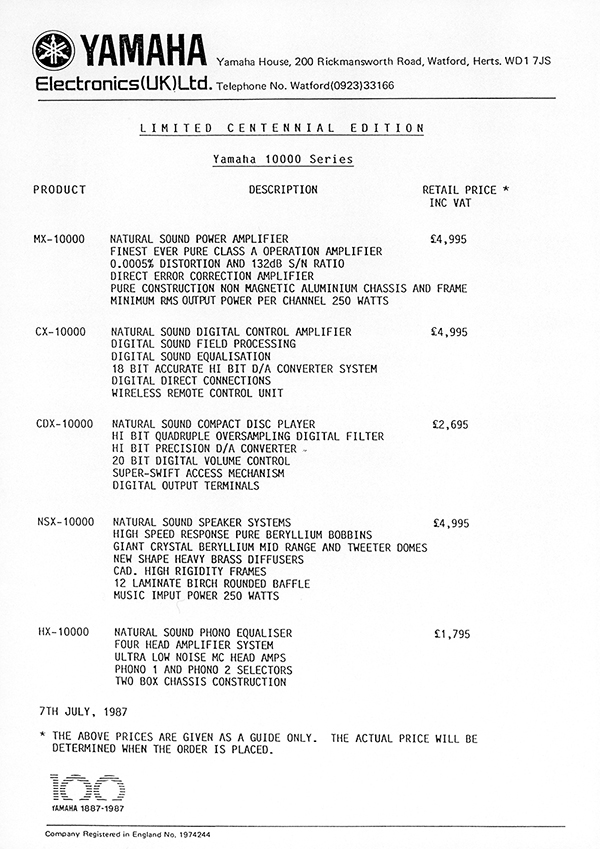
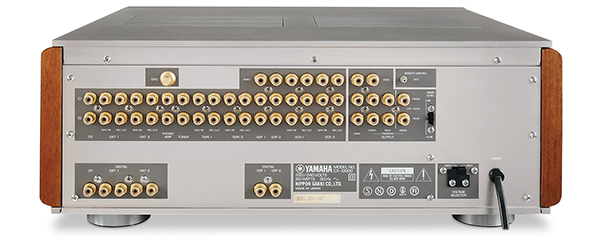
The main source of the system was the £2695 CDX-10000 CD player [HFN Dec ’87 & Dec ’25], but Yamaha also delighted vinyl fans with the matching £1795 HX-10000 phono stage, featuring two switchable inputs and a range of loading and gain options. Power was provided by the mighty £4995 MX-10000 power amp, weighing 43kg and offering a claimed 1.2kW/2ohm dynamic output. This fed the £4995 NSX-10000 loudspeakers, perhaps the ultimate evolution of the classic NS-1000 design.
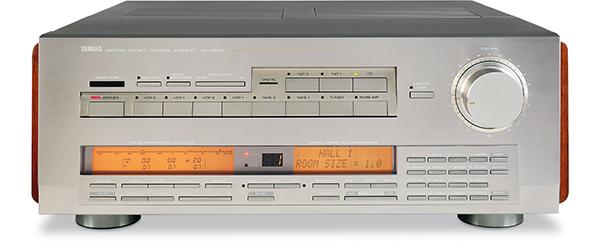
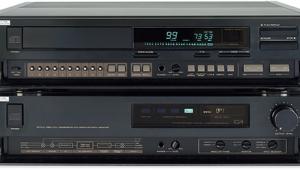
But it was the CX-10000 ‘control amplifier’ (preamplifier), also costing £4995, which was arguably the most impressive of all the components. After all, when did you last encounter a preamp that weighed 24kg and had no fewer than 57 input and output sockets on its rear panel?
Ready for anything
Starting with the basics, the CX-10000 had 11 line-level inputs; six with corresponding analogue outputs that were intended for two analogue tape decks, two DAT decks and two video recorders. No phono stage was fitted but one input was dedicated to the HX-10000, named ‘Phono Amp’, and having its own earth terminal.
The CD input and two DAT inputs and outputs were duplicated digitally and, if an analogue and digital connection were made simultaneously, the latter was given priority. Sampling frequencies of 44.1kHz and 48kHz were supported.
The CX-10000 had separate digital and analogue circuit paths, so if you connected a CD player via the digital input there was no analogue tape output – you either needed to record digitally or make a second connection from the player through the analogue inputs. The ‘Video Disc Player’ connections had corresponding video inputs and the two VCR connections had video inputs and outputs. Composite video outputs were provided for TV monitors.
Digital diva
Yamaha populated the CX-10000 with two DSP cores. One enabled a Digital Parametric Equaliser (DEQ) operating across Low, Mid and High bands, each with a selectable centre frequency offering up to 12dB of cut or 6dB of boost in 0.1dB steps, plus four different Q settings. Low- and high-cut filters were also available – the former operating between 14Hz-900Hz, the latter between 1kHz-19kHz, and both with 6, 12 or 18dB/octave slopes.
The second DSP core implemented Yamaha’s Digital Sound Field Processing technology, first seen in the standalone DSP-1 unit [HFN Mar ’87]. In now familiar fashion, Yamaha shipped the CX-10000 with a selection of programs generated by measurements of real-life concert halls, jazz clubs, etc, from around the world.
With two additional pairs of front and rear ‘effects’ speakers, the CX-10000 looked to recreate the ambience of these locations (including Münster Cathedral) in your living room. Sixteen preset sound fields were stored in the memory, but each allowed users to tweak ‘Room Size’, ‘Initial Delay’, ‘Liveness’ and ‘Reverberation Time’ parameters to their own preference. Up to 16 custom programs, using any of the pre-programmed options as a starting point, could be saved.
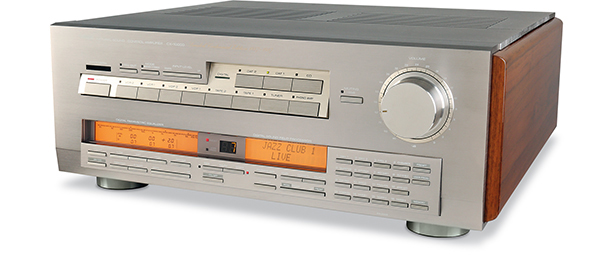
Necessarily, use of these digital parametric EQ and DSP functions meant that analogue input signals would be digitised before being converted back for the preamp outputs. With both options deactivated, and their respective orange-coloured front-panel displays extinguished, an analogue input would pass through the unit fully in the analogue domain.
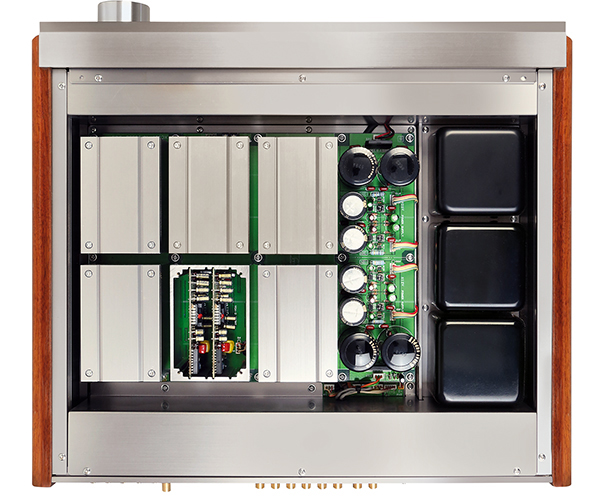
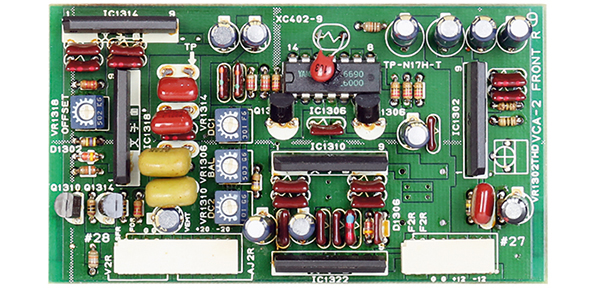
The CX-10000 made extensive use of VCA (Voltage Controlled Amplifier) circuits, using low-noise transistors, and each input could have its sensitivity trimmed by –6dB. All source and function switching was electronic, and all conversion, control and processing functions were implemented using the manufacturer’s own proprietary VLSI chips.
This Centennial Edition unit was a tour de force in terms of build quality. Its 9mm-thick front panel, 5mm-thick top and bottom plates and 3mm-thick rear panel were all made from extruded aluminium. High gloss wooden side cheeks rounded things off, although Yamaha’s plastic IR remote control [p133] let things down a little. Also, this was not the same size as the corresponding handset for the CDX-10000 CD player, spoiling visual harmony on the coffee table.
 Adam listens
Hearing the full Centennial system at a hi-fi show in 1987 left a lasting impression on my 13-year-old self, and listening to the CX-10000 today transported me back to that profoundly affecting demo. Connected to my Yamaha M-5000 power amplifier [HFN Aug ’20], the CX-10000 preamp has lost none of its power to astonish.
The very antithesis of (Quad) Peter Walker’s ‘a length of wire with gain’ it may be, but the CX-10000 is an exceptional performer. While essentially neutral in character, it has an underlying grip of dynamic detail and a knack of drawing you into the music. Most surprising of all are its internal DACs. These may date from decades before ‘high-res’ was even thought of but, for their day, their ‘res’ was about as high as things went.
Throughout the frequency range the CX-10000 is clean and open. Its top end in particular is crisp and detailed, but with no artificial glare or graininess. Instruments always sound natural and believable. The piano on Nicky Holland’s ‘John’s First Wedding’, from her Sense And Sensuality CD [Epic 487992 2], was as realistic and vivid as I have ever heard it, while being well-defined centre stage.
Holland’s vocals on this tale of lost love were heartfelt and soft one minute, soaring majestically the next. The dynamic range of the CX-10000 seems endless, and it can switch from a whisper to a roar in the blink of an eye. This pays dividends on soft material too, where those whispers come from an impressively silent background.
Bass is deep, detailed and blessed with realistic impact. ‘I Can’t Hide’, from Jennifer Warnes’ The Hunter [Private Music 261794], came through the CX-10000 like a breath of fresh air, with taut, solid drum strikes joined by a sinuous, flowing fretless bassline. This is a beautifully recorded track that rarely sounds less than good, but Yamaha’s preamp took it to new heights.
Setting the stage
The CX-10000 can also fill a room with ease, even without artificial assistance from those effects channels. The depth of its soundstages is extensive, and it will stretch images well beyond the loudspeakers themselves while maintaining the precise placement of performers. Largescale orchestral music becomes a thing of wonder, the CX-10000 bellowing out the grandeur of Mozart’s ‘Eine Kleine Nachtmusik’, performed by the Berliner Philharmoniker/Herbert von Karajan [Deutsche Grammophon 400 034-2], with panache.
Being ultra-picky, I have heard the violins on this recording sound just that bit smoother. The CX-10000 is not sterile or soulless, but one or two more modern units, including my own Yamaha C-5000 [HFN Aug ’20], have an extra frisson of warmth and richness across the midband.
Taking the unit out of its full analogue mode, the Digital Parametric Equaliser proves to be effective yet subtle in action, and far more flexible than standard tone controls. It has been invaluable in taming bass room modes, or just adding a touch of top-end sparkle to old and worn tape or vinyl recordings. Bringing it into circuit has minimal effect on the sound before you start making changes. A slight foreshortening of depth perspective is perhaps the only giveaway, but this is something you have to listen out for.
Finally, the preamp’s many Digital Sound Field Processing modes are not the thing for serious evaluation, but they really are a whole lot of fun. With a 1980s-era four-channel Yamaha MX-35 power amplifier and a couple of pairs of Goodmans Maxim loudspeakers pressed into service on effects channel duties, the CX-10000’s digital surround modes rarely failed to bring a broad smile to my face. In fact, I’d even say that, once you’ve experienced ‘Train Song’ from The Best Of Holly Cole [Metro Blue 7243 5 290642 0] in Yamaha’s ‘Jazz Club 1’ preset, or Fragma’s ‘Toca’s Miracle’ from Ministry of Sound’s One compilation [MOSCD 203] with ‘Disco Dynamite!’ engaged, going back to listening to vanilla stereo is something of an anti-climax!
Buying secondhand
None of Yamaha’s Centennial Edition units are commonplace, but the CX-10000 was sold in all world markets (unlike the NSX-10000 loudspeakers, for example) so isn’t quite as tricky to find as some. Not many of them made it to the UK, however, so most secondhand examples are European or Japanese specification.
The unit is built like a tank but incorporates a host of small signal capacitors that have been known to fail. The VCA sections are housed in their own metallic enclosures [see p131], which works wonders for shielding but also gradually ‘cooks’ the capacitors on the boards inside as the CX-10000 gets very warm in use.

While Yamaha used high-quality capacitors on these boards, it only selected components rated to 85oC. All 108 of them may eventually need replacing. I would strongly recommend using new parts rated to 125oC for longevity.
The other issue faced by the CX-10000 is common to high-end Japanese equipment of the era. Essentially, for vibration resistance, some components and connectors were potted in place using a resin that becomes both conductive and corrosive as it ages. Eventually this can short out the PCB tracks and then eat away at them, causing all sorts of odd behaviour and eventually a failure to switch on. Any service or repair work undertaken on the CX-10000 should include the removal of this resin.
Hi-Fi News Verdict
Yamaha’s CX-10000 preamp represented one of the highest of high-end moments from the Japanese hi-fi industry. Designed and built without compromise, it was the beating heart of Yamaha’s 100th anniversary celebrations, and is still a formidable performer by modern standards thanks to its specification. Even if you ignore most of its (fun) bells and whistles, it sounds incredible.Sound Quality: 89%
 | |||||||||||

|
|
| |||||||||









 SPONSORED VIDEO






| Equipment Reviews | |
Music Reviews Awards | |
Latest News Features | |
Resources Newsletters | |
Subscriptions |
WHERE TECHNOLOGY BECOMES ENTERTAINMENT
 © 2026 Hi-Fi News
AVTech Media Ltd
All rights reserved