Wilson Audio Submerge subwoofer


The last subwoofer we auditioned from Wilson Audio [HFN Sep ’22] raised eyebrows simply because of its name. ‘LōKē’ was no doubt meant as an homage to the Norse God, and therefore related to the American marque’s earlier Thor’s Hammer unit, but the phrase ‘low-key’ doesn’t exactly call to mind hi-fi excitement. We’re back on firmer ground with the maker’s new Submerge, the name conjuring images of deep, infrasonic bass.
This model is a far bigger proposition than the LōKē, so a better match for Wilson Audio’s larger loudspeakers, not just the TuneTot standmounts [HFN Nov ’18] and (relatively) compact Sabrina V and Sasha V [HFN Sep ’23] floorstanders. Pricing, too, is ‘bigger’, the Submerge selling in one of five standard Wilson finishes for £31,998, compared to the LōKē’s £9500. Expensive, yes, but remember that a pair of the company’s larger Alexia V or Alexx V [HFN Jan ’22] floorstanders will set you back from £75,998 and £165,000, respectively.
Wheely big
In typical Wilson Audio fashion, the subwoofer’s standard finishes (Galaxy Grey, GT Silver, Quartz, Carbon and Medio Grigio) can be exchanged for numerous ‘Upgrade’ colours (the most striking options including Fly Yellow, Pur Sang Rouge and Spearmint at +5%), plus eleven different ‘Premium Pearl’ colourways (at +10%). Matching it to your Wilson Audio speakers is clearly part of the thinking here.
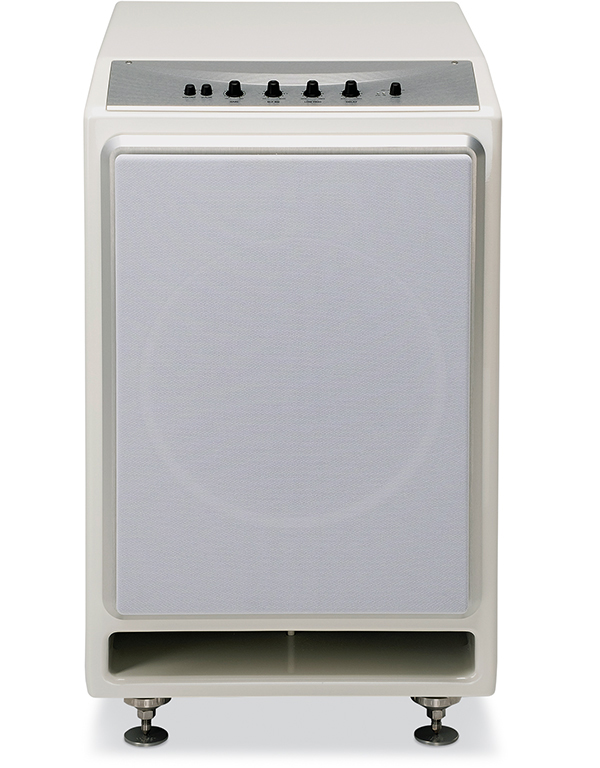
Colour coordination might be desired, because the elephant in the room here is that the Submerge – while not quite looking like an actual elephant in your room – is big. The cabinet, which comes out of the packing crate on four wheels to make manoeuvring it into position easy (it weighs 116kg, so you won’t be lifting it), stands around 77cm tall once attached to Wilson Audio’s ‘Acoustic Diode’ spiked feet. Width is 46cm, and depth 63cm.
Large and heavy aren’t in themselves unusual for Wilson Audio, but I’ll admit to finding the Submerge’s styling some way off the modern, often angular looks of its loudspeakers. It’s similar in appearance to the LōKē, but significantly scaled up and with rotary control dials along the slanted edge of its top surface. Whatever your take on its aesthetics, there’s no questioning the Submerge’s build quality nor the inert mass of its proprietary ‘X-material’ cabinet, with claims of ‘rigidity, inertness, intrinsic damping and extreme hardness’. The side walls grow in thickness towards the front, where they meet an aluminium baffle with brushed finish, below which is a large, slot port. The baffle can be covered by a supplied grille (again with upgrade colours) that’s surely one of the heftiest of its type. It attaches through four heavyweight studs – presumably magnetic fixings wouldn’t hold its weight, nor perhaps stop it flying off during moments of high-output bass…
Solo slammer
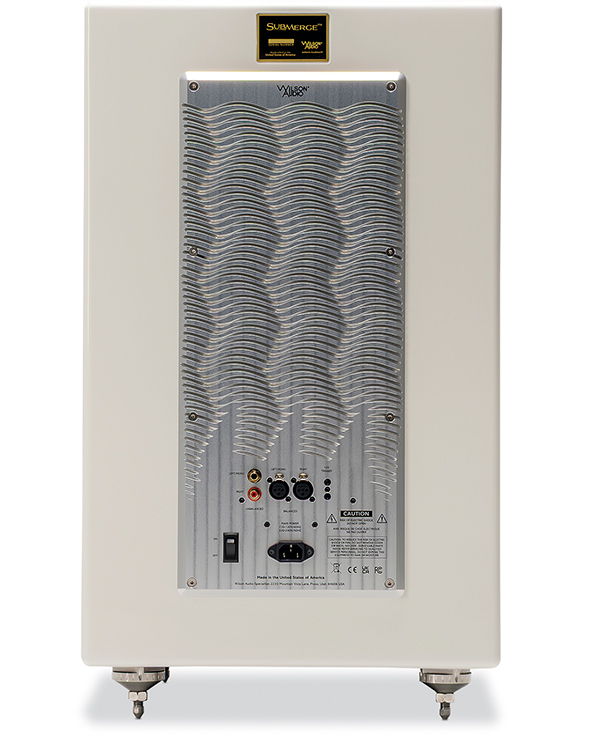
While many other high-end subwoofers feature multiple driver arrays, the Submerge uses a single, front-facing woofer. This is a proprietary 300mm/12in design said to have been ‘specifically optimised for the two bottom octaves of the audible bandwidth,’ and claimed to only move ‘pistonically’ courtesy of its dual-spider suspension and substantial rubber surround (although Wilson Audio makes no claims about its maximum linear excursion). Onboard DSP-driven Class D amplification is rated at 1.6kW [see PM's Lab Report] mounted to an aluminium plate, with heatsinking, that occupies most of the sub’s rear, ‘V-material’, back panel.
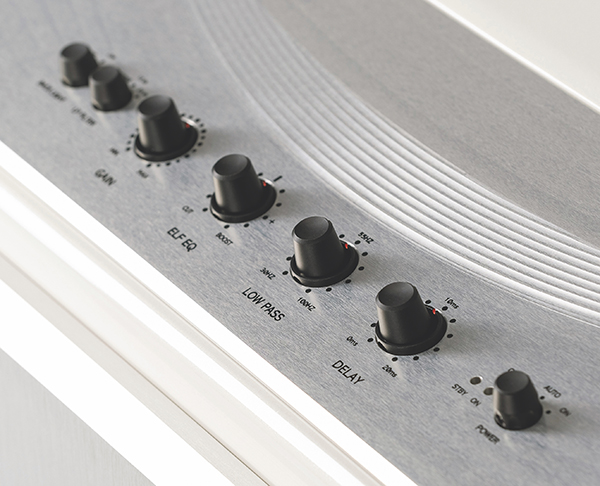
As for those controls on the Submerge’s top, these are analogue pots – similar in appearance to those on Wilson’s outboard ActivXO active crossover – that interface with the built-in DSP to handle all aspects of setup and tuning. There are no controls around the back. Where the LōKē combined a small LCD display with a click/turn navigation rotary to adjust settings, all that’s here are balanced (XLR) and unbalanced (RCA) input pairs, supporting stereo or mono connection, and 12V triggers.
In addition to on, off and auto power modes, and an option to switch on a subtle backlight around the knobs, the Submerge’s controls cover the slope of the low-pass filter (12dB, 24dB or bypass); variable gain (from Min to Max); low-pass filter frequency from 30Hz to 100Hz; an ‘Extreme Low-Frequency Eq’ (ELF) providing a supplementary 10dB cut or boost below 40Hz; and a Delay control claiming some 15msec of adjustment.
The LōKē, by contrast, offers both a conventional phase setting and separate delay adjustment. Of course, any Submerge buyer will have the subwoofer installed and optimised by their dealer, with the manual including a Calibration report sheet to be filled out once the setup is complete.
 Bass blend
There’s a certain irony in the Submerge’s less-than-subtle physical design, because ‘subtle’ is a word that, so often, summed up its performance when paired with Wilson Audio’s Alexx Vfx floorstanders in the HFN Listening Room. Beginning with the ‘ELF’ control at 0 and a 55Hz (24dB slope) low-pass filter, the subwoofer segued into an extension of the main speakers, providing a low-frequency coup de grâce that, with some material, was hard to put a finger on. Spaces sounded bigger, basslines and orchestral lows more solid, instruments a little more textured, but never to the extent that the Submerge became an unwanted star of the show. Which is as it should be.
Careful setup is of course warranted, not only when it comes to placement of the Submerge itself, but with regards to that delay adjustment. During initial listening, using a mix of test tones and bass-centric music, including Bass Mekanik’s ‘Long Way Down’ [King Of Bass; Qobuz download], it became apparent that the addition of the Submerge was attenuating a particular, albeit narrow, band of the floorstanders’ bass output. Adjusting delay/phase put this right.
Kaleida’s ‘Take Me To The River’ [Think EP; Lex Records LEX107EP] is a gorgeous slice of modern pop, with ethereal instrumentation, a playful stereo mix and crystal-clear vocal. It’s also built upon long, deep bass notes to provide weight and stature to the whole shebang. The Submerge/Alexx Vfx system guaranteed the piece sounded spacious, the subwoofer increasing the feeling of scale as much as it solidified the bass. And at no point did it upset the overall balance, so that the almost holographic imaging of the Alexx Vfx floorstanders remained.
Marian Hill, another female pop artist, combines her soulful voice with sparse, bubbling synths and percussive clicks on ‘Differently’, from the Unusual album [Republic Records B0028187-02]. The effect of the Submerge was to send those synths further into the room, making the track seem richer, bouncier, and giving even more of a physical, juddering feel to the lowest notes.
Pulse pounder
PM’s Lab Report [see here] finds the Submerge’s ultimate low-end extension falling short of some, perhaps more cinematically minded, rivals. Subjectively, however, it’s more than adequate for music, and comes into its own with tracks deliberately mixed deep. Jóhann Jóhannsson’s soundtrack to the thriller Sicario [Varèse Sarabande 302067-3698] makes liberal use of low-level effects, particularly the continuous foundation to ‘Alejandro’s Song’, which is almost drone-like beneath the vocal chants.
The same composer’s soundscapes for sci-fi flick Arrival [Deutsche Grammophon; 48kHz/24-bit] are even more atmospheric, none more so than ‘Rise’, which delivered bass that shook my chest wall. Seeking even more, I found selecting a modest 3dB boost on the ELF control to be beneficial – though I would certainly recommend steering clear of the full 10dB…
Diley Simon’s ‘Bass Maniac’ [Qobuz download] does what it says on the tin. Sticking with the instrumental version, the Alexx Vfx/Submerge pairing disgorged the driving, dance rhythms with slam and speed. This is one of the Wilson Audio sub’s greatest strengths: the ‘stop-on-a-dime’ nature of its sound, not necessarily expected from a ported design, avoids the bloat or overhang of ‘lesser’ subwoofers which can make them a turn off to hi-fi traditionalists.
Floor play
A good example of the Submerge’s foundational impact came with the American blues-meets-African blues of Ry Cooder and Ali Farka Toure’s Talking Timbuktu set [World Circuit WCD 040]. On the languid, dreamy ‘Ai Du’, percussion and kick drum were writ large, beneath the sinewy sounds of bows being drawn across strings. Follow-up track, ‘Diaraby’, leapt into life with its guitar riff appearing from a wide, deep space.
On the very subtle end of the scale was Derek And The Dominos’ ‘Layla’ […And Other Assorted Love Songs; Polydor 0602507274788], a track the speakers seemed to eat for breakfast without need of the Submerge, effortless covering the widely mixed drumming of Jim Gordon and Carl Radle’s bass. Yet here, with A/B comparisons, it was apparent the Submerge was lowering the floor a little, particularly when it came to the resonant piano that kicks off the track’s now famous coda.
One question for owners of Wilson Audio’s speakers, to whom this subwoofer is chiefly aimed, is whether it will make them sound better? On this experience, the answer is a firm yes, as the brand has engineered a subwoofer that has the capacity to augment system performance, but take nothing away.
The upright bass on Patricia Barber’s ‘Bye Bye Blackbird’ [Nightclub; Blue Note 7243 5 27290 2 9], the sudden hits of drums, the jazzy piano lines – it all gained an edge in scale and impact, for a more involving experience. But that leaves another question: are you prepared for the Submerge’s size and industrial design?
Hi-Fi News Verdict
Wilson Audio’s latest subwoofer eschews the parametric EQ, app/remote control and larger driver(s) of the high-end, yet still often more affordable, competition, so its appeal outside of the manufacturer’s existing customer base might be limited. Otherwise, the Submerge’s performance – a heady mix of control, speed, subtlety and slam – plus its best-in-class build quality, is worth celebrating.
Sound Quality: 86%
 | |||||||||||

|
|
| |||||||||












 SPONSORED VIDEO






| Equipment Reviews | |
Music Reviews Awards | |
Latest News Features | |
Resources Newsletters | |
Subscriptions |
WHERE TECHNOLOGY BECOMES ENTERTAINMENT
 © 2026 Hi-Fi News
AVTech Media Ltd
All rights reserved