Rotel DX-5 integrated amp with DAC
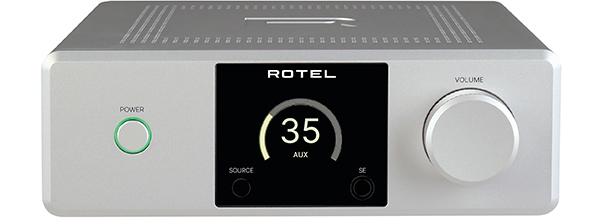

You know where you stand with Rotel. This is a long-running company, still family-owned after almost 70 years, and with a commitment to spending money on what’s on the inside of its products rather than the cosmetics. It still winds its own transformers, and tightly specifies other components it buys in. Its halo brand, Michi, has striking looks [HFN Apr ’25 & May ’24] – from the originals with their Japanese lacquered side-panels to the understated chic of the black-on-black current generation – but the core products remain plain and simple [HFN Apr ’22], looking functional to the point where some might even consider them dour.
Except... things are changing at the Japanese company with the arrival of a new generation of products, spearheaded by the £1399 DX-5 DAC/amplifier we have here and its DX-3 partner, selling for the same price but deleting the DX-5’s speaker-driving capability to concentrate purely on the needs of those of a personal audio persuasion. The DX-5 has just a conventional headphone output as an alternative to its speaker terminals while the DX-3 has both balanced and single-ended headphone sockets. The DX-3 also has balanced XLR preamp outputs, suggesting that a matching power amplifier might be somewhere on the company’s roadmap.
Amps R Us
It’s not immediately obvious from our pictures but, at 21.5cm, the DX-5 is just half the width of the hi-fi separates norm. Of course, there’s more to it than that as the styling has a hint of the latest Michis about it, with a softly chamfered look to the high-quality front panel, and perforated cooling vents in the lid surrounding a stylised ‘R’ logo. In silver or black, these new models have that combination of ‘hewn from solid’ feel and exquisite finishing you’d find in more expensive full-size components from other brands – not to mention the company’s own range of upmarket products. There’s also a suggestion here that what we’re seeing is not so much a standalone offering of compact products but, potentially, the new face of Rotel.
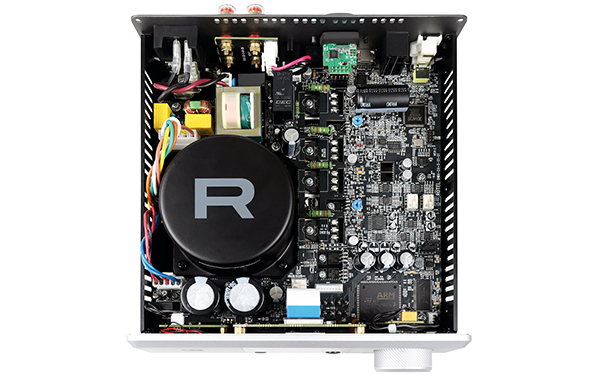
As our internal shot shows [below], all the elements of traditional Rotel hi-fi construction are present and correct, starting with that substantial toroidal transformer, wound in-house and shielded in a can also carrying that new ‘R’ logo. And while the DX-5’s multiple functions may mean the inside of the unit is pretty tightly packed, Rotel has also kept the core engineering well within its established expertise. For example, rather than taking the easy path towards a compact, off-the-shelf Class D amplifier module – already used to great effect in many a modern product – the company has stuck with its traditional Class AB power amp topology, as evidenced by the quartet of Sanken power transistors slotted between that transformer and the DX-5’s main circuitboard.
Rated power here is 33W/4ohm, or 25W/8ohm. These are modest figures, but more than adequate for the kind of small systems the DX-5 might likely be expected to inhabit. That said, as PM reveals in his Lab Report [see here], this little amplifier has rather more oomph to it than you might expect.
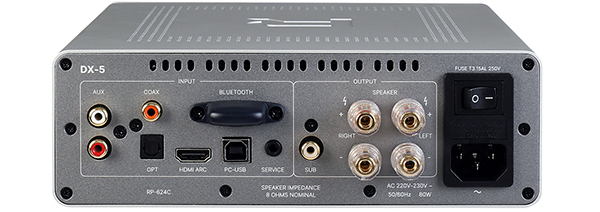
Between mains power in and speaker power out, this seemingly simple device has plenty going on. It has a single set of analogue line inputs, digital optical and coaxial inputs, a USB-B port for connection to a computer or suitable streaming transport, and HDMI ARC to allow the DX-5 to handle TV sound. The USB-B port accepts content at up to 384kHz/32-bit and DSD256, while the optical and coaxial connections are limited to the usual 192kHz/24-bit. Completing the input options is a Bluetooth receiver, with aptX HD capability as well as the default AAC.
For a little ’un, Rotel’s integrated amplifier has usefully substantial combination terminals to take bare speaker wires or 4mm banana plugs, and there’s also a mono subwoofer feed summed from its two channels. The latter is an unfiltered, full-range output so the roll-off will need to be set on your subwoofer of choice.
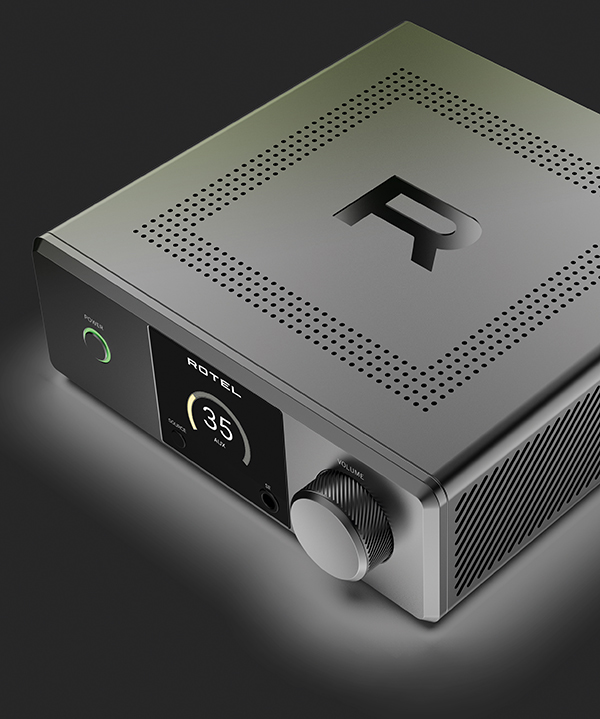
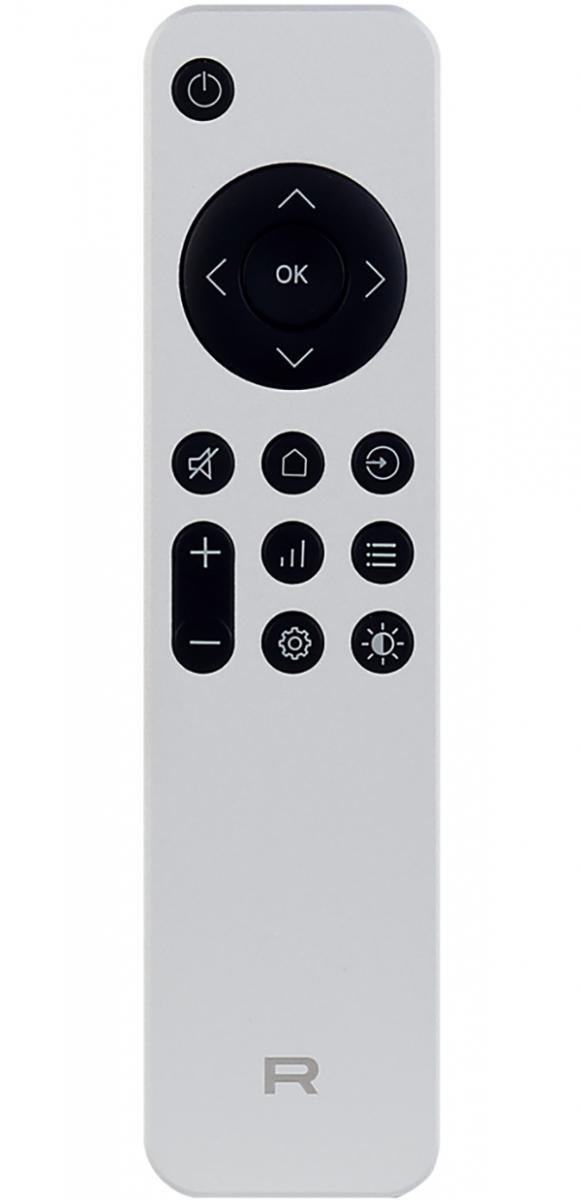
Front panel controls, meanwhile, are limited to power, source selection and volume. To delve into the DX-5’s menus, which offer features such as display dimming/off, power-saving, source naming and digital decoding mode, the supplied remote handset [p87] is used. Incidentally, that digital option allows the user to choose between handling DSD and PCM files up to 24-bit, which is the default setting, or to omit DSD altogether in favour of 32-bit LPCM capability. For most users, the default will do very nicely.
 Driving lessons
Before I’d clapped eyes on PM’s Lab tests [see here], I’d already experimented with the DX-5 driving a selection of speakers, including the tiny and ridiculously cute/affordable DALI Kupids, and PMC’s compact prodigy5 floorstanders. Over an extended listening period – punctuated only by the need to perform a running firmware update, something of a faff involving a PC and the purchase of a USB-to-3.5mm serial adapter cable – I came to appreciate one of the DX-5’s strengths. What it lacks in stature, it more than makes up for with its ability to drive loudspeakers both comfortably and convincingly. And this, I might add, includes everything from simple accompanied voice all the way up to full-force rock and orchestral music.
What’s more – and perhaps fortunately, given the emphasis on digital sources here – the ESS ES9039Q2M-based DAC/analogue stage performed well across a range of file formats. These spanned from relatively low-bitrate podcasts streamed via Bluetooth to online services and locally stored files served up via computer. I tried a couple of affordable DACs, from AudioQuest and iFi Audio, between my computer and the DX-5’s analogue ins, but have to admit to preferring the generous but detailed sound of its onboard conversion.
Loverly stuff
With plenty of dynamic headroom in hand, the DX-5 breezed through the big, exuberant new Sinfonia of London/John Wilson recording of Lerner & Loewe’s My Fair Lady [Chandos CHSA5358(2)]. There was excellent clarity both to what was being sung and the vocal character of the star-studded cast, plus a wonderful richness in the orchestral playing. It’s another triumph for Wilson’s ongoing re-imaginings of classic Broadway and Hollywood scores, and the DX-5 – especially driving the PMC speakers – delivered it with panache.
After recently hearing his trio in concert, I’ve been exploring the catalogue of Suffolk-based folkster John Ward, his simple instrumentation both reflecting and creating music celebrating his home county. The ability of the DX-5 to dig deep into the recordings on Ward’s multi-instrumental/vocal East Of The Sunrise [Ion Music IONCD9] brought out the close harmonies and the musicianship in these (mainly) seafaring tales.
On to a Proms-inspired listen, and the impeccable Quincy Jones score for 1960s caper movie The Italian Job [MCA MCD 60074]. This gave the DX-5 full rein to show its capacity to reveal scale and warmth, and its considerable speed when called upon to swing. The sound was lushly romantic with the opening ‘On Days Like These’, complete with the Matt Monro vocal, and it drove the good-time rhythms of the closing titles with superb snap and punch. Rotel’s amp is more than capable of blowing the doors off!
With Vaughan Williams’ Fantasia On A Theme Of Thomas Tallis, played by the Academy of St Martin in the Fields/Sir Neville Marriner [Argo 414 595-2], the DX-5 did superbly with a Kingsway Hall recording already well past its 50th birthday. Frankly, it delivered both the drama of the piece and the scale of the orchestra in a manner you wouldn’t expect from a nominal 25W output.
Similarly, the little amp growled through the low bass on the EERA mix of ‘Monsoons’ from Public Service Broadcasting’s recent Night Flight remixes album [So Recordings SOAK622], powering the track along while illuminating the band’s familiar use of snippets of archived sound. Yes, I’m sure a monster power amplifier could shake the walls even more convincingly, but the Rotel DX-5 never sounds any less than up to the job. It stays clean and crisp even when working hard.
Block party
Not that some classic Police pushes it too hard. A blast of ‘Spirits In The Material World’ and ‘Every Little Thing She Does Is Magic’ from 1981’s Ghost In The Machine [A&M 493 655-2] revealed just how tight the trio could be before it all got loose and tantrummy.
Stewart Copeland’s drums hit really hard and Sting’s bass thumped along behind the jangling guitar of Andy Summers. Mind you, if you want to hear the DX-5 getting really tight and funky, look no further than The Blockheads weaving their magic behind the great Ian Dury on ‘What A Waste’ from Do It Yourself. It slinks behind the verses and goes for the charge into the chorus, before sounding seemingly unstoppable on the extended 12in version of ‘Reasons To Be Cheerful, Part 3’ from the album’s 2015 Deluxe Edition [Edsel EDSK 7081]. It’s bonkers, but brilliant, and the Rotel DX-5 simply powers it along with panache.
Hi-Fi News Verdict
This little amplifier may be the start of something big for Rotel, not least in the adoption of a fresher, more refined design language that seems likely to be adopted by the company for more of its products. However, it’s clear the manufacturer’s traditional values have been maintained beneath the skin, giving the DX-5 not just a bigger, more dynamic sound than its paper specs might suggest, but wider appeal, too.
Sound Quality: 86%
 | |||||||||||

|
|
| |||||||||








 SPONSORED VIDEO






| Equipment Reviews | |
Music Reviews Awards | |
Latest News Features | |
Resources Newsletters | |
Subscriptions |
WHERE TECHNOLOGY BECOMES ENTERTAINMENT
 © 2026 Hi-Fi News
AVTech Media Ltd
All rights reserved