Pye Black Box record player Lab Report
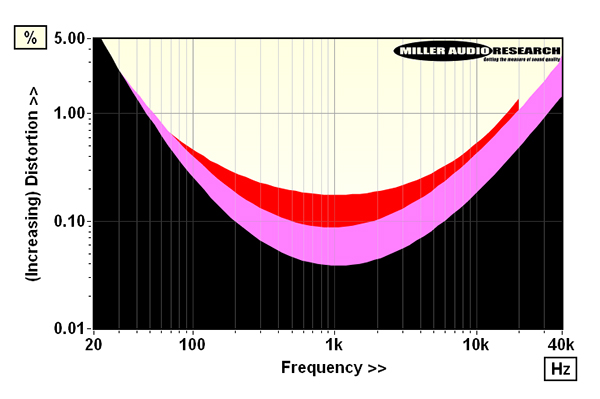
There are no measurements of the autochanger here – my test LPs are irreplaceable – but before launching into any ‘serious’ testing it was necessary to rotate the treble control clockwise and achieve as flat a response as possible. Fully anti-clockwise, the tone control yields a response from the amplifier that rises to +3.8dB/20kHz, but turned halfway a remarkably flat +0.1dB/20Hz to +0.25dB/20kHz (re. 0dB/1kHz) was achieved. The response peaks at +2.5dB/52kHz, rolling away to –10dB/100kHz, but realises a slightly ‘brighter’ +0.35dB and +0.45dB/20kHz into lower 4 and 2ohm loads, respectively [see boxout]. The fact that this response is largely unaffected by loading is, in part, thanks to Pye’s generous use of feedback, wrapped around the output transformer’s secondary winding. Output impedance falls from 1.2ohm/20Hz to 0.46ohm/20kHz and distortion is as low as 0.17%/1kHz (re. 0dBW) as a result. Transformer core saturation necessarily causes distortion to rise at bass frequencies, reaching 4.7% at 20Hz/1W [see Graph 2].
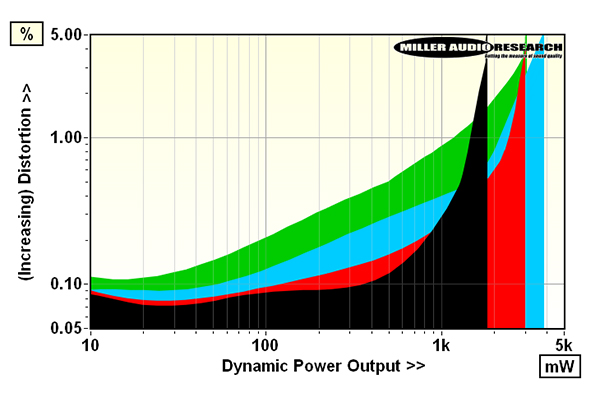
Power from those two diminutive EL42 pentodes, albeit operating in UL push-pull mode, is also necessarily limited. Various power outputs were specified ‘back in the day’ but not with respect to distortion. In practice, the Black Box delivered 1.5W/8ohm/1kHz to 1% THD, increasing to 2.0W/8ohm and 3.2W/4ohm at 5% THD – this relatively hard clipping point is, again, a feature of the ‘global’ feedback regime. As is the non-existent dynamic headroom as the Black Box delivers 1.9W, 3.1W, 3.8W and 3.1W (1.8A) into 8, 4, 2 and 1ohm loads, respectively, at up to 5% THD [see Graph 1, below, and note that the X axis here is scaled in mW, not W]. PM
 | |||||||||||

|
|
| |||||||||














 SPONSORED VIDEO






| Equipment Reviews | |
Music Reviews Awards | |
Latest News Features | |
Resources Newsletters | |
Subscriptions |
WHERE TECHNOLOGY BECOMES ENTERTAINMENT
 © 2026 Hi-Fi News
AVTech Media Ltd
All rights reserved