Pye Black Box record player Boxout
Our Pye Black Box is of the earlier generation that hosts two Celestion drivers, connected in parallel with the output of the amplifier, and each notionally ‘full range’. Placed in a corner location but otherwise tested in conventional fashion, we can see the Black Box’s forward response falls shy of that achieved by modern loudspeakers [see Graph, below] with errors of ±7.8dB over an effective 90Hz-9.8kHz bandwidth (–6dB re. 1kHz). The response amplitude is corrected for a 2.83V input, showing an indicative sensitivity of 87dB/1kHz and 90.6dB from 500Hz-8kHz, while the deep cancellation notches at 340Hz and 890Hz vary according to placement. Distortion also varies from a low minimum of 0.2% over the peaks in the midband to a higher 4% through the dips (all re. 90dB SPL/1m), the former also realised as very persistent cabinet and cone resonances on the CSD waterfall spectrum [not shown here].
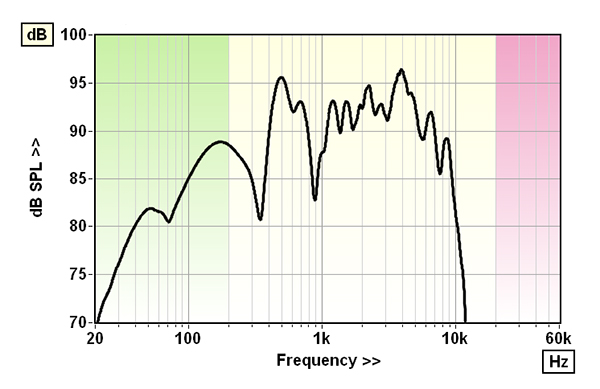
It is clear that the EL42 tube-based amplifier is optimised for a low impedance speaker [see PM's Lab Report] and, indeed, the loading imposed by those two parallel-coupled drivers drops to 1.4-1.5ohm (230Hz-1.1kHz) with swings in impedance phase of +38o/–26o through the mid-bass. This combination represents a tough 0.7ohm EPDR for the amplifier at 30Hz and, more importantly, an EPDR that’s sub-1ohm from 1kHz-7kHz. So here’s another reason why Pye extended the Black Box’s feedback network around the secondary of its output transformer...
 | |||||||||||

|
|
| |||||||||














 SPONSORED VIDEO






| Equipment Reviews | |
Music Reviews Awards | |
Latest News Features | |
Resources Newsletters | |
Subscriptions |
WHERE TECHNOLOGY BECOMES ENTERTAINMENT
 © 2026 Hi-Fi News
AVTech Media Ltd
All rights reserved