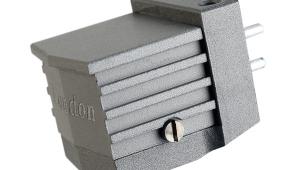
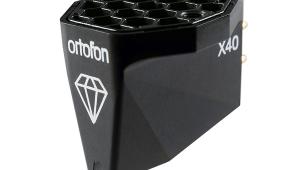
Ortofon MC X40 MC cartridge Diamond Life
Budget pick-ups may still employ a spherical/conical stylus but the tracing footprint – the contact patch between the diamond and walls of the vinyl groove – is far removed from the near-vertical edge of the original cutter stylus. The 18μm major radius (the vertical dimension of the diamond/groove contact patch) of Ortofon’s ‘elliptical’ and ‘nude elliptical’ styli – MC X10 and MC X20, respectively – is similar to that of a basic conical diamond, but their 8μm minor radius (the horizontal dimension of the contact patch) is considerably smaller, offering superior tracing ability. The MC 30X’s ‘nude fine line’ stylus further elongates this footprint with major/minor radii of 40μm/8μm, but it’s the Shibata diamond fitted to the MC X40 that wins out with its even finer, blade-like 50μm/6μm profile. The facets [see picture below] are ground onto the end of a diamond shank and glued to the tip of the MC X40’s boron cantilever.
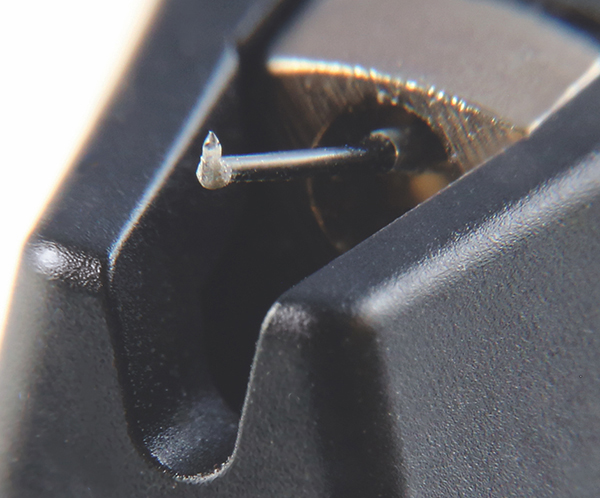
The origins of the Shibata, and other elongated line contact profiles, can be traced back to the 1970s and JVC’s CD4 four-channel record format which demanded the ability to trace grooves up to 45kHz. Although ultrasonic extension is not strictly necessary with today’s stereo LPs, the desire to reduce tracing distortion has kept development alive. The most advanced ‘micro-ridge’ profiles may have a mere 2μm minor radius but their vertical contact area must be limited to avoid the stylus tip dredging the very bottom of the groove. PM
 | |||||||||||

|
|
| |||||||||













 SPONSORED VIDEO






| Equipment Reviews | |
Music Reviews Awards | |
Latest News Features | |
Resources Newsletters | |
Subscriptions |
WHERE TECHNOLOGY BECOMES ENTERTAINMENT
 © 2026 Hi-Fi News
AVTech Media Ltd
All rights reserved