Ortofon MC X40 MC cartridge
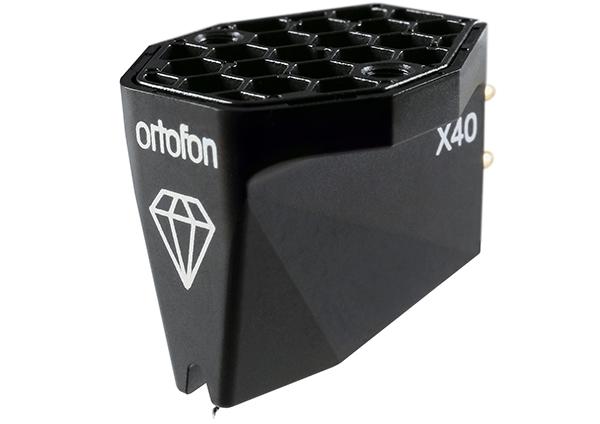

With a selection of cartridges that runs to 90 models, you might wonder what a new range could bring to the Ortofon fold. That impressive figure includes the legendary SPU moving-coils, the once-futuristic but now-familiar Concorde and OM moving-magnet lines, the affordable 2M models, and high-end MCs costing well into the thousands [HFN Mar ’22 & Jun ’25]. This crowded house has now been expanded by the four-strong moving-coil MC X Series, and it will prove a relief to some that the truly exceptional top cartridge, the MC X40 reviewed here, costs £875. Yes: under a grand.
Silver service
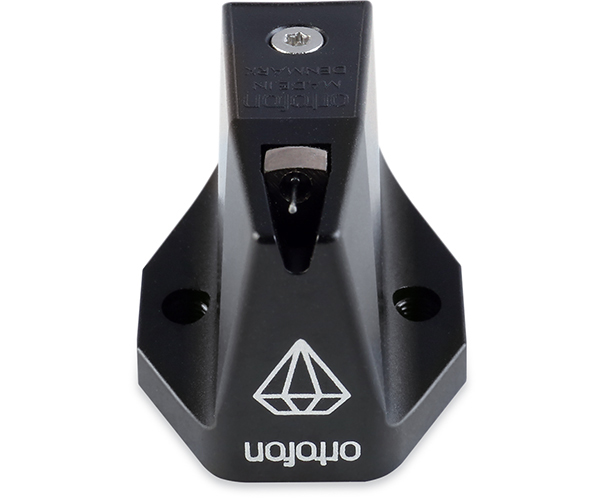
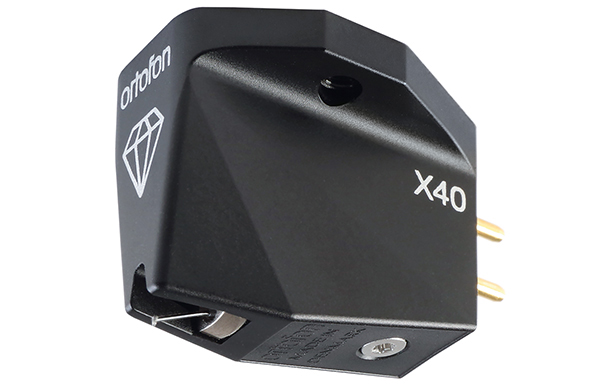
Common to all four MC X pick-ups are a distinctive black-coated stainless-steel honeycomb body (a dream to install), the mechanisms featuring newly developed suspension and dampers, a one-piece magnet pole cylinder, and silver-wound coils on a cross-shaped armature.
That word ‘silver’ tells you this is an example of how coil wire materials other than copper have entered the affordable mainstream. Ortofon uses the term ‘Pure Silver Coil System’, the ultra-fine silver wire being of high purity ‘for exceptional signal clarity and detail’. As silver wire has been a big deal in high-end cartridges for at least 40 years, let’s all agree it’s not just an alternative to copper, but one with its own identifiable sonic characteristics.Inside each MC X series cartridge is an ‘Optimised Magnet System’, formed on a one-piece pole cylinder and rear magnet yoke. Ortofon attributes to this design ‘maximum magnetic efficiency’ but, arguably, the most distinctive feature of the MC X cartridge bodies is one that will not be seen once the cartridge is mounted in any headshell which covers the entire top surface. That injection-moulded honeycomb stainless-steel frame undoubtedly increases body rigidity without adding to the weight. At 8.6g, the MC X40 will cause no issues with the majority of tonearms.
Where the fun really comes in is with the cantilever and stylus assembly. The base-model MC X10 (£269), is fitted with an aluminium cantilever and an elliptical stylus of 8/18μm. Step up to the MC X20 (£429) for a more refined nude elliptical stylus. In the MC X30 (£599), the stylus changes to a fine-line type, while the MC X40 under test is equipped with a nude Shibata stylus [see boxout] and a change of cantilever to boron.Material concerns
As there is certainly a segment of the audiophile community which obsesses over cantilever materials and styli profiles, and – like all reviewers – I have observed these seemingly small differences within a model range, it would be interesting to learn if any presuppositions would be realised. Cutting to the chase, I was not disappointed, because the MC X40 categorically reaffirmed what I have been experiencing for at least the last five years’ worth of listening to a wide variety of cartridges, notably including boron cantilevers.
I am now ashamedly partial to those prohibitively expensive one-piece diamond cantilever/stylus assemblies (and I certainly cannot ignore the heart-stopping prices), and was intrigued by SoundSmith’s cactus needle cantilever. But I otherwise admit to no biases vis-à-vis styli profiles. That’s because there are primitive spherical types which blow away ellipticals, let alone lesser cantilevers which easily better their alleged superior siblings.
But do note that I am not assuming any upsets apply to the MC X series, because my confidence in Ortofon is such that I would expect audible gains with each step up the range, as I found with the four Ortofon 2M variants I have tried. I would posit, however, that a holistic approach is needed, and that one must not generalise about either styli shapes or cantilever materials.
Manual intervention
Ortofon is so thorough and seasoned at this that the MC X40 is as simple to install as any cartridge this side of a Denon DL-103. The pins are colour-coded and widely spaced, the flat top and pointed prow afford straightforward azimuth and VTA setup, and the well-protected stylus remains easily visible through a slot. The manufacturer supplies the most basic of instructions though, telling you only that the MC X40 tracks best at 2g.
What I didn’t appreciate is having to go online via a QR code to find out the recommended loading should be above 50ohm. It would not have inconvenienced Ortofon to print that in the minimalist, emoji-esque, text-free booklet supplied with the MC X40.
That said, I found the cartridge sounded of its best at 100ohm, while the refined nature of the cartridge and its finely profiled stylus mean that it responds audibly to any changes you might care to make: varying the loading, playing with the VTA, and the move from one headshell to another all yielded vivid results. Great expectations
As if to prove the worth of my many hours spent comparing cartridges strictly because of their styli and/or cantilevers, the MC X40 from the first notes exhibited exactly what I hoped for… exceptional speed and attack, the retrieval of ultra-fine details, and – as is a by-product of styli which track deeply – the need to ensure that LPs are cleaned well into the groove. Equally, there was a surprise in that the tracking ability was way above the often so-so moving-coil norm, nudging into classic Shure MM territory, especially at the inner grooves [see PM's Lab Report].
Two contrasting LPs let me know that I was listening to something special, both superbly recorded live albums capable of providing the listener with a massive stage. PM’s testing confirmed precisely what I heard, if expressed differently: in both cases, the soundfield ‘shape’ was deeper rather than wider in absolute terms, the depth more precisely defined than the left/right edges. But it hardly mattered.
First up was Ben Webster’s At The Renaissance [Craft Records/Contemporary CR00388], the quintet recorded at a small Hollywood club in 1960. It covers all bases for a jazz album of the era, especially one which features five maestri performing familiar melodies. The lure for me, besides wanting to experience how the MC X40 would recreate a small space, was to hear saxophone to the fore. Retrieval of detail was so natural-sounding that those who absolutely insist on detecting the sound of the saxophonist’s breathing will have no grounds for complaint. More exciting, though, was the image specificity within the soundstage, the edges counting for little because the five players were so solidly portrayed from left to right.
Stardust smoothie
As for moments that added to the musicality and authenticity, there were occasional bursts of Frank Butler’s drums to make you sit upright, their impact arriving during quiet moments to demonstrate just how fast the MC X40 handles dynamic contrasts and moves from soft to loud. On ‘Georgia On My Mind’ and ‘Stardust’ in particular, Webster’s sax oozed warmth and expressiveness. This is one smooth cartridge.
At the other extreme is Jeff Beck With The Jan Hammer Group: Live [Mobile Fidelity MFSL 1-547]. Although no specific venues have ever been credited, one can tell by the sound that the recordings took place in much larger halls than the Webster gig, including the Astor Theater in Reading, Pennsylvania.
Fender fluid
From the outset, this was about high levels, rapid attack and the kind of transients which will challenge any system. After the Webster LP, it enabled the MC X40 to reconstruct a completely different acoustic, with all-amplified instruments. Beck’s playing is known for fluidity as much as it is for sheer speed, so finesse is the order of the day, hard rock playback levels notwithstanding. This may seem the antithesis of what best reveals the subtlety of the quieter Webster performance, but Beck and Hammer were playing jazz as much as rock so the conceptual gap is narrower than you might think. When it came to Beck’s legendary interpretation of The Beatles’ ‘She’s A Woman’, the liquidity of his Fender Stratocaster possessed character as much in keeping with a human voice as with metal strings. This cartridge has no problem juggling such textures.
For actual vocals, I chose to test the MC X40’s midband prowess with the familiar tones (at least to aged Boomers) of Donovan, with the stunning reissue of The Hurdy Gurdy Man [Impex IMP6055]. Like Ben Webster’s sax playing, Donovan’s singing is breathy, especially from the very opening of the title track.

This is a feast of assorted droning instruments (including a tambura), militaristic drumming, and air around the vocal. I’d already heard how sublime was Impex’s remastering via a cartridge priced ten times that of the MC X40, so I knew what the LP offered. Such is its performance, Ortofon’s newest model turns out to be an exemplar of the Law of Diminishing Returns!
Ticking all the boxes
Less mystical in both content and the choice of instruments is the late Dan Fogelberg’s Souvenirs [Impex IMP6064]. Midwesterner Fogelberg’s output was firmly in the West Coast troubadour tradition, and the presence of Joe Walsh as both producer and guitarist assure this LP’s place on an Eagles family tree. Here was an opportunity to hear layered acoustic and electric guitars, while Fogelberg’s voice was of a higher register than Donovan’s. ‘Part Of The Plan’ ticked all the singer-songwriter boxes, as well as arresting backing vocals, Ortofon’s MC X40 giving each voice its own space. How clearly? I swear I could pick out Graham Nash.
Hi-Fi News Verdict
Tired as I am of apologising for high-end prices, it’s a privilege to hear a new moving-coil which does everything right, nothing wrong and even looks upmarket. If I were churlish enough to ask for a wider soundstage or a tad more bass weight, I’d still guess the MC X40 cost around £3000. If this is an undeniable bargain at £875, what are its siblings offering for even less? The MC X series looks to be a triumph.
Sound Quality: 90%
 | |||||||||||

|
|
| |||||||||









 SPONSORED VIDEO






| Equipment Reviews | |
Music Reviews Awards | |
Latest News Features | |
Resources Newsletters | |
Subscriptions |
WHERE TECHNOLOGY BECOMES ENTERTAINMENT
 © 2026 Hi-Fi News
AVTech Media Ltd
All rights reserved