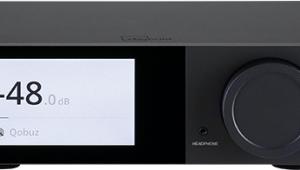
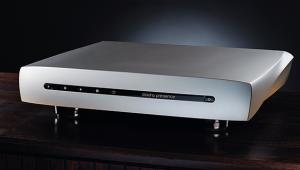
Lyngdorf TDAI-2210 streaming amplifier Boxout
The design DNA of Lyngdorf's TDAI-2210 can be traced back some 30 years to the 'World's First Digital Amp!' that made headlines in our sister title, Hi-Fi Choice [May '98]. Previously, I'd already reported on a prototype of what was to become the TacT Millennium after designer Lars Risbo had visited in 1995. Here, at last, was a truly digital Class D amplifier whose switching frequency was directly synchronised to the incoming sample rate (no higher than 48kHz in those days) and where the number of pulse widths was strictly determined by the truncated bit depth (8-bits, or 256 pulse widths). In an analogue Class D amp, the switching frequency is arbitrary and the pulse widths continuously variable.

Above: Hi-Fi Choice May ’98
Among the Millennium's many innovations was its high-order digital noise-shaping. The truncation of incoming 16-bit data into an upsampled 8-bit stream produced a huge increase in broadband noise which was 'shaped' out to higher, ultrasonic frequencies, restoring the original dynamic range within the audioband. Ultimately, the amplifier's S/N ratio was – and still is – determined by the residual noise of its switching PSU. In this digital Class D amp the DC power supply is directly connected across the speaker load, albeit modulated by the PWM control signal, so both dynamic range and volume adjustment (gain) are both limited and controlled by adjusting the supply, not the signal voltage. PM
 | |||||||||||

|
|
| |||||||||














 SPONSORED VIDEO







| Equipment Reviews | |
Music Reviews Awards | |
Latest News Features | |
Resources Newsletters | |
Subscriptions |
WHERE TECHNOLOGY BECOMES ENTERTAINMENT
 © 2026 Hi-Fi News
AVTech Media Ltd
All rights reserved