Michi Prestige X430 integrated amplifier

Flagship product ranges are nothing new – in the 1970s and '80s, Optonica was to Sharp what Aurex was to Toshiba and Lexus is still to Toyota. In the 1990s, Rotel thought this a worthwhile wheeze and introduced its Michi range of models to great acclaim [see boxout]. In 2019 the name was reborn, with the range now expanded by a more attainable series, dubbed 'Prestige'.
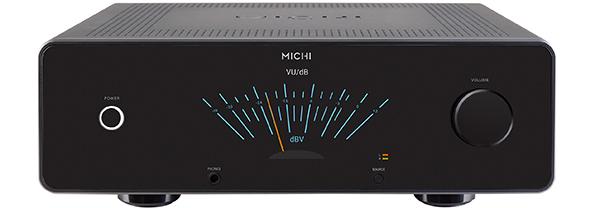
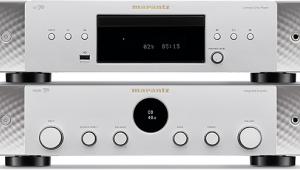
The £4499 X430 stereo integrated is Prestige's opening gambit, and although the industrial design is more compact, with contoured edges, this amplifier is every inch a Michi product, its dark glass front panel only giving up its secrets when powered. Undercutting its bigger brother, the X3 S2 [HFN Jan '24], by around £1500, the X430 integrated will be joined later in the season by a partnering Prestige Q430 CD player, priced at £3599.
The X430 is packed with options. The unit boasts three line-level inputs through unbalanced RCAs, plus a further balanced input on XLR. An MM phono input is also available, with fixed gain and loading. On the digital side it offers no fewer than eight inputs that feed an ESS Sabre ES9039Q2M 32-bit DAC. Three are optical and three are coaxial, all capable of accepting audio data up to 192kHz/24-bit, while an HDMI connector allows access to a stereo PCM ARC audio feed from a television or similar, at up to 48kHz/24-bit.
Roon service
A PC connection through a USB-C port extends digital format compatibility to 384kHz/32-bit and DSD256, and the unit is certified Roon Tested. A second USB-A socket is fitted but this is merely to permit software updates, although it will also power a connected USB device. The network port is for control only as the X430 is not equipped with an app-driven hi-res audio streaming facility. On the other hand, aptX HD and AAC Bluetooth are supported via a built-in antenna.
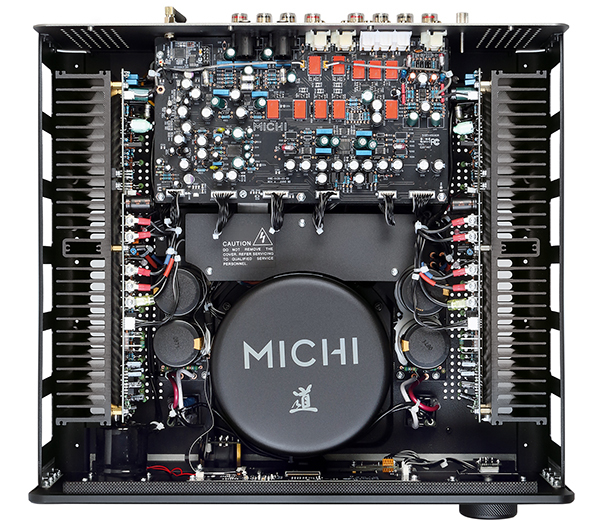
Above: Massive linear PSU [bottom] feeds the X430's very capable power amp, each side using six pairs of high current output devices [on heatsinks]. Digital PCB [top] hosts ES9039Q2M DAC and wireless BT aptX HD interface
Power trip
On the output side, the X430 can drive two pairs of loudspeakers via switched A/B outlets and it also has sockets to run two mono subwoofers. There are stereo preamplifier outlets to feed another power amplifier 'used to drive remote speakers', as it suggests in the user manual. Given the issues experienced in PM's lab testing with the amplifier's protection being invoked if over-driven with high level digital inputs, the X430 is probably not ideally suited to pure preamplifier duties.
Frankly, I'm not sure why you'd want to do this anyway, given that a key selling point of the X430 is its prodigious power output. Rated at 340W/4ohm and with seemingly limitless load-driving capabilities [see [see PM's Lab Report] there's unlikely to be any speaker the X430 cannot handle. Based around a Class AB output stage using high current output transistors and fed by a proprietary, in-house built toroidal transformer, Michi promises 'effortless listening, tight controlled bass and a sense of dynamic ease at all volumes'.
The whole unit is built on a solid aluminium chassis and has a knurled volume control with a delightfully tactile feel. A large central display appears on power-up with details of input selection and volume level, or can be switched to show a VU meter, a dB Peak Power meter or a bargraph-style spectrum analyser.
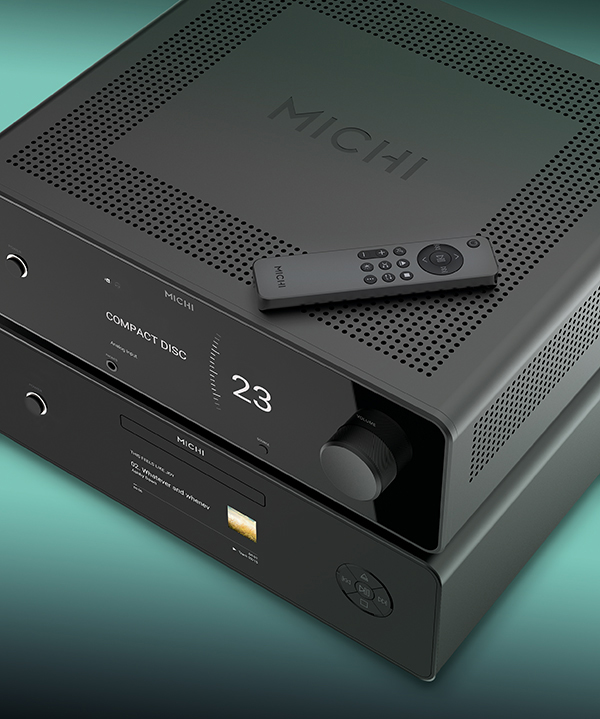
Above: The X430 integrated will be joined later in the season by a partnering Prestige Q430 CD player
There are many other hidden facilities within the menu, such as the ability to re-name inputs, adjust bass and treble and even set a maximum volume limit – not a bad option given the copious power available! It is also possible to set the X430 to sense an input signal on its coax/optical, USB, Bluetooth or HDMI ARC inputs. When set, the amp will power on when it detects a signal on the chosen input, and power down after ten minutes of 'no signal'. This means that it can activate without manual intervention, eg, when you switch on the TV.
To allow the X430 to integrate into a home network, it includes both an Ethernet socket and a standard RS232 D-type connector, lending itself to remote operation via an external controller. The X430 is supplied with a stylish remote control handset [see below] and a sturdy mains lead in a natty cloth bag. All in all, this unassuming black box caters generously for traditional offboard CD/streaming source components even if vinylistas might rue the omission of an MC phono stage. But then perhaps there's more to come from Michi…
 Punch perfect
Connected to my regular PMC twenty5.24 speakers [HFN May '17] and with a Naim CD5 XS/Flatcap XS plugged into the CD input, the X430 announced its intentions straight out of the gate. As might be suspected from its solid appearance and generous power output, this is a gloriously dynamic, tight and punchy performer. It reproduces all kinds of music with authority, a wonderful level of control, and the sense that it is never approaching the edge of its limits. But neither is the X430 a 'one trick pony' in this respect. A finely judged feeling of balance throughout the frequency range ensures its low-end potency doesn't overpower the broader picture. If there's a deep, driving bassline to be heard then you'll know about it, but otherwise the X430 has a delicacy and subtlety that is quite surprising at times.
The solid beats of 'The Tree Knows Everything', from drum 'n' bass producer Adam F's Colours album [Positiva 7243 8 21725 2 9], were a riot of weight and impact, while the low, sliding synthesiser bass notes were sinuous, warm and impressively deep. By way of contrast, Gretchen Peters' vocals on the country ballad 'On A Bus To St. Cloud' [The Secret Of Life CD; Imprint Records 05101 0002] were soft, heartfelt and blessed with just the right level of emotion. Once again, the bassline was a deep and detailed companion, but Phil Kenzie's soprano saxophone also had lifelike richness and scale.
Big reach
Throughout the midband, the Michi Prestige X430 offers insight and clarity. Main vocalists were located firmly centre stage with backing performers to their left and right, and instruments were vivid within their own area. True, the amp doesn't quite offer the stage depth of some rivals, nor does it push the music forward into the room in the manner of some competitors. But where it really does score is in the spread of sound across the width of the soundstage, placing instruments and effects well beyond the physical boundaries of the loudspeakers.

Above: Switched A/B speaker binding posts and variable preamp outputs, on RCAs, are joined by MM phono and four line inputs (one balanced on XLR). Digital inputs include three optical/coaxial, USB-C, HDMI ARC and wireless BT. Ethernet is for control
As a result, other less overtly spacious recordings, such as Around The Next Dream from the Baker Bruce Moore (aka BBM) power trio [Virgin 7243 8 3978 2 1], sounded more lavish than I was expecting. The X430 smartly separated Gary Moore's acoustic guitar during the intro to 'Where In The World', giving the track an open, wide presentation that can often be lacking. Once again, though, it was the drum strikes on 'Waiting In The Wings' that really caught the ear – the level of dynamic immediacy and sheer clout available from the X430 is a rarity, even at this price.
Lossless lessons
The amplifier's top-end is open and lucid, resulting in a clean, crisp performance. However, I did notice it falter a couple of times when it came to the finest of details. On Steely Dan's 'Jack Of Speed', from the band's Two Against Nature CD [Giant 924719-2], the main cymbal strikes were bright and shimmery with excellent levels of decay. On the other hand, the hi-hat that backs things up tended to appear now and then rather than remaining a constant presence. The X430 didn't once sound dull or muddled in its rendering of treble details but did fail to pull the occasional subtlety fully out of the background.
Playing a 96kHz/24-bit download of the same Steely Dan track from a laptop running the Foobar2000 audio player, into the Michi amp's USB input, and it seemed much less affected. Those hi-hat subtleties were more obvious. In addition, Patricia Barber's rendition of the jazz standard 'Bye Bye Blackbird' [Nightclub, Premonition Records] was a 'hairs on the back of the neck' delight, every inflection easy to hear.
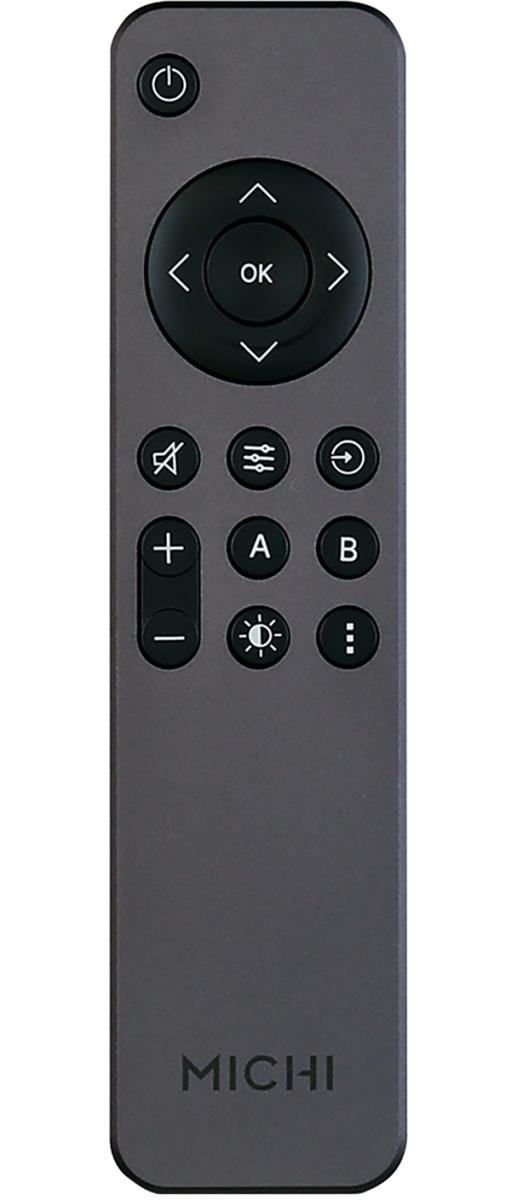
Above: Rotel's Michi remote gives access to the setup menu as well as source, volume, mute, tone/balance control and display brightness
Clearly, the X430's DAC stage was working its magic here, and playing a couple of the previous CD tracks from Spotify Lossless through the amplifier's Bluetooth connection tended to back this up. In this format they were almost indistinguishable from the silver disc versions, save for a slight softening of bass impact – not that there wasn't still plenty left, of course.
An audition of the amp's built-in MM phono stage, using my Michell Gyro SE/SME 309 and an Ortofon 2M Black [HFN Mar '11], found the X430 staying in character. Bass, once again, was deep and brilliantly defined. The Michell deck and Michi amp worked together to create soundstages on a grand scale, the addition of the vinyl source bringing a nice touch of depth. On 'C-Side' from Khruangbin's Texas Sun EP [Dead Oceans DOC214], Laura Lee's bass was lined up neatly behind Leon Bridges' centre-stage vocals. The X430 offers power and poise.
Hi-Fi News Verdict
Marking the debut of Michi's new Prestige strand, the X430 integrated turns in an impressive performance. Format compatibility and connectivity are generous, while its prodigious speaker-driving power opens the door to a myriad different systems. All this, plus a sound that's detailed, dynamic and enjoyable and, above all, consistent across its inputs. In short, it's a bit of a star!
Sound Quality: 89%
 | |||||||||||

|
|
| |||||||||









 SPONSORED VIDEO







| Equipment Reviews | |
Music Reviews Awards | |
Latest News Features | |
Resources Newsletters | |
Subscriptions |
WHERE TECHNOLOGY BECOMES ENTERTAINMENT
 © 2026 Hi-Fi News
AVTech Media Ltd
All rights reserved