Flawed by design
No matter how meticulously engineered, any product is likely to suffer a failure at some point. Which is why Barry Willis believes designers should pay more attention to ease-of-repair
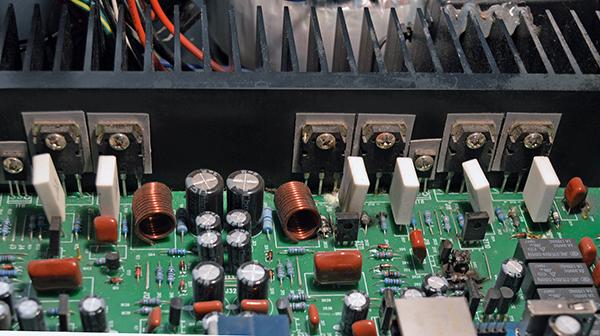
Pet peeve time again! Pictured above is a view inside a high-end integrated amplifier (cropped to make brand identification nearly impossible). Look closely at the shot of the circuitry. You may notice a tiny pile of white powder on the circuit board near the centre-most output transistor.
This device and a couple of its mates are shorted out, part of a cascade failure that destroyed a bridge rectifier, a large-value filter capacitor, and a relay delivering DC to the amp’s active circuitry, including Wi-Fi and Bluetooth receivers, not shown. The amplifier’s 5A mains fuse provided scant protection – until it was too late.
Disassembly required
In this model, the main audio output heatsink is mounted transversely in the chassis, not directly to the back panel. The chassis is made of a single sheet of steel, wisely perforated for convection cooling, but unwisely made without an access panel to the underside of the PC board. This means that what might be a straightforward repair becomes a curse-filled days-long nightmare.
Instead of simply identifying, removing, and replacing damaged components, a technician must completely disassemble this amp, including removing the front and rear panels, at the risk of causing further damage. They then have to test it with all its parts dangling in free air. Further damage might happen upon reassembly. It’s an insane design, one that should cause its designer and production supervisor banishment from the audio industry. That will never happen, of course – this sort of loony-tunes assembly is dismayingly commonplace.
Okay, here I’m talking mainly about the high-end arena. Most mainstream products make some sort of concession to the reality that, sooner or later, they may require servicing. These brands provide for this with access panels or other means of getting inside. This is not the case with all high-end brands, however, whose makers sometimes suffer from a delusion of the most intolerable kind – the belief that their designs are perfect and will never fail. Of course they will. It’s simply a matter of when, not if.
Learning on the job
My amp was plagued by other problems. Used as a standalone DAC/preamp, not as an amplifier, it had no load on the output devices, and hence, generated little heat. But the power amp was still being driven and so an accidental short caused an over-current that cooked the hapless output transistors. Moreover, there’s no service information available for hapless techs who attempt to make any repairs.
As a working-class hero, I have done more than my share of construction work, including renovating a number of houses, and have done countless custom home entertainment installations. I reached the conclusion long ago that architects would be better suited for the real world if their training required a couple of years of actual hands-on construction work, rather than simply doing computer-aided design in a cushy office.
Without such essential experience they will continue to produce plans for structures that are difficult to build, impractical to use, and rife with unanticipated problems.
Similarly, aspiring electronics engineers and equipment designers should be required to put in a couple of years on the service bench so they can learn from the mistakes of their predecessors. Or, perhaps, take a course in production engineering. Without this training, they will continue to have no idea what’s wrong with what they’ve engineered, or what mishaps await downstream.
The belief that esoteric products will remain flawless forever is both cynical and delusional. Most problems – electronic, mechanical, social, political – have their roots in bad design. We’d do well simply to say no to this nonsense.































 SPONSORED VIDEO






| Equipment Reviews |  |
Music Reviews Awards | |
Latest News Features | |
Resources Newsletters | |
Subscriptions |
WHERE TECHNOLOGY BECOMES ENTERTAINMENT
 © 2026 Hi-Fi News
AVTech Media Ltd
All rights reserved