Reborn turntables
Steve Harris on why modern versions of classic amplifiers sensibly make use of new technologies, leaving reborn turntables as the best place to get your genuinely authentic vintage fix
From every hi-fi brand with any history, we now expect to see anniversary editions, revivals and re-imaginings of supposedly classic vintage models.
But it’s almost impossible to fashion a product in exactly the way it was built 50, 60 or more years ago. Look inside a 1950s valve preamp with its hand-soldered wiring and you’ll think, ‘How on earth did they make these things?’.
Model makeover
A new ‘reinvented’ tube amplifier is likely to have parts mounted neatly on circuit boards, along with extra modern electronics for reliability and ease of use. LEDs in the bases of the tubes can be used for fault indication, or just to make them glow more impressively.
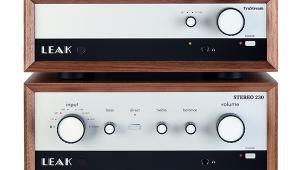
In 2020, when International Audio Group (IAG) announced its revival of the dormant Leak brand (acquired along with Wharfedale in the 1990s), it appeared that we might get some new Leak tube amplifiers. But sensibly, perhaps, the first new Leak amp echoed the solid-state Stereo 30 of the 1960s, rather than the valve classics of the 1950s.
It’s been a different story with the Quad II power amplifier, which first appeared in 1953 [Vintage Review, HFN Mar ’14]. In 1996, under the brand’s previous management, there was a gold-plated limited edition, nominally celebrating Quad’s 60 years in the audio business. Then, in 2000, with IAG in control, came the Quad II-forty [HFN Nov ’00], rated at more than twice the power of the 15W original. There was a new tube preamp to match.
In 2005, the Quad II Classic launched as a ‘faithful reproduction of the original valve monoblock with the build quality and aesthetics lovingly updated for the modern era’. Hard-wired, not a circuit board in sight. After this came a series of tube amps designed by Tim de Paravicini.
Eventually, in 2024, Quad revived its solid-state 33/303 pre/power amplifiers [HFN Jan ’25] with performance and facilities intelligently updated. Above all, at around £2400 for the pair, these products came at an affordable price.
Ice with that?
That’s more than you can say for some recent special edition turntables. Back in 2013, Linn’s 40th anniversary LP12, with a plinth made from whisky barrels, could be yours for a mere £25,000. But for the 50th anniversary Sondek LP12-50, with industrial design by former Apple VP Jony Ive and an ultra-dense Bedrok plinth, you’d pay £50,000.
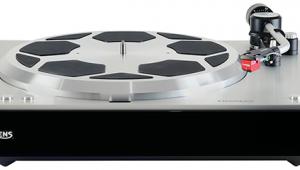
From the 1980s on, enthusiasts who rebelled against the dominance of belt-drive turntables started turning to the Swiss-made, idler-driven Thorens TD 124, in production from 1957 to 1965. But in the current Thorens TD 124 DD [HFN Jul ’21] a direct-drive motor replaces the original idler-plus-belt system. A logical choice, but from a heritage point of view, it’s a bit like putting a quartz movement into an antique clock.
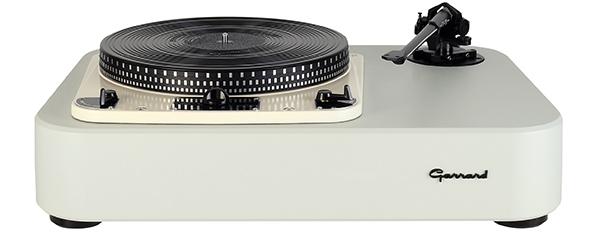
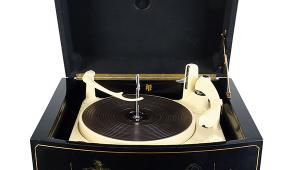
Which brings us to the Garrard 301, the UK’s classic idler-drive ‘transcription motor’, originally produced from 1954 to 1964. When Cadence Audio acquired the Garrard brand in 2018, it already owned SME, so SME’s engineering facilities were available to create a 301 that was both authentic and ‘better than new’.
Existing chassis castings were refurbished and finished to an amazing standard, while other parts were newly made. The 301 Classic, in traditional walnut, was followed by the 301 Advanced [HFN Aug ’24] with its new polymer resin plinth.
Such meticulously hand-crafted pieces, absolutely recreating the prized original, can only be built in small numbers. As with high-end continuation cars, the perfection of the product does ultimately justify the price. Aston Martin has had no difficulty selling its continuation DB4s for more than £1m each.
You can say, as Jaguar Classics does of its cars, that the best hi-fi continuation models are ‘just as desirable as one of the originals’, if not more so. But also, they can be way more expensive.




























 SPONSORED VIDEO






| Equipment Reviews |  |
Music Reviews Awards | |
Latest News Features | |
Resources Newsletters | |
Subscriptions |
WHERE TECHNOLOGY BECOMES ENTERTAINMENT
 © 2026 Hi-Fi News
AVTech Media Ltd
All rights reserved