Best laid plans
The age of copper broadband is coming to an end, replaced by fast fibre and a new breed of ISPs. Barry Fox discusses the bewildering choice – and wonders who really needs Gigabit speeds
If you use copper broadband for music and movie streaming, be aware. You are soon going to have to switch to fibre. Like it or not. So it will help to know a bit of background.
The DSL (Digital Subscriber Line) system that fools analogue copper telephone lines into carrying digital broadband, by splitting the signal into many narrow carrier bands, is brilliantly clever. But it’s had its day. When copper connections fail, the underground multi-core ‘main’ cables are not replaced. Dud pairs of wires are replaced by better pairs in the same bundle.
The Openreach era
The future is all fibre. But fitting it is tricky and fitter crews are still struggling with duff componentry, and hampered by inadequate training. Customers are faced with a bewildering choice of subscription options from rival service providers. Sales staff are often misleading customers, either through ignorance or deliberately.
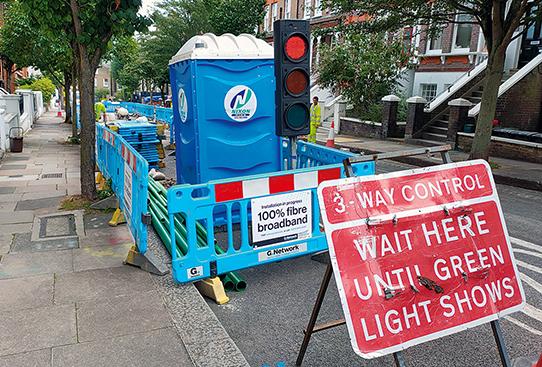
Enforced competition is a good thing, but it has created a jungle of confused options. For example, in 2006 BT was forced to create Openreach, an arm’s length company that controls BT’s exchanges, ducts, poles and street ‘furniture’. Some competitors (including Sky and EE) rent bandwidth on BT’s infrastructure and sell it as their own. Yet newer rules and regulations such as Physical Infrastructure Access let BT’s competitors (like Hyperoptic) pull their own fibres through BT’s ducts and direct-market their own services. Some other competitors (like G-Network) also direct-sell after digging up the roads to lay their own cables. And others (like CityFibre) use BT’s ducts and poles to carry their own fibres and sell their services through other competitors (like Vodafone).
What matters is that this competition is driving down the price of fibre into the home to a starting base of around £20 a month for 150Mbps. Even this cheapest option is around ten times the download speed of simple copper and a hundred times the upload. It’s plenty good enough for streaming music and movies and Internet surfing – and fibre still works reliably when ducts get flooded. Telesales people will try and sell you much higher speeds, up to a Gigabit, for much higher prices. This is usually gross overkill, unless you run a hotel or have several dozen children all watching Netflix at the same time.
Cable capers
Your home Wi-Fi will reduce the speed, too. For a bit of fun, ask a sales pitcher to explain why you need Gigaspeeds. Then listen to them struggle.
The hi-fi world is used to using S/PDIF optical fibre cables. But they are short and relatively tough with rough and ready push-fit connectors. They carry a couple of Mbs for a few metres inside a warm, dry room. Broadband fibre is different. The cables carry up to a Gigabit and connecting ends must be perfectly aligned and heat-fused to avoid loss of light. The fibre ‘drops’ from street poles into homes run for many tens of metres through wind and rain, with heavy birds likely to sit on them. The cables must go round corners in lazy bends, not sharp turns. Once fibre is kinked it is useless, much like satellite coax copper.
Fitters complain that the pre-made optical ‘tail’ connectors they are given are often faulty. The fibre ends are misaligned and lose light. Some fitters are entrusted with ‘splicing’ tools which align and heat-fuse cables, plugs and sockets. But the tools cost £5000, precise alignment needs skill and fusing does not work well outside in cold weather.
On two separate occasions I’ve seen fitting crews from different companies have to discard all their available tails because they weren’t up to standard. One of the crews then used their own splicer. The other had to call for a specialist splicing crew to drive to the rescue. This plays havoc with fitting schedules – and eats into the profits of the service provider. It perhaps explains why these companies are trying to recoup costs by using automated chatbot helplines powered by Artificial Stupidity.






























 SPONSORED VIDEO






| Equipment Reviews |  |
Music Reviews Awards | |
Latest News Features | |
Resources Newsletters | |
Subscriptions |
WHERE TECHNOLOGY BECOMES ENTERTAINMENT
 © 2026 Hi-Fi News
AVTech Media Ltd
All rights reserved