Eversolo T8/DAC-Z10 streamer/DAC
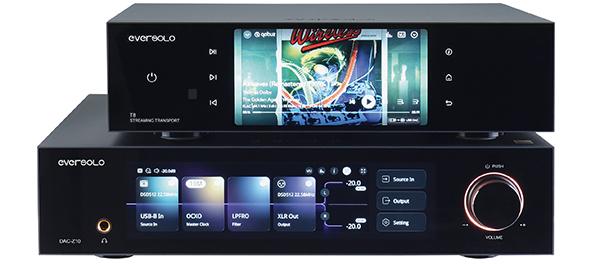

In only a few years Eversolo has captured the audio enthusiast’s attention, notably those hunting for well priced do-it-all boxes brimming with functionality. Frankly, it’s hard to imagine more features being shoe-horned into streaming DACs like its DMP-A8 [HFN May ’24] or DMP-A10 [HFN May ’25], all of which, and more, are separated into the two-box £1290 T8 streamer/music library and ‘purist’ £1940 DAC-Z10 reviewed here.
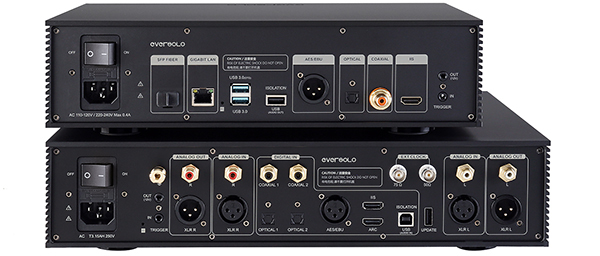
Both halves of this dynamic duo can be used separately, of course. The T8 will drive a third-party DAC, integrated amp or active speakers with a digital input. The DAC-Z10 can handle digital sources in a system, including a TV via HDMI eARC. Unusually, there’s also an analogue input and high-quality R-2R ladder volume control, making the ’Z10 a more versatile ‘switchboard’ than many outboard converters.
Metal ’n’ meters
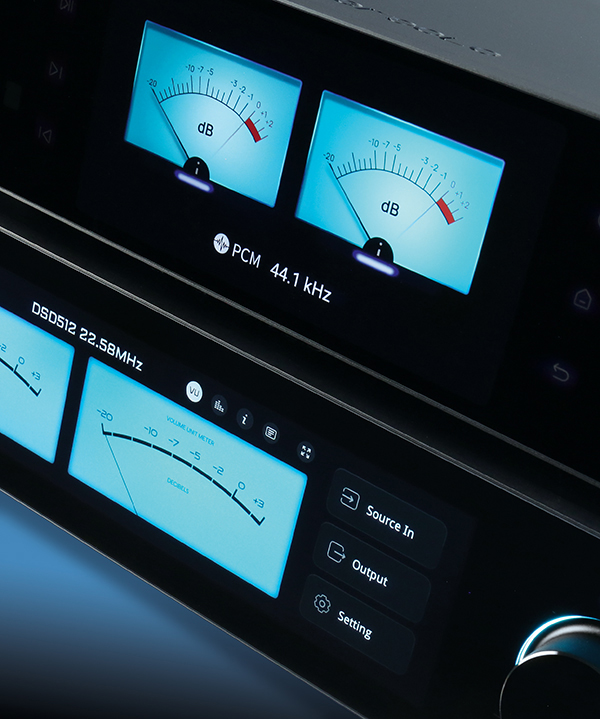
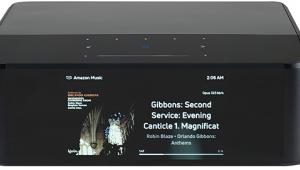
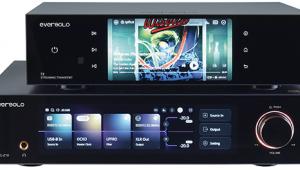
The black alloy chassis of the DAC-Z10, with its largely aesthetic heatsinks on the sides, looks very similar to that of the DMP-A8. It’s a sleek but also tame affair with a sheet of dark glass on the front. This hides an 8.8in/225mm full-colour touchscreen, situated next to a 6.35mm headphone socket and a large volume knob with an LED halo. In typical Eversolo fashion, you can select the brightness and colour of the ring, along with a host of customisations for the main display.
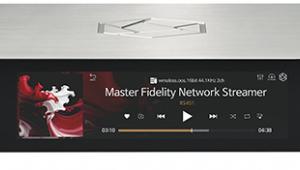
There are multiple VU meters and spectrum analysers from which to choose, but I quite like the flow-chart option with four boxes displaying the input, digital source quality, clock and selected filter. The T8 streamer/library has a similar but more compact chassis, allowing for a smaller 6in/150mm screen that’s still perfectly sized to display cover art and the familiar Eversolo OS interface.
This is a highly adapted open-source version of Android, minus the Google services but with a lot of Eversolo’s own code. That includes EOS, the audio engine that side-steps Android to ensure hi-res audio is handled in bit-perfect fashion by the T8 while also enabling digital room correction and extensive EQ options. On the other hand, the upside of the T8’s Android platform is its support for the many popular streaming apps. Next to the usual suspects, like Qobuz and Tidal, the T8 can run Apple Music and Apple Classical (including hi-res), and Spotify on the streamer itself.
The many apps and streaming options – presented separately in the Eversolo app and onscreen – next to external streaming options including Roon or AirPlay, could make the user experience overwhelming. Fortunately, the new interface introduced with Eversolo’s Play amplifier [HFN Jan ’26] has simplified dealing with these many settings and options.
To the power of three
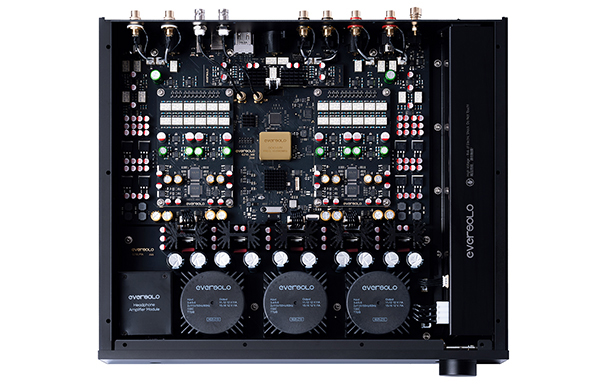
Despite appearances, neither the T8 nor DAC-Z10 are solely ‘feature first’ products but include a deal of audio-focused engineering. Eversolo’s FIA (Fully Isolated Architecture) aims to keep analogue and digital stages separate and free from interference. This extends to the use of three discrete linear power supplies in the ’Z10 [see pic, below], one dedicated for each channel and a third for digital ‘housekeeping’. Two sets of Asahi Kasei’s flagship AK4191EQ upsampling/noise-shaper and AK4499EXEQ DACs are leveraged here, one pair per channel.
Neither is the T8 short on technology. It can be used wirelessly or via wired and optical Ethernet [see boxout] while under the chassis there’s a host bay for external SSDs, offering up to 16TB storage for an extensive music file collection. There are also multiple digital outputs, the fully isolated USB and I2S ports likely being the audiophile’s choice [see PM's Lab Report]. The latter even supports eight variations in I2S configuration to suit the different implementations of I2S-capable hardware from other brands.
While the network-connected T8 is easily controlled via the excellent Eversolo Control app, so too can the ‘off-line’ ’Z10 be accessed from your smartphone or tablet. The key here is to engage the DAC’s Bluetooth mode before pairing it with your mobile device, after which the ’Z10 will appear within the app. From that point on, remote control is possible, even if Bluetooth is not selected as an input, enabling adjustment of volume and input/outputs. The AKM DAC’s digital filters are accessible here too, in addition to Eversolo’s many display modes.
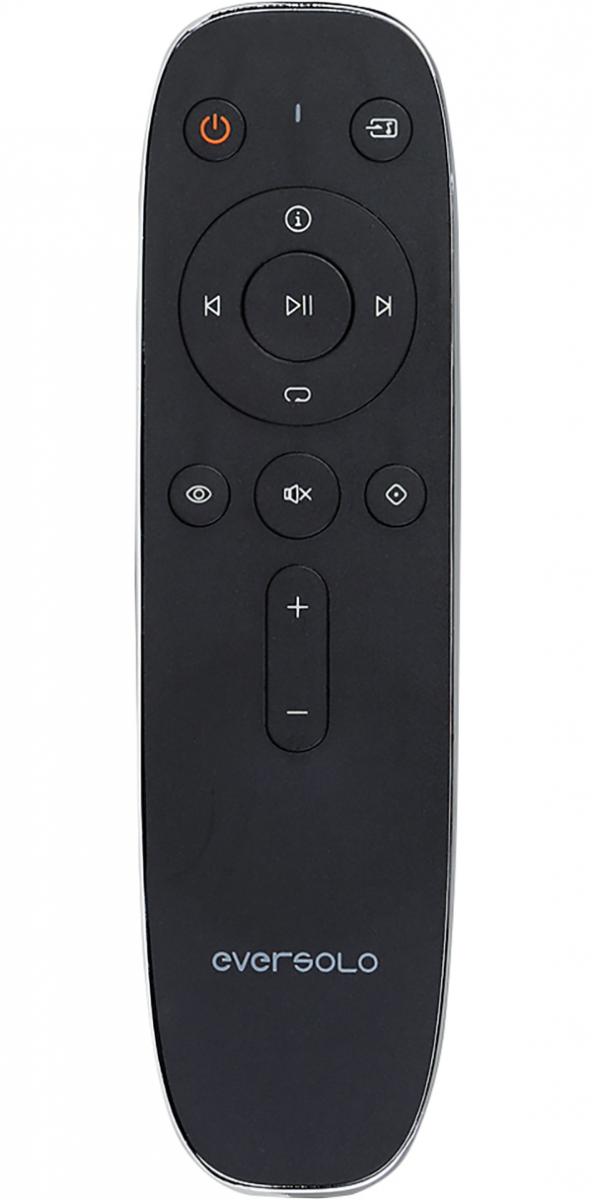
If you want to stay ‘old school’ then physical remote handsets are bundled with both the T8 and DAC-Z10 – useful for the former’s digital and the latter’s analogue volume controls. Naturally, the Eversolo Control app provides the fullest experience and is still easy to use despite being jam-packed with functions. The ability to mirror the display of the T8 on your ’phone/tablet is especially smart, giving the most complete remote control possible.
 Match making
Even though Eversolo’s T8 and DAC-Z10 are not strictly designed as a pair, there’s no reason why you would not use them together. Doing exactly that, with an I2S/HDMI connection between the two boxes, I ran balanced XLR cables from the DAC-Z10 to a Hegel Röst amplifier [HFN Jul ’17], driving a pair of Radiant Acoustics Clarity 6.2 standmount speakers.
Fed by the T8 streamer/music library, the DAC-Z10’s sonic signature was revealed to be one of fine detail and transparency. This Eversolo duo didn’t add its own flavour to the Hegel/Radiant Acoustics system but did give it plenty to dig into. The airy performance of ‘The Saddest Noise’, from Christopher Tin’s The Lost Birds: An Extinction Elegy [Universal Music Classics digital download; 96kHz/24-bit], was a case in point. Delivered by the ’Z10, the choral singing by UK a cappella group VOCES8 appeared large and powerful, but also superbly resolved. The DAC-Z10 dealt supremely well with the numerous singing parts, making it easy to pick out the low tremolo of a baritone, for example.
Pieces of eight
Listening to this album, recorded at Abbey Road with the Royal Philharmonic, it was hard to believe there are only eight people in the choir. Even through relatively small speakers, my room appeared packed with dense layers of vocals and orchestral music, resulting in an enthralling – and poignant, considering Tin wrote his compositions to commemorate lost wildlife – performance.
If your entry point into the experimental rock soundscapes of Canadian band Godspeed You! Black Emperor was their dark, sample-laden 1997 debut album F# A# Infinity, you’ll find 2017’s Luciferian Towers [Constellation Records CST126] more melodic and guitar-focused, if still far from accessible. Skipping to the three-part ‘Bosses Hang’, the T8/’Z10 delivered these tracks with a great deal of resolution, a well-defined guitar wall being just a part of their intense composition. There was crisp detail and soundstage depth here, on a level you’d expect from a more expensive outboard DAC.
Glorious giddens
No doubt related to its creation in the full Covid isolation of 2020, Rhiannon Giddens’ and Francesco Turrisi’s They’re Calling Me Home [Nonesuch 075597915709; 96kHz/24-bit] is an album of simple arrangements, sparse but beautiful. Giddens has a remarkable voice, but during ‘I Shall Not Be Moved’ my attention was focused on the refined rendering of the chitarra battente played by Turrisi. The contrast in the recording between this Italian baroque guitar and a banjo was conveyed with sensitivity, the T8/’Z10 keeping the twang of the latter distinct from the softer notes of the former.
Eversolo’s DAC is not, however, analytical to a fault. Together with the streamer/library, it serves music with both clarity and a sense of balance, never giving undue emphasis to detail over tone and nuance. It’s then up to the amplification and speakers to add whatever musical ‘colour’ you might prefer – which is how it should be.
Got the blues
Atmospheric, well-recorded music like the Giddens/Turrisi album, or Tony Joe White’s ‘You’re Gonna Look Good In Blues’ [Closer To The Truth, Swamp Records; CD res.], really showed off the Eversolo pairing at its best. The silken tone to White’s lead guitar playing, the resonance of his baritone vocals, and the way the background keyboard seemed to pour from the speakers into every corner of the room was superb.
‘Highwaymen’, from singer-songwriter Jake Smith [A Freight Train Through The Night; self-released, 44.1kHz/24-bit], is more simplistic, being only steel string acoustic guitar, gravelly voice, and the claps and cheers of an enthusiastic live audience. It’s testament to the clean, coherent presentation of the T8/DAC-Z10, and the duo’s ability to build a believable soundstage, that this intimate track was still hugely involving.
Hi-Fi News Verdict
This Eversolo pairing is impressive, but the T8 and DAC-Z10 also make their mark as standalone greats. As a digital transport, the T8 marries a keen technical design with an extensive set of features, including an SSD bay, and a user-friendly if dense interface. The DAC-Z10 has its focus squarely on sound quality, offering top-notch conversion and wide-ranging connectivity without breaking the bank.Sound Quality: 88%
 | |||||||||||

|
|
| |||||||||









 SPONSORED VIDEO






| Equipment Reviews | |
Music Reviews Awards | |
Latest News Features | |
Resources Newsletters | |
Subscriptions |
WHERE TECHNOLOGY BECOMES ENTERTAINMENT
 © 2026 Hi-Fi News
AVTech Media Ltd
All rights reserved