Devialet Astra ‘Opéra de Paris’ streaming amplifier

French audio marque Devialet has been on quite a journey. Its first product, in 2010, was the D-Premier [HFN Apr ’10], an innovative integrated amplifier showcasing the ADH (Analogue/Digital Hybrid) topology of designer/company founder Pierre-Emmanuel Calmel and colleague Mathias Moronvalle [see boxout]. Eye-catchingly designed, thrillingly innovative and a sonic marvel, Devialet’s amplifier was a shot in the arm for the hi-fi industry.
The company followed it with a slew of successor models over the next eight years, evolved from the original. Yet, buoyed by plenty of outside investment, Devialet also expanded into other areas, most notably its Phantom active loudspeakers [HFN Feb ’15], but also home theatre soundbars and in-ear headphones. As the 2010s rolled into the 2020s, some wondered if it had moved on from making amplifiers altogether. Now, though, comes the Astra.
Off the scales
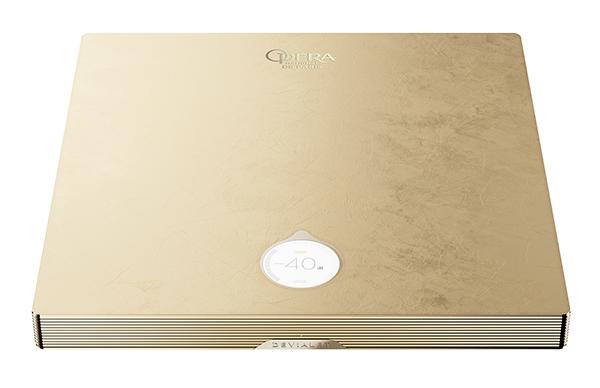
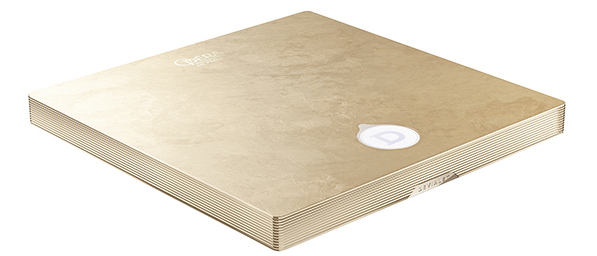
Like the D170 [HFN Sep ’13] and later Expert models, this is a clear continuation of the D-Premier design, meaning the old ‘bathroom scales’ jokes can be dusted off once more. It truly does look unlike any other integrated amp on the market, measuring 386mm wide and deep but only 47mm high, and with no immediately obvious physical controls (there are small power and Bluetooth pairing buttons on its right-hand side). Two finish options are offered, a standard Light Bronze for £14,000, and the gilded, gold-leaf Opéra de Paris version seen here, at £18,000. Both prices compare favourably to the D-Premier’s 2010 tag of £12,000.
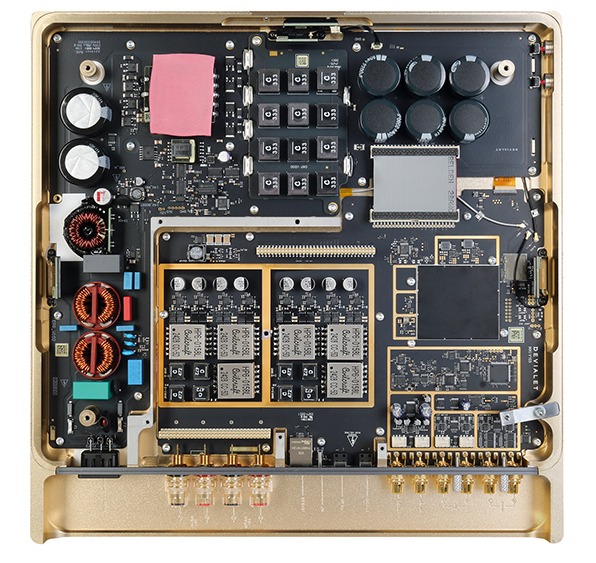
Devialet says the Astra’s design ‘draws heavily from the timeless aesthetics of the Art Deco and Streamline movements’, and in either finish it should catch the eye of visitors to your listening room. But this isn’t only a question of style: the amplifier’s manageable size and 7.8kg weight, made possible by cutting-edge switching power supply and Class D technologies, mean it can go where many others claiming 2x150W/8ohm [see PM's Lab Report] cannot. The only flaw in the slim design is that space is tight around the Astra’s recessed rear-panel inputs – gone is the D-Premier’s detachable rear panel that allowed easier access.
App and running
Otherwise, this amplifier copies the original’s playbook by offering configurable RCA connections. Functions are line-in, MM/MC phono in and coaxial digital in, plus subwoofer pre-out and a digital out for tethering the Astra to another model (the company sells Dual packages, each amp operating as a monoblock, and says up to eight of the units can be combined). There’s also a USB-C input – used for our listening with Aurender’s W20SE server [HFN Mar ’23] – plus two optical ports. Yet there’s no sign of the HDMI and AES/EBU connections of the D-Premier, or the SD Card slot used to handle the amp’s configuration. The latter, instead, is done via the network [see boxout].
The Astra can get ‘online’ via Ethernet or Wi-Fi, and – because it’s 2025, not 2010 – is a genuine streaming amp with a companion app (the D-Premier only received its streaming ability by way of an optional Wi-Fi module, and required custom PC/Mac software). Spotify, Tidal Connect, Google Cast, AirPlay, UPnP and Roon are all on the menu, which is a decent haul, though it’s a surprise Qobuz, also from France, isn’t currently offered.
Spin doctor
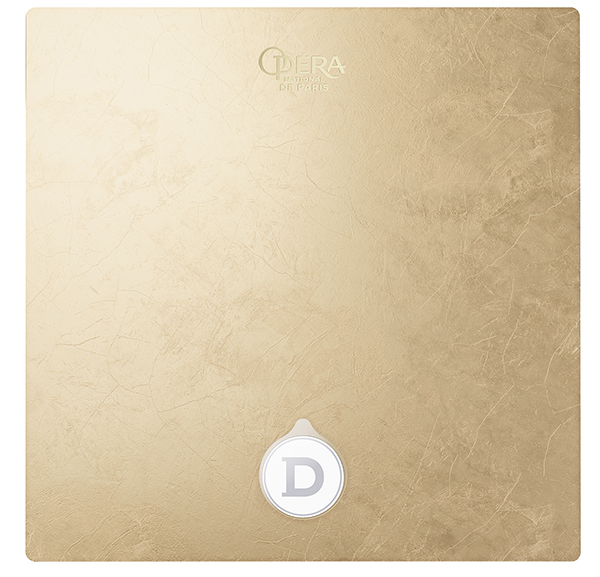
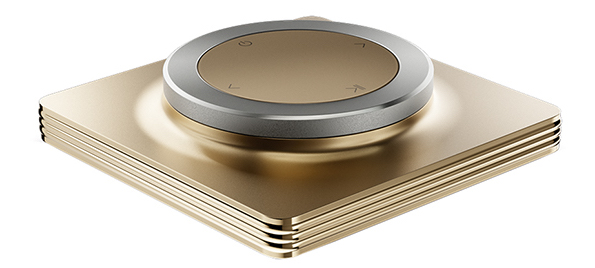
Bundled with the Astra is a table-top remote styled like a miniature version of the amp, albeit with a large rotary with an illuminated display in its centre. Turn the dial clockwise or anticlockwise for ±1dB changes in volume, and press the icons around its edge for power, track skip, play/pause and source selection.
This remote is fun, but its functions are also found on Devialet’s app, plus others including tone control and a ‘Bass Reducer mode’. This, says the manufacturer, is for ‘reducing bass intensity for a smooth experience’ – I tried it, and didn’t like it. And when using the app to view the amp’s range of inputs, there’s also an Adaptive Volume Level option (again, not something I would recommend for critical music listening!).
PM discusses Devialet’s ADH technology in detail [see boxout]. Other under-the-hood developments, since the previous generation, are the Astra’s introduction of a new iMX8 processor and latest DOS3 operating system. In addition, an 800MHz SHARC DSP handles Devialet’s familiar Speaker Active Matching (SAM) technology, which seeks to maximise the bass performance of named loudspeakers, and Record Active Matching (RAM) which optimises loading and eq for a myriad MM/MC cartridge models.
Not changed since the D-Premier are the two Burr-Brown PCM1792 DACs at the heart of the Astra, so while its USB-C input accepts files up to 384kHz/24-bit, all audio processing – including of the analogue inputs, sampled at 96kHz – is conducted at a resampled 192kHz/32-bit.
 Drive time
Like its predecessors, this Devialet amp confounds expectations. Once set up in the HFN listening room, and with its SAM feature configured for Wilson Alexx loudspeakers (the Vfx model not yet present in the database), the slender Astra generated a largescale soundstage, with definition and drive to the lower registers. To quote PM when I highlighted the visual difference between it and the likes of Gryphon’s Diablo 333 [HFN Dec ’24], ‘it’s more than powerful enough’.
All the same, the Astra isn’t likely to convert dyed-in-the-wool tube lovers to the digital Class D cause, being a very measured, well-controlled performer, with soundscapes that are tonally neutral and skewed toward the pursuit of crystal-clear detail. It doesn’t sugar-coat your music, so will leave an icy glare on tracks recorded that way. The focused, slightly flat production of ‘Albatross’, from Corrosion Of Conformity’s album Deliverance [Columbia, CD res], shone through, as much as the track’s metallic-sounding guitar riffs.
This kind of ‘take it or leave it presentation’ can take a while to get used to, but certainly helps you listen in to the music. On the C.O.C track, the smart hi-hat work was as apparent as the textured edges to the Sabbath-style bassline. Similarly, Alice Cooper’s ‘School’s Out’ from the album of the same name [2023 remaster, Rhino/Warner; 96kHz/24-bit] sounded as rough-edged as expected, Cooper’s lyrics coming with spit and snarl, later backed by a gang of school kids and a barrage of instruments.
Grit ’n’ gloss
It’s with more opulent recordings that the Astra sounds its best in terms of warmth and flow. The Gospel groove of Ray Charles and Gladys Knight’s ‘Heaven Help Us All’ [Genius Loves Company, Concord/EMI; DSD64] was carried by a mellifluous bassline, beneath sumptuous brass and piano. The Astra also nailed the two vocal styles, with Knight a match for the lush instrumentation, and Charles sounding distinctly grittier.
The amplifier’s staging of this track was impressively wide, and another superb recording, ‘Rosanna’ by Toto [Toto IV; Columbia, DSD64], was given a similarly enveloping portrayal. It wasn’t just Joseph Williams’ vocal track that sounded improbably huge, but also the keyboard, piano and guitar solos that took turns to fill the room. Missing, though, was a degree of dynamic attack, as the Astra seemed unsure about letting the dramatic production really fly.
Present and correct
This was a trait I noted elsewhere, from Don Henley’s ‘The Boys Of Summer’ [Building The Perfect Beast, Geffen; 192kHz/24-bit] where the drum track didn’t blast through with the snap I’ve heard before, to the gunshot-style bursts in Aerosmith’s ‘Janie’s Got A Gun’ [Pump; Geffen, 192kHz/24-bit], which reverberated pleasantly, rather than threateningly, through the room. Compared to some other high-power integrated amps, the Astra’s overall presentation is arguably – perhaps intentionally – a little ‘safe’.

Still, this also makes it supremely easy to listen to – as does the grip and reach exerted on the low octaves. Woolly, formless bass is not a concern here. Kick drums on Lalo Schifrin’s ‘Burning Bridges’ [My Life In Music; Aleph Records], felt almost physically present, and the slow cello notes and thumps of double bass on Hans Zimmer’s ‘Wheat/The Battle’ suite [The World Of Hans Zimmer, Sony Classical; 48kHz/24-bit] were deep and foreboding.
I’ve been on a Zimmer whirlwind recently, as his pieces are both a) masterfully constructed and b) great for auditioning audio gear. On this live Gladiator medley, the Astra found the power to track the expansion from quiet opening to full-on finale, strands of violin notes twisting in and out of view next to choral and brass swells. Again, the sensation was of musical detail laid bare, but here also with a hint of coarseness in the upper frequencies.
This sort of artifice can limit the suspension of disbelief that a great musical system should bring, but perhaps I’m being overly harsh on what is a svelte, powerful, streaming amp designed with an eye on living room acceptance. And the Astra still gets plenty right, excelling with a wide rendition of The Allman Brothers Band’s epic ‘Mountain Jam’ [Eat A Peach, MoFi; DSD64], where it gave brilliant focus to every snare, tom and cymbal during the lengthy ‘dual-drummer’ battle, and ensuring the piano on Anna Fedorova’s Intrigues Of The Darkness [Channel Classics; 192kHz/24-bit], appropriately enough, emerged from a deliciously dark background. When this amp is good, it’s as good as gold.
Hi-Fi News Verdict
Devialet’s stylish Astra isn’t for the ‘pure Class A’ brigade, and diehard vinyl fans may well sniff at its digital audio processing. Not to worry, as for the modern music fan there’s much to enjoy, from the power delivery, slender form factor and streaming integration, to its neutral, revealing sound. Fifteen years on, does it feel quite as groundbreaking as the original? No... but it certainly still stands out from the crowd.
Sound Quality: 86%
 | |||||||||||

|
|
| |||||||||








 SPONSORED VIDEO






| Equipment Reviews | |
Music Reviews Awards | |
Latest News Features | |
Resources Newsletters | |
Subscriptions |
WHERE TECHNOLOGY BECOMES ENTERTAINMENT
 © 2026 Hi-Fi News
AVTech Media Ltd
All rights reserved