Aurender N50 streamer/music library
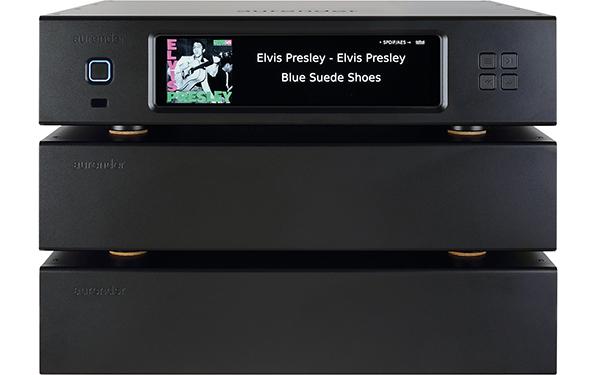

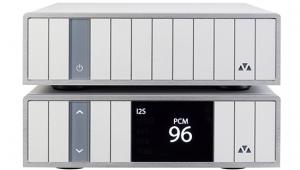
Three boxes, and not a DAC in sight… Aurender’s flagship music server, the N50, is a £38,900 combination of Server box with display – able to play from online services, local storage on USB or NAS devices, or optional onboard storage – and a separate ‘Audio’ unit that offers numerous digital outputs. The third box is a screened PSU, offering separately regulated supplies to power both the Server and Audio enclosures. Its most extravagant network bridge yet, Aurender’s N50 is clearly a further evolution of the earlier two-box N30SA [HFN Jul ’23], and described by the Korean company as ‘the most luxurious, elegant, and high-performance approach to streaming and file-based playback available’.
These three units, connected by multicore cables, are intrinsic to the operation of the N50 as a whole. You can’t pick and choose – it comes as a stack, or not at all. Custom umbilicals connect the power supply to the Server and Audio boxes, with a data cable linking those two. As standard, 60cm cables are provided, with 1.5m options available should you wish to have the units on separate shelves – or indeed the Server box, which houses the N50’s colour LCD display and controls, visible, and the other two hidden away.
At your service
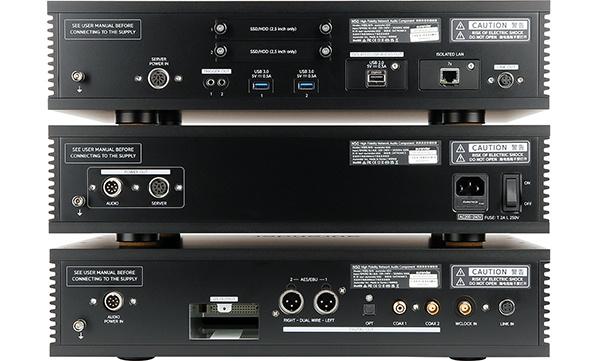
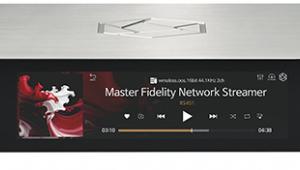
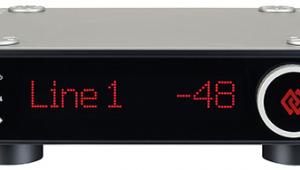
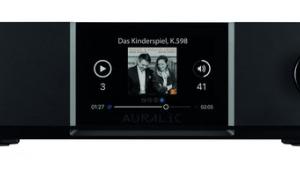
The Server unit, based around an Intel Quad Core CPU and 480GB NVMe storage for both system and digital audio caching, has basic controls, plus inputs. The fascia is dominated by that large (1920x480) display, just over 20cm wide, with a cluster of controls (mode, play/pause, next/previous) set to one side. To the rear is the power input, two USB-A 3.0 ports for offboard storage, an Ethernet port (with multiple transformer isolation) for the in-house streaming implementation, and the data feed to the Audio box. Most important, arguably, is the filtered and galvanically isolated USB 2.0 audio output to feed an asynchronous DAC.
In addition, two drive trays are provided, secured with thumb-screws. These will accept 2.5in drives, Aurender recommending Samsung QVO or EVO series, Western Digital, or Seagate internal SSD drives. The Audio enclosure, meanwhile, has matching power and data connections, plus two AES/EBU digital outs – which can run together in dual-wire mode into suitable DACs up to 384kHz/32-bit and DSD128 – and optical, coaxial and BNC outputs (192kHz/32-bit and DSD64). There’s also a word clock input, for use with Aurender’s MC10 or MC20, and an I2S output, with the option of fitting an MSB Pro ISL module instead.
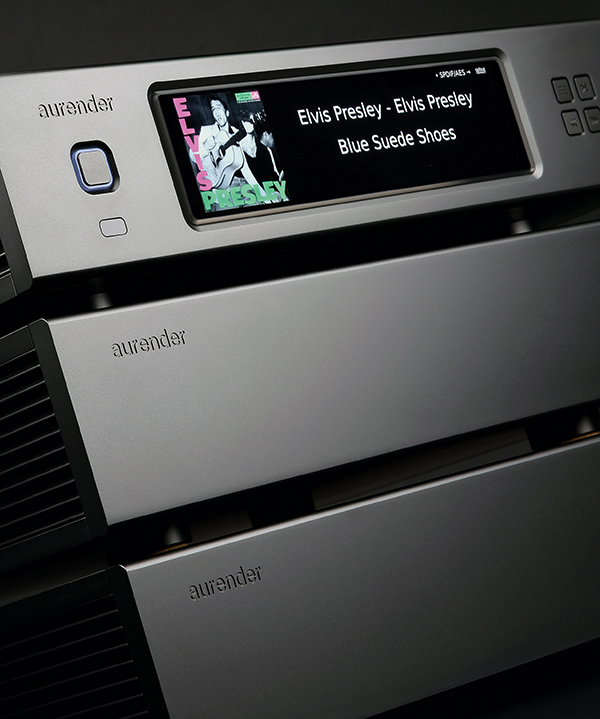
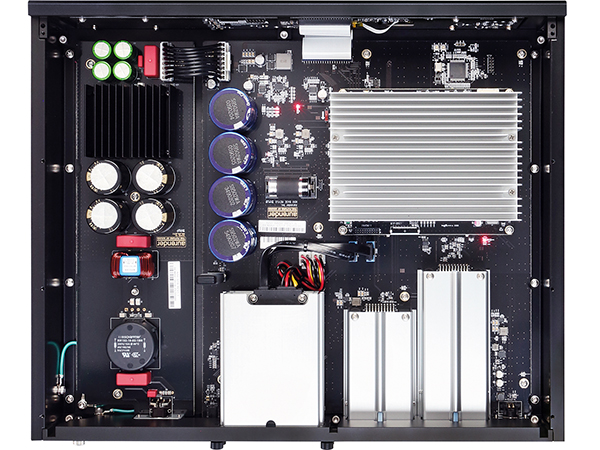
The partnering Power unit – all three boxes share the same black or silver alloy chassis design – houses what Aurender describes as ‘two laboratory-selected, high-inductance toroidal transformers, each vacuum-encapsulated and epoxy-filled within a polished stainless-steel enclosure, ensuring maximum isolation and durability’. The power supply also uses multi-layer AC and DC filtering to, as far as possible, suppress power-line noise.
The Server employs an OCXO clock with FPGA control for ultra-low jitter [see PM's Lab Report], and the three-box construction is intended to minimise interference and noise. The whole set-up is both solidly built and superbly finished, as is usual with Aurender’s products.
Super store
Playback from streaming services or local storage is simple and logical via the company’s excellent Conductor app [see boxout], while the convenience of using the N50 as a one-box – well, three-box – storage and playback solution shouldn’t be underestimated. A couple of 4TB 2.5in drives to fit inside won’t be cheap – budget about £1000 or so for the pair – but once installed it’s simple to copy over an entire music library for fast, convenient access. In addition, the N50 provides the ability to download purchased music directly from Qobuz or Highresaudio to that internal storage.
 Perfect pictures
Plumbed into the HFN reference system [HFN Yearbook ’25] – with the USB DAC section of the dCS Varèse stack between the N50 and amplification from CH Precision and Constellation, driving the big Wilson Audio Alexx Vfx floorstanders – Aurender’s flagship swiftly set out its stall with a sound both weighty and extraordinarily vivid. Playing the 2016 remastered version of ELP’s Pictures At An Exhibition [BMG/Manticore BMGCAT2CD3], I was taken aback by the stunning levels of detail on offer – in decades of enjoying this live set it was as good as I have ever heard, with a simply massive sound from Carl Palmer’s equally massive drumkit, and Greg Lake’s bass tautly underpinning Keith Emerson’s keyboard gymnastics.
Coming right up to date with the slick K-pop of supergroup BTS’s Arirang album [Bighit Music; 44.1kHz/24-bit], there was growling bass and stunning focus from the lead vocal on ‘NORMAL’, all layered over the swagger of the production and the tight, clean harmonies. The soundstage filled the space between the loudspeakers to dramatic effect. Yes, it’s all entirely commercial – supremely so, in fact – but it did sound rather magnificent.
Mind you, that ability was also heard to good effect with the Netherlands Radio Philharmonic Orchestra/Karina Canellakis recording of Rachmaninoff’s The Bells [Pentatone 5187523; 192kHz/24-bit]. Here was real drama and wonderfully vivid instrumental colour, aided by orchestral mass and explosive power without trading any insight into the solo voices. The momentum was palpable, the staging and definition superb.
Presence really is a major factor with the Aurender N50, the sound being delivered without a hint of blur or confusion. The Isidore String Quartet’s recording of Haydn’s String Op 20 No 2 [Adorations; Delos DE3622] was tight and fluid, with a wide-open dynamic and a tangible sense of space around the four performers. It’s a fine recording, and the N50/Varèse did it full justice, just as it did the Steven Wilson remix of the title track from Van Morrison’s Moondance [Warner Music download]. This was like hearing the song afresh.
Planet mercury
The sound was suitably mystical and atmospheric with ‘The Prophet’s Song’ from Bob Ludwig’s 40th anniversary remaster of Queen’s A Night At The Opera [Island Japan UIGY-9513; DSD64]. The opening guitar was close and focused, while Freddie Mercury’s voice drifted in from mid-distance to close-up, in front of the tight Taylor/Deacon rhythm section. It’s pompous nonsense of course, but effective, with Mercury’s voice multitracking and layering in the ‘Now I Know’ section, before the band slams in with its lumbering riffs.
It’s perhaps just as operatic as the better-known ‘Bohemian Rhapsody’, an old warhorse that came up fresh through Aurender’s N50. The fine detailing took me deep into the mix and all that studio wizardry – for all its familiarity the track can still chill at half a century’s distance, just as Brian May’s guitar never loses its ability to snarl and growl from the speakers. And, yes, the Wayne’s World headbanging moment was suitably heavy and gratifying.
Thunderstruck
Similarly, the big, bold piano that opens Supertramp’s ‘From Now On’, from Even In The Quietest Moments…, now in a brand-new remaster and 192kHz/24-bit release [A&M Records download], came across both vibrant and spacious, while the album-closing ‘Fool’s Overture’ rivalled the Queen tracks for epic scale and ambition. There’s another wistful piano intro here, building to a massive, thundering charge aided by the crisp, tight, rhythmic ability of the N50. All those sound effects and snippets of dialogue were woven through the music with excellent clarity, and the pulsing bassline sounded huge.
At which point PM and I vanished down a rabbit-hole, listening over and again to Tori Amos’s cover of The Boomtown Rats’ ‘I Don’t Like Mondays’ from the recent remaster of her Strange Little Girls album [Rhino/Atlantic; 96kHz/24-bit]. We compared Tidal and Qobuz streams of the new version and the 2001 original with the download played on the N50, and then via the dCS Varèse’s own streaming front-end. To my ears the N50 playing the download through the dCS DAC via USB just edged it over the Varèse’s own streaming provision.
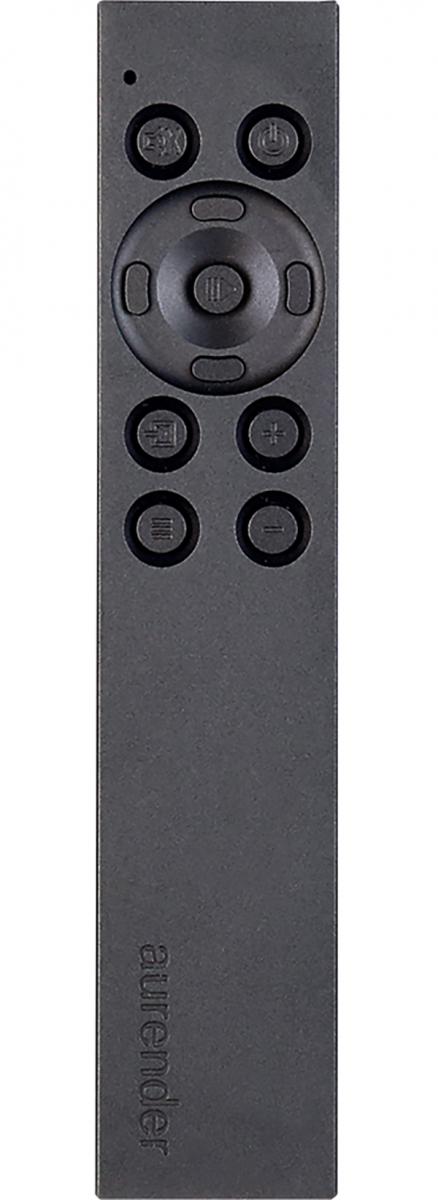
These experiments nailed the capabilities of the Aurender N50 as a top-class music source. If you want to hear streams, downloads and even your CD rips at their best, and really can’t stretch to a quarter of a million (!) for the dCS Varèse, the N50 feeding a decent DAC would do very nicely indeed.
Hi-Fi News Verdict
Three boxes just to drive digits into a DAC? Yes, and it works brilliantly. Combining Aurender’s super-slick operating system and app, the N50 has the capacity to compel a vivid, dynamic and thrilling sound from your choice of outboard converter. Just make sure to budget the extra for internal storage, and you won’t go wrong with what is an excellent keystone for a state-of-the-art digital music system.Sound Quality: 90%
 | |||||||||||

|
|
| |||||||||









 SPONSORED VIDEO






| Equipment Reviews | |
Music Reviews Awards | |
Latest News Features | |
Resources Newsletters | |
Subscriptions |
WHERE TECHNOLOGY BECOMES ENTERTAINMENT
 © 2026 Hi-Fi News
AVTech Media Ltd
All rights reserved