Arcam SA45 streaming amplifier

When Arcam launched its HDA line in 2019 claiming ‘a complete redesign of the look and internals’ of its hi-fi hardware, it was necessary to take the first part of that statement with a pinch of salt. Amplifiers like the SA30 [HFN Jul ’20] might have benefited from some extra chrome details, but the smart-if-conservative styling wasn’t that far removed from the company’s earlier FMJ and Solo series. It’s only now, thanks to a ‘brand redesign’, that Arcam’s range of amplifiers and sources appears properly overhauled.
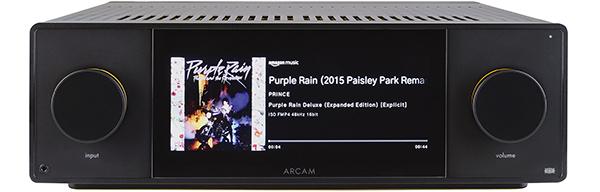
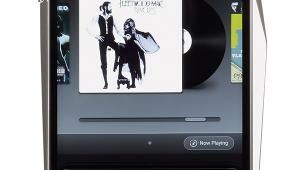
The SA45 streaming amplifier, on test here and costing £4500, is an example of the new approach. This flagship model in Arcam’s Radia lineup carries a large (8.8in/224mm), full-colour display to show album art, chosen input, Internet radio presets and more – a first for the brand that puts it on a par with rival units from NAD [HFN Jul ’24], Naim [HFN Nov ’24] and HiFi Rose [HFN Jul ’25]. Then there’s the new colour scheme, which mixes black (rather than grey) casework with eye-catching yellow flourishes, both on the amp itself but also on the bundled remote [p61] and Radia app [see boxout].
Gee whiz
What we have here, then, is an Arcam integrated amplifier with a lot more kerb appeal than that of previous generations. At the same time, beneath the fresh aesthetic of the SA45 are some familiar technologies, including the 5th generation of its Class G amplification rated at 2x180W/8ohm. This uses a conventional output stage fed from multi-rail supplies, which are introduced according to signal demand. The higher PSU rail is only switched in once the audio output rises above a certain level – a method first introduced by Arcam in its AVR600 [HFN Jul ’09]. Although the Class G concept is at least 40 years old, Arcam’s refined version sees its PSU smoothly track the audio level rather than switch abruptly between voltages [see PM's Lab Report].
Another stalwart of Arcam’s amplifiers is Dirac Live Room Correction, a third-party calibration platform. A puck-shaped microphone is included with the SA45, plus instructions on how to download a mic calibration file and the Dirac software to a PC/Mac. The calibration process is time consuming, with Dirac suggesting at least five mic measurements, and will baffle technology novices. However, from experience it can produce ‘night and day’ differences in systems with compromised loudspeaker positioning and/or poor room acoustics. It also offers deep-dive adjustment to satisfy tweakers.
Socket to ’em
The SA45 supports Dirac’s Bass Control tool for subwoofer integration, and offers dual outputs on both unbalanced RCA and balanced XLR connections. If that seems generous, then the rest of the connectivity follows suit. On the amp’s rear panel, underneath the chassis’ overhanging lip, are separate MM and MC phono inputs, 3x RCA and 1x balanced XLR analogue line ins, and preamp outs (again on RCA and XLR) for using the SA45 with external amplification. On the digital side you get pairs of optical and coaxial inputs, an Ethernet socket for network connection, USB-A for playback from storage devices, and HDMI eARC. Wi-Fi and two-way aptX Bluetooth (enabling BT headphones) are also to be found onboard.
Six stack
Alongside its fifth generation Class G amplification, the SA45 features Arcam’s newest digital audio and streaming platform. Qobuz Connect, Tidal Connect and Spotify Connect are supported, in addition to Apple AirPlay and Google Cast (with Roon certification apparently pending). Meanwhile, file handling reaches 384kHz/32-bit PCM and DSD512, via the ESS DAC that’s part of a new six-layer board and fully balanced analogue circuitry. There’s also a new linear power supply with toroidal transformer, leaving a switchmode PSU to handle standby operations.

Above: Massive toroidal transformer [top right] services the Class G PSU/amp [bottom]. Multi-layer PCBs [top left] host network module, HDMI eARC input, ES9027SPro DAC, MM/MC phono stage, line in and isolated preamp outputs
Any of the SA45’s inputs, analogue or digital, can be passed through its DSP/Dirac stages, but analogue signals do not go through an ADC by default. This was the case with the SA30, requiring the user to select a ‘Direct’ playback mode if they wanted to maintain an all-analogue path. Respect is due to Arcam here for making its user operation that little bit more intuitive.
That said, there’s still a learning curve to using the SA45, outside of running Dirac, as you need to become familiar with which functions are covered by the Radia app, and which require either the front-panel source/navigation control or the IR remote. The display, despite first appearances, is not a touchscreen. Settings include a choice of four digital filters, dimming/off/on options for the display and the illumination around the volume and source knobs, input ‘hiding’, balance, maximum volume and more. Note, though, that there are no loading options for the MM/MC inputs.
 Grip ’n’ grace
Proof that Arcam’s ‘brand redesign’ hasn’t led to a wholesale change in its sonic values is apparent in the SA45, which has a performance reminiscent of the company’s previous top-flight amps. Like the SA30, it sounds purposeful and powerful, displaying the ‘grunt’ expected of a flagship while bringing grip and depth to percussion and basslines. This solidity continues all through the audioband, for a listening experience possessing plenty of body and heft.
As befits the amp’s all-in-one ethos, it also steers clear of an over-analytical approach in favour of a crowd-pleasing performance that’s as suited to Taylor Swift as Tchaikovsky. Listening to the former’s ‘Blank Space’ [1989 (Taylor’s Version), Republic Records; 48kHz/24-bit], via Qobuz Connect, the SA45 struck a good balance between thick synths and glossy overlaid vocals, finding space for every element. Switching to Simon Rattle and the Berlin Philharmoniker’s rendition of the Nutcracker’s overture [EMI Classics; CD res], the amp sounded sweeter and lighter, focusing attention on small details, from tinkling percussion to pizzicato violins.
There’s greater depth to the music in ‘Act 1, No 1’, where the SA45 rose to the occasion. I wouldn’t want to imply you can hear when the Class G amplification switches in its additional power rail, but there’s often the impression that the amp has kicked into a higher gear when confronted by deep basses.
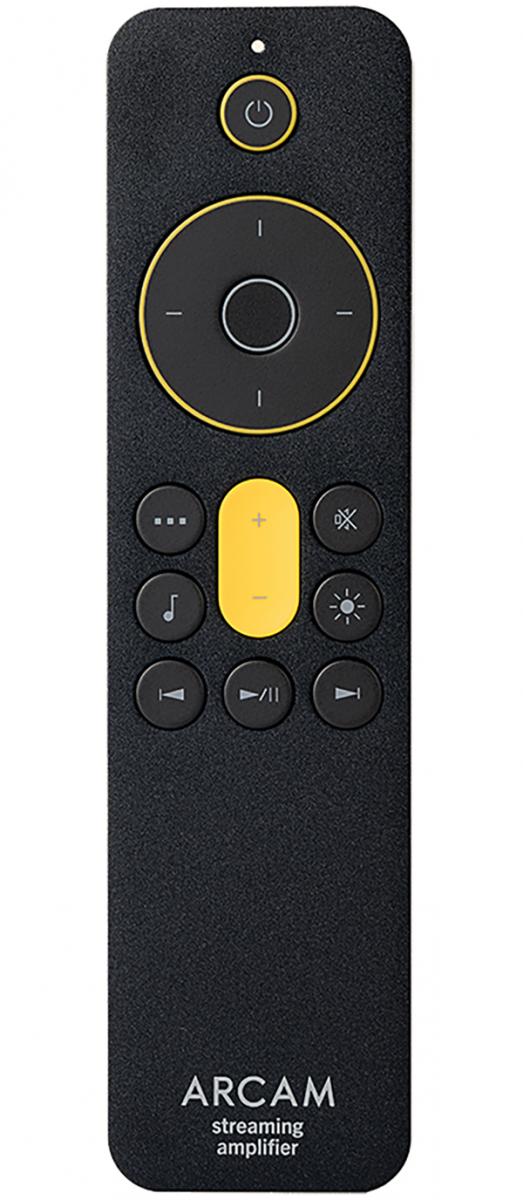
Above: Handset has matching yellow accents and allows full control/configuration of the SA45’s functions, but you’ll still need the Radia app to stream music across
A selection of demo faves – including Francine Thirteen’s ‘Queen Mary’ [self-released; CD res] – made this abundantly clear, the SA45 generating enough true, deep sounding bass from my B&W 705 S3 Signatures [HFN Aug ’24] that I had to remind myself I wasn’t using a subwoofer.
This bass prowess – weighty but tight and well defined – is a constant highlight. Nas’s ‘N.Y. State Of Mind’ [Illmatic; Columbia 44.1kHz/24-bit] has a hip-hop beat that sounded ready to burst through the SA45, each kick drum taut and impactful beneath the rapper’s rapid-fire lyrics. And although there’s little in the way of a stereo mix here, the amp’s handling of the piano samples, and that driving rhythm, elevated the track to almost hypnotic status.
Across the universe
The SA45’s digital stage performs admirably overall, sounding focused and detailed if not quite hitting the precise, airy highs of dedicated solutions. Black Sabbath’s riff-filled ‘Symptom Of The Universe’ from the album Sabotage [Rhino/Warner; 96kHz/24-bit] sounded a little more cohesive and revealing in the high frequencies played via a Matrix Audio Element X2 Pure streamer [HFN Dec ’23] into the SA45’s balanced XLR input. Using that source to stream Kari Bremnes’ ‘A Lover In Berlin’ [Norwegian Mood, Kirkelig Kulturverksted; CD res] found the amp combining a detailed, textured depiction of the upright bass with a feather-light delivery of her vocals.
Thanks to this ‘best of both worlds’ performance, I struggled to find any music that would trip up Arcam’s flagship. Eric Clapton’s ‘Goin’ Down Slow’ [Pilgrim, Reprise Records; CD res] sounded clean and crisp, with rattlesnake-like percussion flitting behind keyboards, guitar, and Slowhand’s understated vocals. This track may straddle blues and easy listening, but the SA45 made every second a pleasure.
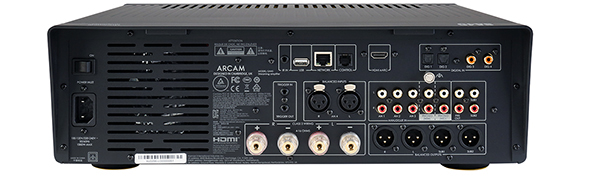
Above: MM/MC, four line inputs (one balanced on XLR) are joined by two preamp and filtered sub outputs (RCA and XLR), with digital on two optical, two coaxial, USB-A and HDMI eARC. Bluetooth 5.4 is supported alongside Wi-Fi and wired Ethernet (up to 384kHz/32-bit), and note the pairs of chunky 4mm speaker sockets
Equally, the rough-hewn, boogie vibe of The Doors’ ‘Peace Frog’ [Morrison Hotel, 50th Anniversary Deluxe Ed., Rhino; 192kHz/24-bit] was handled as confidently as the ambient swirls and dub-style basslines of Seefeel’s ‘Moodswing’, from their Pure, Impure EP [Too Pure; CD res.]. On this instrumental, the SA45 again showed off its excellent low-end grip and midband detail.
There isn’t overt softness or warmth to this amp’s sound – tonally it’s generally neutral – but it remains inviting to hear. And the comprehensive connections and app controller make the SA45 ready for many sources. During my listening I spent hours with Radio Paradise via the amp’s Internet Radio, aiming for background music. Soon, though, Emerson, Lake & Palmer’s ‘Lucky Man’, from their debut [Island Records], had me paying attention. There was sparkle to the acoustic guitars, the drums were widely staged, and that Moog synth solo sounded as eerie as ever.
Hi-Fi News Verdict
The SA45 is a fine standard bearer for Arcam’s overhauled hi-fi lineup and aesthetic rebrand. Without doubt its most stylish and well-connected amplifier yet, this powerful integrated feels thoroughly modern in both design and execution. Sonically, meanwhile, it’s something of a chameleon, ready to headbang one minute and soothe the next, all while adapting to your room through the Dirac software.
Sound Quality: 88%
 | |||||||||||

|
|
| |||||||||








 SPONSORED VIDEO






| Equipment Reviews | |
Music Reviews Awards | |
Latest News Features | |
Resources Newsletters | |
Subscriptions |
WHERE TECHNOLOGY BECOMES ENTERTAINMENT
 © 2026 Hi-Fi News
AVTech Media Ltd
All rights reserved