DALI Kupid loudspeaker
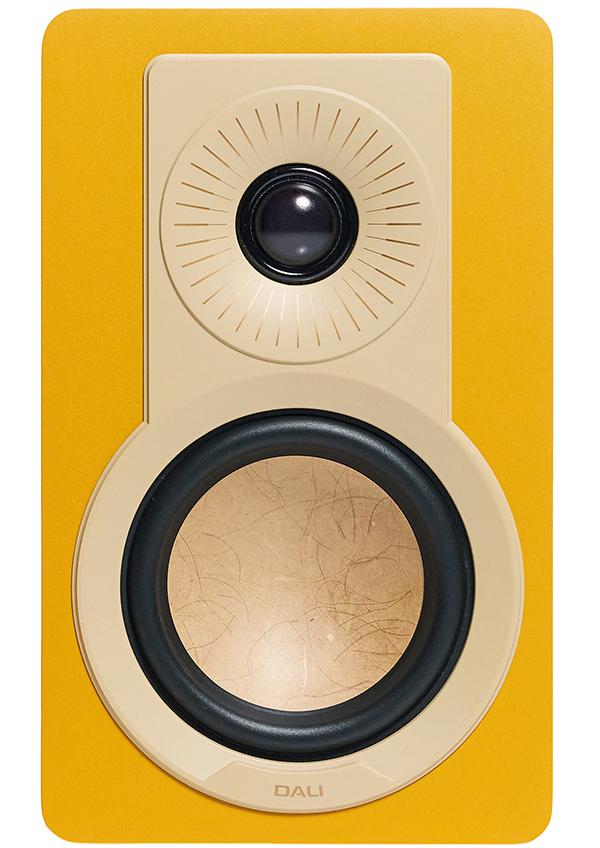

Over the past few years, DALI has established a firm presence in the premium loudspeaker market with impressive feats of engineering realised in its KORE flagship [HFN Dec ’23] and Epikore [HFN Feb ’25] ranges. However, the company that 40 years ago started as a budget brand for Scandinavia’s HiFi Klubben chain is making something of a return to its affordable roots with the Kupid. At £299 a pair, these pint-sized ‘bookshelf’ speakers are a universe away from the £85,000 KORE, but both are said to be built according to DALI’s ‘core’ design principles.
Bright young things
Even though the Kupid is a follow-up to the Spektor range, which consisted of three models, this two-way bookshelf is a one-off, with no apparent plans for a floorstanding scion or centre speaker. However, to make up for this sparsity of models, DALI is offering the speaker in five finishes, including some spiffy colourways. Chilly Blue and Golden Yellow [pictured here] are nearly as vibrant as their quirky names suggest, while Caramel White, Ash Black and Dark Walnut will tempt those with a more traditional view on interior design.
DALI has made huge investments in its Nørager factory over the past few years in order to increase its manufacturing output in Europe – this was previously only the case for ranges starting at Opticon level. However, building a loudspeaker locally and keeping the price at £150 a piece is not feasible, DALI reasonably states, so while the Kupid is designed in Denmark, it is manufactured in China.
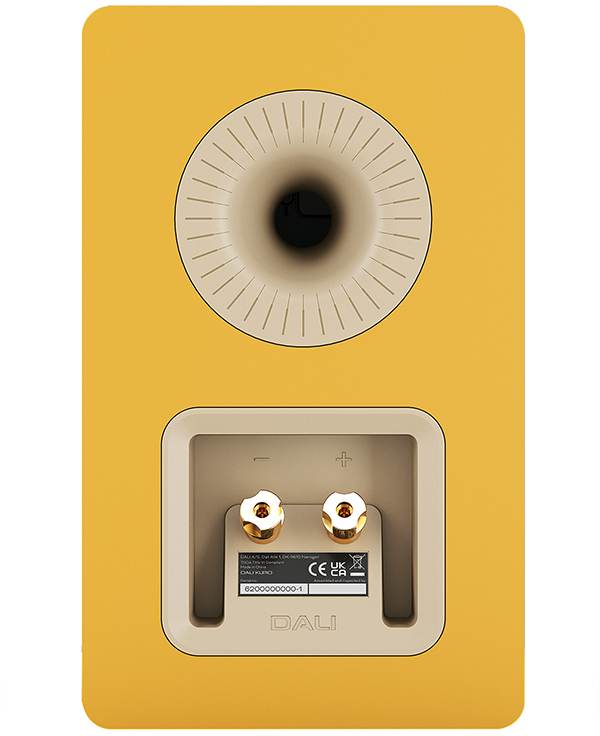
That doesn’t prevent the Kupid from appearing a well-built little speaker. It is small enough to fit on a bookshelf if desired – which is unusual, considering that many of the retro-styled ‘bookshelf’ models now in vogue have footprints larger than a floorstander [see boxout]. Moreover, the cute Kupid appears even more wee than it really is thanks to the rounded cabinet edges and vinyl finish which further soften its appearance. A quick glance at the rear also brings an unexpected surprise as DALI has eschewed cheap cable binding posts in favour of some rather hefty 4mm terminals [see pic, below].
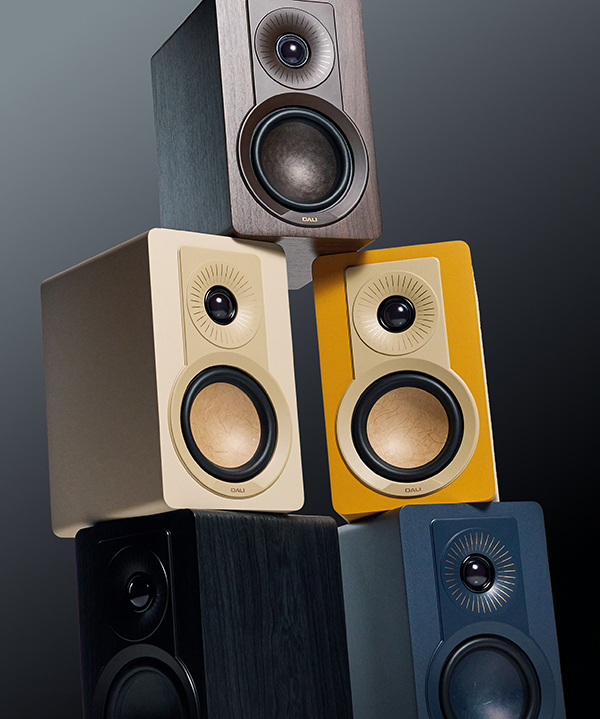
On four of the five colourways the moulded surround for the speaker’s dome tweeter and bass/midrange driver matches the colour of the cabinet, as does the dye for the woofer’s cone. The Golden Yellow version of the Kupid is the exception to this, sharing the same moulding and woofer cone colour as the Caramel White iteration. For review purposes, DALI sent us every single colour version, and the yellow one turned out to be even sunnier in real life than captured in these pictures.
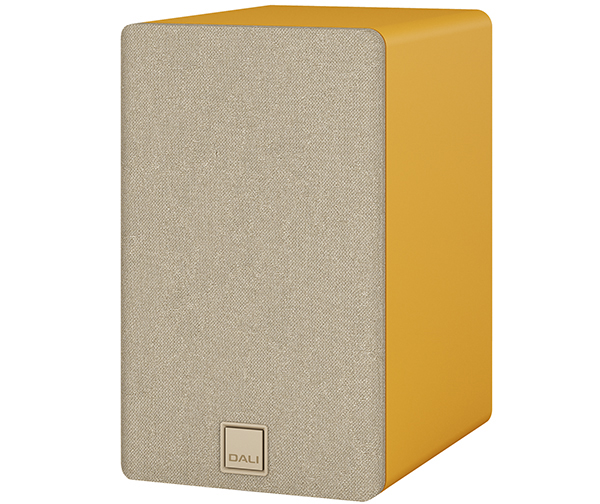
The bundled grilles are also appealing, being dressed in a matching Scandi mélange textile. The speakers look a lot more chic with them on, even if they are not as classy as more expensive fabrics from Kvadrat or Gabriel. All in all, perhaps taking a leaf from KEF’s book, DALI has obviously looked for some colourways to make an impression with younger buyers. And there’s nothing wrong with that!
Know your boundaries
The Kupid is necessarily a two-way design, with a 26mm soft dome tweeter taking care of everything above 2.1kHz and a 4.5in/115mm woofer working below. As is DALI’s wont, the diminutive woofer features a paper/wood fibre cone, and is reflex loaded via a rear-firing port. As PM notes in his [see PM's Lab Report] it might, instead, be worth placing the enclosures close to a wall to both tune the bass via boundary reinforcement while attenuating the unwanted pipe mode. This turned out to be useful advice, as did DALI’s typical recommendation to face its loudspeakers straight down the room, putting the listener off the line-of-sight axis.
Finally, as the Kupid’s cabinet is a relatively light 2.9kg, you can easily hang this 245x150x198mm (hwd) speaker on a wall or a ceiling beam without requiring a special bracket. There’s even a small hook included in the packaging for single-screw mounting.
 Love is in the air
DALI is one of the few loudspeaker companies that clearly articulates what it is aiming for when designing a new model, and its principles concentrate on low distortion, wide dispersion and easy placement, among other things. Bringing all these values to bear in a very affordable speaker is no mean feat, of course, yet the Kupid does sound broadly like you would expect a DALI loudspeaker to perform, while simultaneously running into the limits of a small unit with a basic acoustic design.
It’s hardly a revelation that the Kupid’s low-frequency extension is rather limited, although its performance in this area will still make the listener look up on occasion. Bass output is far from precise – unlike with DALI’s more expensive models – and can sound a tad loose, but the Kupid still delivered the electronic dance music of Kx5’s eponymous debut [Mau5trap Recordings MAU50533A1X] and Stromae’s Multitude [Polydor download; 44.1kHz/ 24-bit] with sufficient oomph.
Playing this content from an affordable WiiM Amp [HFN Nov ’24], the Kupid showed its foundational value in the way it carried off musical rhythms with speed and punch. The cabinet construction here might not be very sophisticated, but that didn’t stop the sound image remaining tight and focused. And considering its entry-level pricing, I was quite impressed by the speaker’s ability to communicate the awkward Latin American cumbia rhythm of ‘Santé’ on the Stromae set. That title means ‘cheers’, so it’s appropriate that the track’s percussion has a fascinating ‘drunk’ feel to it, which the Kupids handled without tripping over their own feet.
There are limits on how much sheer resolution is up for grabs, but again the speaker offers more than you would expect, especially in the midrange. Listening to the Kupid is all about managing your expectations. Crank the volume dial up to 11 and you might find these little speakers sounding rather too compressed and ‘noisy’. But at regular listening levels, they do the job beautifully.
Because of their price and size, a pair of Kupids could find their way into a ‘secondary’ system rather than serving critical listening duties – a bedroom, office or kitchen, for example, driven by a similarly compact amplifier like the WiiM Amp or a Bluesound PowerNode. Alternatively, they might be ideal speakers with which to revive older kit. With that scenario in mind, I partnered them with a Sony TA-A1ES amp [HFN Apr ’14], launched more than a decade ago. As it is fully analogue, adding a WiiM Ultra network player was required to stream music.
Fun feelings
In a playful mood, I listened to the albums of Marvel’s Guardians Of The Galaxy film series, which cover three decades of pop music, one per movie. The first includes mainstays such as Blue Swede’s cover of ‘Hooked On A Feeling’ and Norman Greenbaum’s ‘Spirit In The Sky’ – it would be hard to get more of a 1970s vibe going [Hollywood Records 00050087314460]. The Kupids don’t create a large soundstage, but they delivered these tracks with vigour and a decent amount of detail, so that Greenbaum’s buzzing guitar had a satisfying, textured feel to it.
Switching to the second film [Hollywood Records 00050087368715], ‘Guardians Inferno’ is the sole original – and slightly unhinged – composition on the soundtrack. DALI’s speakers kept up with the pace of this funky disco tune, and effectively lifted out the vocals from David Hasselhoff. Always capable of getting one’s feet tapping, the Kupids brought a smile to my face every time ‘The Hoff’ blasted out another line of knowingly silly lyrics.
Informed by my experience with the Sony amplifier, the WiiM unit did begin to feel a touch underpowered driving the Kupids. Pairing them with a Marantz Stereo 70s, which is still on the budget side at £629, yielded a more substantial wall of sound, albeit with slightly more ‘wooliness’ as a trade-off. The speakers conveyed the uplifting nature of ‘Santa Fe’ by Beirut [The Rip Tide; Pompeii Records POMP003], focusing attention on its repeating synthesiser melody and giving the drums a firm presence.
Typical of Beirut’s music – aka multi-instrumentalist Zach Condon – are the tuba and other brass parts that evoke Balkan music traditions, interspersed with folk instruments that conjure up the American South. It’s a heady mix, but DALI’s small speakers coped with the diversity, presenting these tracks with warmth and coherence.
Hearing Yo-Yo Ma’s Six Evolutions – Bach: Cello Suites [Sony Classical 0886447042472; 96kHz/24-bit] was a delight, partly because the Kupid’s rich midrange allowed me to perceive the grain of the strings and the woody resonance of the instrument. And with ‘Beautiful’ by Ayo [Royal; Wagram Music 3375872], the loudspeakers once again performed above expectations for their price point. The German-Nigerian’s vocals, in front of plucked guitar and jazzy drums, sounded soulful and seductive – exactly what is required to be drawn into this track. DALI’s Kupids are small and inexpensive, but they succeed, just like their more upmarket siblings, in establishing a real connection with the music.
Hi-Fi News Verdict
What sets the Kupids apart from other such speakers is not the range of trendy colours – nice as they are – or the pleasant price tag. It’s the fact that they were created by an experienced team, allowing a fairly basic ‘bill of materials’ to perform above expectations. DALI has done a cracking job in producing far more thrills and musical enjoyment than might normally be expected from a ‘lifestyle’ box.Sound Quality: 88%
 | |||||||||||

|
|
| |||||||||















 SPONSORED VIDEO






| Equipment Reviews | |
Music Reviews Awards | |
Latest News Features | |
Resources Newsletters | |
Subscriptions |
WHERE TECHNOLOGY BECOMES ENTERTAINMENT
 © 2026 Hi-Fi News
AVTech Media Ltd
All rights reserved