Sargent’s stripes

He spent 20 years in charge of the Proms but was largely distrusted by orchestral players, and – says Christopher Breunig – was not that well admired by record reviewers back in the day
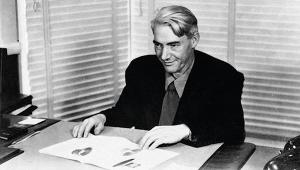
He cut a highly urbane figure – as you can see from the 1946 Crown Unit film, Instruments Of The Orchestra, where, with the LSO, he introduces Benjamin Britten’s Young Person’s Guide To The Orchestra. YouTube also has, in sound only, a recording of his surprise final appearance speech at the end of the 1967 Proms, a few weeks before his death from cancer. Knighted in 1947, Sir Malcolm Sargent had a reputation as an opportunist, a womaniser and a person indifferent to the morale or expectations of those who played under him. However, to the general public, Sargent – affectionately known as ‘Flash’, a name he disliked – was mainly associated with the Henry Wood Promenade Concerts, where he was chief conductor for 20 years.
Free tuition
In his early 20s Sargent was working as an organist, and conducting and producing Gilbert and Sullivan operas, while he had aspirations as a composer: in 1921 Sir Henry Wood commissioned his brief tone-poem An Impression On A Windy Day (hardly Tapiola!), which Sargent also premiered.
In a 1965 Montreal interview, which can be seen on YouTube, he said he never had any ambition to be a conductor and felt his calling was as an organist. But the Russian pianist Benno Moiseiwitsch (popular in the UK) gave him free piano lessons to professional standards; then, seemingly, it was Sir Adrian Boult who suggested he switch to conducting.
Over the years he became most highly regarded for his performances of the big choral masterpieces, and he maintained his keenness for G&S, recording with the D’Oyly Carte Opera Company for Decca. But today? Probably to most HFN readers he’s just a name from the past, with a discography hardly worth exploring, substantial though it might be.
However, there are recordings that do deserve attention – eg, either of his versions of Holst’s The Planets. The stereo remake was with the BBC SO, but I prefer the Decca mono, with its splendid sound, which now comes as a download with The Perfect Fool ballet music [Decca 4845670].
Also on Decca is one of the most enjoyable versions of Prokofiev’s Peter And The Wolf, Sir Ralph Richardson narrating and Sargent conducting the LSO. The download includes the Classical Symphony, taped at Kingsway Hall at the same time [4336122] – a recording that often used to figure in our headphone reviews.
The EMI release of Walton’s Symphony No.1, with Sargent and the New Philharmonia, came in the same month as Previn’s RCA with the LSO, the composer saying they ‘both had their good points’ but inclining towards the RCA. My preference is for the Sargent, however.
Back in 1945 Sargent had put together a (composer approved) suite from Walton’s Henry V film score, but this was not recorded until 1986 when Carl Davis made an EMI CD with the LPO.
A Beecham quip
Jacqueline du Pré’s debut in the Delius concerto, Sargent with the RPO, was also the first recording of the work. His world premiere of Vaughan Williams’ last symphony, No.9, is remastered on Somm, while a BBC SO live No.4, and that of Sibelius, can be extracted as downloads from a 20CD ICA Classics compilation.
Beulah now has a substantial and fascinating downloads catalogue, not all historic in content. There are around 20 albums with Sargent, including two live concerto performances with Moiseiwitsch as soloist: Delius/Beethoven ‘Emperor’. Seven different versions of Mendelssohn’s Hebrides Overture (!) find Sargent next to Karajan, whom Beecham once said was ‘like Sargent – but musical’.
A Beethoven’s Fifth shows Sargent in wilful mood elongating the last note in the opening ‘motto’ each time in a way that not even Wilhelm Furtwängler would have emulated.














 SPONSORED VIDEO







| Equipment Reviews |  |
Music Reviews Awards | |
Latest News Features | |
Resources Newsletters | |
Subscriptions |
WHERE TECHNOLOGY BECOMES ENTERTAINMENT
 © 2026 Hi-Fi News
AVTech Media Ltd
All rights reserved