Quad ESL 2912X loudspeaker Origin story
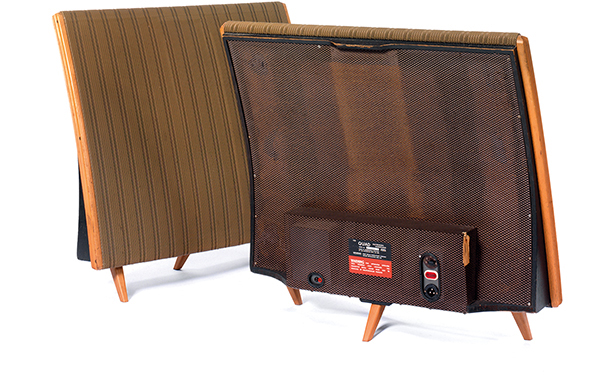
When Quad’s Peter Walker came to replace the long-running ESL-57 [pictured below], not only did he draw upon improvements in material technologies – the tensioned thin-film membrane and stator coating – but he also leveraged a step-change in how that membrane was addressed. The ESL-63’s innovation? Instead of simultaneously driving the charged membrane (actually two bass panels and a central treble strip) across its entire surface, the push-pull stator electrodes were divided into a series of concentric rings of equal area. The audio signal was fed to the inner through to the outermost rings via a delay line, emulating the spherical wavefront of a notional point source set some 30cm behind the loudspeaker.
This remains the core driving principle at work within the ESL 2912X which, like the ESL 2912 before it [HFN Jan ’13], adds two further charged membrane panels above and below the central pair. The ESL 2912X is clearly larger than the ESL-63 and the virtual ‘point source’ is now set some 40cm behind the middle two panels. Also, in practice, the peripheral panels are only driven by the outermost ring(s) of the concentric electrode array, boosting bass output and extension [see PM's Lab Report]. The audio input, fed to the stator ‘rings’, is first stepped up to 5.25kV via a pair of massive C-core transformers. The latter, upgraded in the ESL 2912X, are critical in determining the power handling and wide bandwidth of these enigmatic electrostatics. PM
 | |||||||||||

|
|
| |||||||||




















 SPONSORED VIDEO






| Equipment Reviews | |
Music Reviews Awards | |
Latest News Features | |
Resources Newsletters | |
Subscriptions |
WHERE TECHNOLOGY BECOMES ENTERTAINMENT
 © 2026 Hi-Fi News
AVTech Media Ltd
All rights reserved