Man on a mission
Barry Fox went from making music with Bill Ashton to watching him establish the National Youth Jazz Orchestra. Fifty years later, he worries Ashton’s ‘experience matters’ ethos has been lost
We go to live music events and theatre shows, and listen to live broadcasts, expecting the perfection we hear from edited recordings. We wince at just one cracked note. But where do perfect players, who can play in all styles, come from? There is a big difference between passing music college exams and reading difficult parts under pressure.
The wind of change
World-renowned trumpet player/arranger/composer/leader Guy Barker chatted recently to singer/pianist/all-round-talker Ian Shaw at Ronnie Scott’s jazz club in Soho. He recalled his time at the Royal College of Music. ‘When I went through the RCM door each day I wanted to learn to play their kind of music and leave jazz for the evenings at Ronnie’s.’
At Barker’s Final Exam, a patronising music professor sought to challenge him. ‘You’re the chappie that plays jazz. Please play us some.’ When Barker resisted, the stuffy examiner said, ‘I suppose it’s like breaking wind in a chapel’.
In recent years musical colleges, like the RCM, have stopped being stuffy and now offer jazz courses/degrees, and stage all kinds of concerts. But before that there was only the National Youth Jazz Orchestra, the jazz equivalent of the National Youth Orchestra. It’s where Barker cut his teeth.
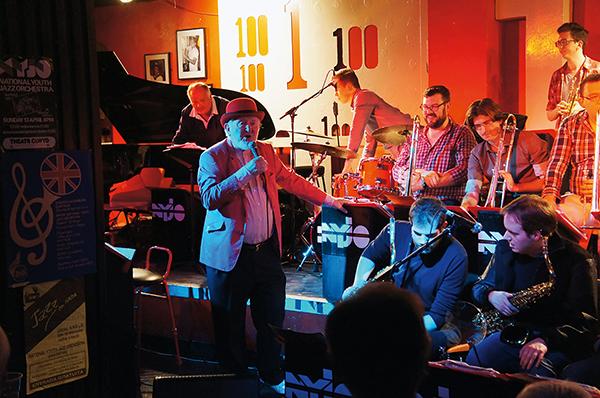
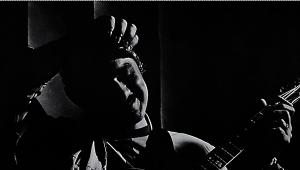
The NYJO was not created and funded by a quango. It was the result of one man talking the hind legs off so many of the right people that they eventually gave up and gave him a chance to prove himself wrong. The man was Bill Ashton [pictured at the mic, above], and he proved himself right.
As I mentioned in a previous column [HFN Apr ’25], written just after Bill died, I had a close interest in the NYJO since before it was born. I’d played with Bill in duff bands in the RAF, then university, and then around London. When we all grew up and recognised we weren’t going to make it as musicians, Bill came up with the idea of a jazz version of the NYO.
That was 1965. We all laughed until Bill had the last ha-ha. His NYJO became a national success and spawned regional spin-offs. At any recording session, West End show or music broadcast you’ll find a roster of ex-NYJO players.
What made the NYJO so relevant to the real-world music business was the hard-knocks experience the band generated. They regularly rehearsed at the Cockpit fringe theatre, performed at London pubs, toured for one-nighters, and graduated to the Proms and Christmas seasons at Ronnie Scott’s. To kill journey time in the band bus, one musician used a portable keyboard with a built-in printer to generate gibberish scores that the others tried to sight-read.
Bill persuaded big but slightly past-prime musical names to come over from the US and tour round the country with the NYJO, including Frankie Laine, Shorty Rogers and Peggy Lee. The NYJO made over 40 LPs and CDs, often with big-name British musicians cajoled by Bill into guesting and arranging. Young, green musicians experienced live performance and studio pressures.
Exit music
Around 2010, the NYJO was taken over by the Arts Council and Bill became ‘retired’. As one ex-NYJO musician told me, ‘They took his band away from him’.
Bill had run the NYJO from home with shoestring help. Now it has offices in Woolwich and its website lists a Chief Executive, Programmes & Operations Director, Operations and Partnerships Manager, Ensembles Manager, Learning Programmes Producer, etc. Yet the latest recording was made in 2019. Full-blown band shows are few and far between. All the emphasis is on ‘learning’ events.
Worthy, maybe, but very different from the school of real-world experience that Bill built with next to no money or staff.






 SPONSORED VIDEO






| Equipment Reviews |  |
Music Reviews Awards | |
Latest News Features | |
Resources Newsletters | |
Subscriptions |
WHERE TECHNOLOGY BECOMES ENTERTAINMENT
 © 2026 Hi-Fi News
AVTech Media Ltd
All rights reserved