EAT E-Glo Petit B phono preamplifier Boxout
The EAT E-Glo S [HFN Mar ’17], the original EAT E-Glo Petit [HFN Feb ’19] and the E-Glo 2 [HFN Feb ’25] were either all-tube or tube/transistor hybrid designs but all, to a greater or lesser extent, had limited input overload margins. This is important, for while it’s tempting to think of, say, an Ortofon 2M Red [HFN Oct ’08] producing just 6mV (re. 1kHz/5cm/sec), it may deliver in excess of 50mV when navigating the boldest of grooves. All phono stages must have sufficient input headroom to accommodate these peak MM/MC signals, preventing overload and crushing distortion. And difficulties can arise here if tubes are employed in relatively low-voltage circuits.
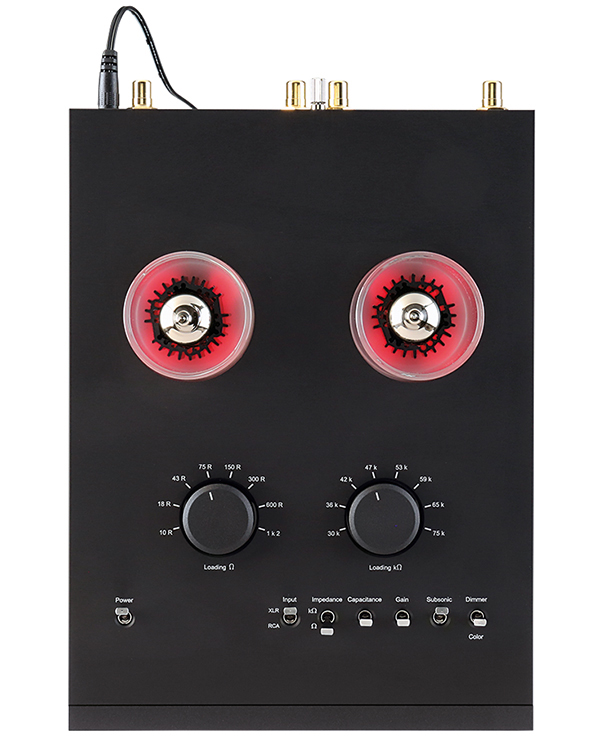
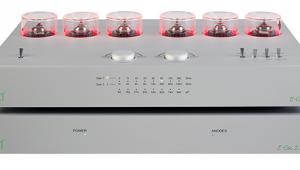
Like the E-Glo Petit, the Petit B is still powered from an 18V wall-wart DC supply and offers the same +40dB, +45dB, +50dB, +55dB, +65dB and +70dB gain options. However, the Petit’s input overload thresholds of 60mV, 55mV, 33mV, 16mV, 5.5mV and 3.9mV (for 1% THD), respectively, are increased to 122mV, 65mV, 38mV, 20mV, 6.5mV and 3.45mV in this new model. EAT has achieved this, in addition to balanced inputs and outputs, by increasing the ‘transistor count’ and overall internal gain. The input features three discrete low-noise op-amps, the RIAA EQ is fully active with a triode/transistor buffer, and the balanced output is a DC-coupled, J-FET op-amp-based stage. There’s another boost to performance too – distortion is 10-100x lower than we saw in the Petit and significantly better buffered against changes in output level, and all without sacrificing the A-wtd S/N ratio. There’s much more to the new Petit B than a tri-colour light show... PM
 | |||||||||||

|
|
| |||||||||







 SPONSORED VIDEO






| Equipment Reviews | |
Music Reviews Awards | |
Latest News Features | |
Resources Newsletters | |
Subscriptions |
WHERE TECHNOLOGY BECOMES ENTERTAINMENT
 © 2026 Hi-Fi News
AVTech Media Ltd
All rights reserved