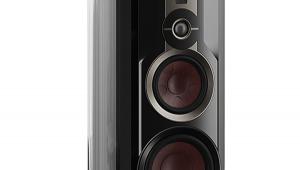
Dynaudio Confidence 20A active loudspeaker Stand and deliver
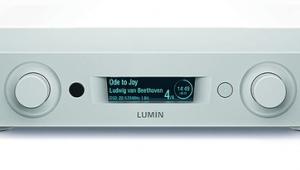
Nestled with ergonomic efficiency within the Confidence 20A’s stands are all the DSP and electronics required to drive the speakers from either an analogue line or digital input. Because the digital input also requires a source equipped with a high quality digital volume control, the LeedH system used by Lumin [HFN Apr ’24] being a rare example, most users will drive the Confidence 20A via a balanced preamp connection. Here incoming audio is sampled at 48kHz before passing to Dynaudio’s two-stage digital crossover running on an Analog Devices DSP. This is bespoke code and not a digital ‘model’ of any existing Dynaudio passive crossover despite employing relatively gentle slopes at 2.5kHz, and offering good phase coherence and minimal group delay.
The high- and low-pass feeds are then converted back into analogue using the same Cyrus Logic ADC/DAC codec that handles the incoming audio. A Pascal T-PRO2 Class D module, with switchmode PSU and two amps (400W and 150W for bass/mid and treble, respectively) provides the muscle. The AES digital input may be processed natively (44.1kHz-192kHz) or upsampled to 192kHz, before joining the same path as the digitised analogue input. However, it’s arguable that while a 96kHz sample rate will realise a fractionally higher ultrasonic extension from the Esotar 3 tweeter [see Lab Report, p79] the significantly increased load on the DSP may have its own impact on overall sound quality. My advice? Stick with analogue or 48kHz digital audio. PM
 | |||||||||||

|
|
| |||||||||







 SPONSORED VIDEO






| Equipment Reviews | |
Music Reviews Awards | |
Latest News Features | |
Resources Newsletters | |
Subscriptions |
WHERE TECHNOLOGY BECOMES ENTERTAINMENT
 © 2026 Hi-Fi News
AVTech Media Ltd
All rights reserved