Burson Conductor Voyager DAC/headphone amp Boxout
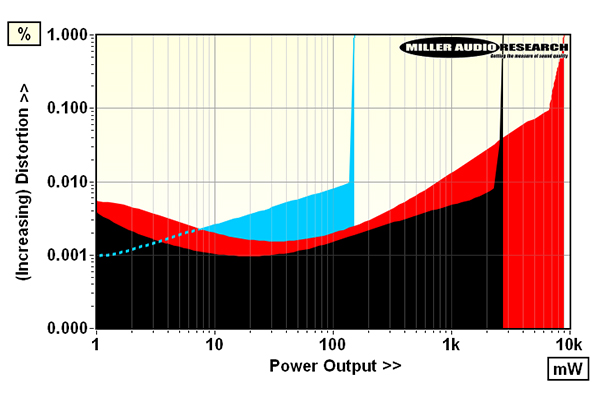
The maximum output achieved by Burson’s headphone amplifier is not only determined by the choice of Low (1.75dB) or High (6.95dB) gain but also by the clipping voltage of the input ADC. Sampling at 192kHz/24-bit, this input overload point is reached at 4.3V (balanced XLR in), yielding a maximum output of 5.21V (Low) and 9.51V (High; all re. 1kHz/1% THD). In High gain mode, via its single-ended 6.35mm socket, this translates into a 151mW output driving high impedance (600ohm) in-ears and 2735mW (2.74W)/32ohm before rising to a phenomenal 8.91W/8ohm [see Graph, right]. Let’s put this into context – the Conductor Voyager very nearly matches the (Class A mode) output of the Unitra WSH-805 integrated amp, also reviewed in HFN Mar ’26. It will not only drive any headphone likely to cross its path, but the Conductor Voyager will also make music with a sensitive speaker like the DeVore O/Bronze .
The 800mohm output impedance is also usefully low, ensuring the Conductor’s headphone system response is largely unaffected by swings in load impedance. In practice the HF response might ordinarily be governed by your choice of the Conductor Voyager’s digital filter, IIR bandwidth and ‘DAC path’ settings [see PM's Lab Report] – with the minimum phase filter engaged, and all else in bypass, the response has –1dB points at 2Hz-30kHz, falling to –16.7dB/100kHz. Distortion is also largely unaffected by load impedance, the Conductor Voyager holding to a very low 0.0009-0.006% from 20Hz-20kHz (re. 10mW/32ohm). Finally, and of great importance to users of sensitive ear buds, residual noise is a usefully low –98dBV (13µV) even though, courtesy of a gentle mist of white noise, the A-wtd S/N ratio is only a little above average at 87.4dB (re. 1V/32ohm). PM
 | |||||||||||

|
|
| |||||||||









 SPONSORED VIDEO






| Equipment Reviews | |
Music Reviews Awards | |
Latest News Features | |
Resources Newsletters | |
Subscriptions |
WHERE TECHNOLOGY BECOMES ENTERTAINMENT
 © 2026 Hi-Fi News
AVTech Media Ltd
All rights reserved