Burson Audio Timekeeper Voyager V-400 MAX power amplifier Boxout
Clamped within their own little (red) heatsink enclosure are two of Burson’s proprietary op-amp PCBs, the dual-channel V7 module pictured below also visible in our full inside shot [see previous page]. This module forms the +6dB input buffer to the Voyager V-400 where, rather than employ an off-the-shelf ‘audio’ IC op-amp, Burson has designed an ‘application specific’ gain block using its choice of discrete components. The idea is not new – Marantz’s HDAM op-amps have been a staple of its designs for decades. Also, in the 1980s, Deltec’s hybrid operational amplifier, the DH-OA32, combined SMD-type components on a highly stable ceramic substrate where the track work and resistors were formed using special conductive paints, a technique known as the ‘thick film’ method.
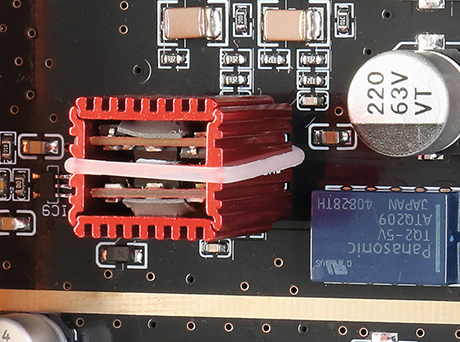
Burson’s op-amps are arguably less sophisticated but at least the selection of silver mica capacitors, high tolerance metal film resistors, and matched FETs has enabled it to fine-tune sound quality in a way impossible with general-purpose IC solutions. The latter’s need for greater in-circuit flexibility typically requires more transistors and other components etched into the substrate – Burson’s discrete op-amps offer a simpler audio path with optimised performance. PM
 | |||||||||||

|
|
| |||||||||







 SPONSORED VIDEO






| Equipment Reviews | |
Music Reviews Awards | |
Latest News Features | |
Resources Newsletters | |
Subscriptions |
WHERE TECHNOLOGY BECOMES ENTERTAINMENT
 © 2026 Hi-Fi News
AVTech Media Ltd
All rights reserved