LAiV Harmony μDAC USB DAC Boxout
Several Far East brands, Topping [HFN Feb '26] and LAiV included, offer proprietary R-2R DAC solutions although, in effect, the former is a 32-stage FIR/'moving-average' DAC offering better low-level linearity and reduced quantisation errors. LAiV's implementation is arguably closer to a purist R-2R or 'ladder' DAC, so-called because of how digital bit words of increasing size (significance) occupy more resistor 'rungs' in the sequence of matched resistors. Twenty four 'rungs', each twice the significance of the last, are required to accommodate a 24-bit signal although, in practice, each element comprises two resistors, one twice the size of the other, in a series/parallel network. Hence the term R-2R. LAiV operates its R-2R network in differential mode to further reduce noise and suppress low-level distortion caused by fixed quantisation errors [see PM's Lab Report].
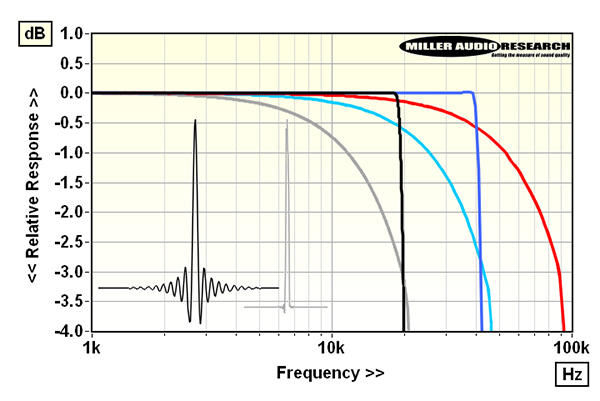
To be 'purer' still, LAiV offers the opportunity to run this R-2R DAC in NOS mode – eschewing any digital filter, side-stepping any time domain distortion [grey impulse, Graph] above but also leaving the DAC and its partnering amplifier open to intermodulation distortion from the unsuppressed aliasing images. Stopband rejection is just 1.4dB and the response(s) roll gently away to –3.2dB at 20kHz, 45kHz and 90kHz with 44.1kHz [grey], 96kHz [cyan] and 192kHz [red] files, respectively. LAiV's OS mode invokes a linear phase digital filter with a brickwall cut-off, trading a full 89dB stopband rejection for pre/post ringing in the time domain [black impulse]. Responses cut off slightly early – at 19kHz with 44.1kHz files [–4.6dB/20kHz; black trace] and 41kHz with 96kHz files [–23dB/45kHz; blue trace]. At 192kHz the OS/NOS responses are the same [red trace]. PM
 | |||||||||||

|
|
| |||||||||









 SPONSORED VIDEO







| Equipment Reviews | |
Music Reviews Awards | |
Latest News Features | |
Resources Newsletters | |
Subscriptions |
WHERE TECHNOLOGY BECOMES ENTERTAINMENT
 © 2026 Hi-Fi News
AVTech Media Ltd
All rights reserved