Aurender A1000 network-attached DAC
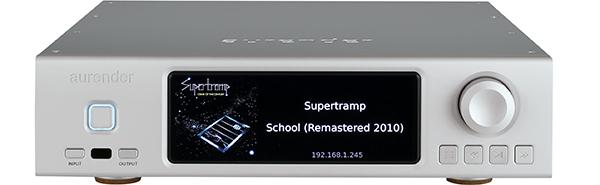

Considering the last Aurender model reviewed in HFN was the three-box flagship N50 network server, with an asking price of £38,900 and – as reviewer Andrew Everard put it – 'not a DAC in sight' [HFN Jun '26], the South Korean marque's A1000 appears both positively affordable and brimming with features. Selling for £4600, this single-chassis unit combines network streaming and app control with a DAC stage offering fixed and variable output, plus the option of adding onboard storage.
In this regard, Aurender's A1000 faces stiff competition in a way its premium N50 server does not. Multi-functional network player/DACs are not uncommon around or below its price point, particularly from new brands also hailing from the Far East. Yet Aurender, established in 2010 in Gyeonggi-do with the mission statement of 'taking the computer out of "computer audio"', has longevity on its side, as shown by the maturity of both its hardware and software.
Junior giant
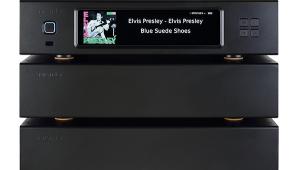
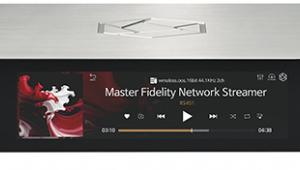
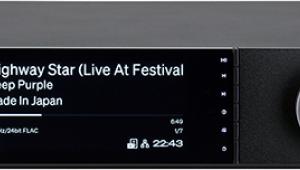
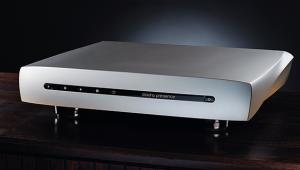
The A1000 is the company's new entry-level network player/DAC – or 'Analogue Music Server' in Aurender speak – although this is not betrayed by either its styling or construction. The industrial design shares much in common with the manufacturer's bigger, higher-specification models, from the deployment of a large, full-colour interface to the square control keys and illuminated power/standby button. The hefty aluminium chassis, in black or natural finish, appears elegant, its thick front panel curved at the top and bottom, and the sides featuring (decorative) heatsink fins. Dimensions of 350x97x356mm (whd) put it between full-size and compact.

Above: Multiple linear PSUs [left] power the Quad-core 2.0GHz CPU, 120GB NVMe cache and 2.5in drive bay [all top right] plus the audio PCB with two AK4490REQ DACs [bottom right] and Libre (Google Cast) network module [centre]
Control via the A1000's transport buttons, input and output selectors, and volume rotary (which has an illumination ring that changes colour to signify the selected source) is feasible. But, as usual, this networked device is best driven via its bespoke app, not least because Aurender's Conductor platform is fast, blessedly free from bugs and includes useful features [see boxout] The A1000's bundled Bluetooth remote, with thumbwheel navigation and labelled buttons, doesn't share the main unit's heavyweight build but is nonetheless a good example of the breed.
The A1000's connections and features might see it taking the place of several separates in a streamlined set-up, perhaps used directly into a power amp or, simpler still, a pair of active speakers. Something missing, however – and this could well be a deal-breaker depending on the makeup of the rest of your system – is a matching pair of balanced XLR outputs.
Core control
This isn't an Aurender idiosyncrasy (its step-up units are suitably equipped), so their absence here, plus that of an integrated headphone amplifier, is entirely down to meeting a price point. Still, one might reasonably argue that if rival DAC makers can implement balanced analogue outputs on a device at this price, then so should Aurender.

Above: The industrial design shares much in common with Aurender’s bigger, higher-spec models
Anyway, analogue output is therefore limited to single-ended RCAs, while USB-A and coaxial connections are provided for a digital output into an outboard DAC. Wired digital inputs comprise coaxial, optical, USB-B, a second USB-A for external storage, and HDMI ARC, the last of those a new addition to the Aurender armoury. Meanwhile, above its row of inputs can be found a removable cover concealing a bay for 2.5in drives (SSD or HDD), up to 8TB.
For connection to a home network, the A1000 relies on a Gigabit Ethernet port. The company still eschews the use of Wi-Fi in its hardware, saying 'most Wi-Fi networks are unreliable and subject to drop-outs and limited bandwidth'. For an audiophile component approaching £5000, I don't consider this a limitation. The A1000 isn't entirely cable-tied either – aptX HD Bluetooth streaming, plus Tidal Connect, Spotify Connect, Airplay and Google Cast compatibility, provide quick connections for guests who haven't downloaded the Aurender app.
The brainpower for the A1000's network functions and user interface comes from a Quad-core ARM Cortex-A55 CPU fed by its own linear power supply. Two further power supplies are dedicated to the unit's dual mono D/A conversion, which uses two of AKM's long-running 4490REQ chips [see PM's Lab Report]. Related to the DAC, Aurender provides a choice of six digital filters. There's also the option to put the unit into Critical Listening mode, whereby its display is shut down in addition to 'other background functions'.
 Hell yeah!
The reassuring feel of Aurender's rock-steady software platform and robust hardware is mirrored by the A1000's performance. Used as an all-singing, all-dancing streaming DAC over its analogue outputs into a Hegel H150 integrated amplifier [HFN Jan '26], the A1000's AKM-based DAC stage wasn't found lacking in detail or resolution. But more importantly, its revealing, vivid nature was complemented by an inherent naturalness to the sound, and superb low-end weight. From low-bass detail to tonal nuances in the presence band, the A1000 appeared superbly balanced.
Queueing up the title track from AC/DC's Highway To Hell [2020 remaster, Columbia; 96kHz/24-bit], Malcolm Young's brilliantly economic riff came through my B&W 705 S3 Signature speakers [HFN Aug '24] with exceptional detail, the chunky chords still clearly being a collection of notes rather than a poorly defined whole. An upper layer of sizzling harmonic distortion (from Young's guitar, not the Aurender DAC...) was also on show as the instrument echoed into the studio acoustic. Digital data in, musical magic out. Young is soon joined by a no-nonsense drum track. The A1000 gave each kick drum thud and hi-hat strike its own detectable character, one punchy and deep, the other crisp but natural.
Star turn
The A1000 pulled off the same trick with The Rolling Stones' 'In The Stars', a single from the band's new Foreign Tongues album [Polydor Records; 48kHz/24-bit download], where a glossy, detail-rich sheen to piano and background singers was countered by another one of Mick Jagger's processed vocals.
With the A1000's rock 'n' roll chops established, Anne-Sophie Mutter's East Meets West [Alpha Classics; 192kHz/24-bit] provided it with a different challenge, its tracks focused on establishing the violinist front and centre and evoking the ambience of its various recording venues. Hearing Mutter bend and attack the strings of her instrument during the discordant, propulsive 'Gran Cadenza, For Two Violins' alongside Nancy Zhou, recorded in New York's Carnegie Hall, the effect was almost hypnotic. Aurender's DAC conveyed the physical nature of the performance, the punches of pizzicato weight amid soaring, gossamer-thin highs.

Above: Bespoke BT remote control covers off input and output selection, volume and navigation of the configuration menus
More evidence of its evocative delivery could be heard in 'They All Laughed' from the 1957 Ella And Louis Again album [Verve Reissues, 96kHz/24-bit]. This puts the two legendary vocalists in front of the Oscar Peterson Trio, for a recording that's all about captured nuances and a live-in-the-room feel. Even within the mono envelope, the A1000 established the distance between Armstrong and his mic, and the players behind, while missing nothing of his gravelly yet rich voice. Fitzgerald's had more enunciation, presence and – yes – sass.
Boss move
Ryan Adams' track-by-track re-recording of Bruce Springsteen's Nebraska is a curious idea – the Boss's original low-fi album is a classic and it's arguable that Adams' version, released in 2023 [PAX-AM; 44.1kHz/24-bit], lacks the necessary rawness and intimacy in the pursuit of more modern production. That said, his take on 'Atlantic City' sounded lush through the A1000, the opening acoustic guitar being delicate yet full-bodied, and the force with which Adams strikes the low strings well conveyed. Similarly, the clarity of the A1000's performance had me listening out for the eerie double-tracked vocals that come and go during the chorus.

Above: A USB-A host port for external drives joins a bay for one internal 2.5in drive, plus coax, opt, HDMI ARC, USB-B and Ethernet inputs and BT [black bar, top]. Digital outs are on coax and USB-A (768kHz/32-bit; DSD512) alongside analogue outs (RCAs)
Price tag firmly in mind, there really is nothing to fault here save that balanced output omission. Yes, you might hope for more pronounced differences in the digital filter options, but this unit's natural, expressive, full-bodied presentation is so appealing I had no desire to tweak it. Do give the Critical Listening mode a try, though, if you can cope without having the A1000 displaying album art. This brought tangible gains in bass definition and overall clarity, notable in the rich bottom-end and contrasting tones of mandolin, viola and guitar on Alison Krauss & Union Station's 'Deeper Than Crying' [So Long So Wrong; Rounder Records RCD 0365].
Indeed, the A1000's rendition of this track encapsulated what makes it a standout in its field. Free of the slightly gritty feel that can blight lesser-quality digital sources, this streaming Aurender DAC sounded smooth, detailed and dynamic as it painted an uncanny picture of Krauss and her band making sweet music in their Nashville Studio.
Hi-Fi News Verdict
Other than its price versus the rest of the brand's hardware (and no balanced outputs), there's nothing especially 'entry-level' about Aurender's A1000. In practice it possesses qualities that may even turn dyed-in-the-wool vinylistas onto digital replay. This streaming DAC also beguiles with its superb fit and finish, onboard storage potential, and superb control app. It's definitely one for your shortlist.
Sound Quality: 88%
 | |||||||||||

|
|
| |||||||||







 SPONSORED VIDEO







| Equipment Reviews | |
Music Reviews Awards | |
Latest News Features | |
Resources Newsletters | |
Subscriptions |
WHERE TECHNOLOGY BECOMES ENTERTAINMENT
 © 2026 Hi-Fi News
AVTech Media Ltd
All rights reserved