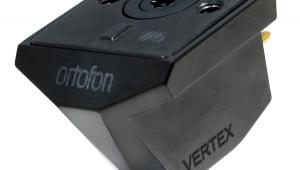
Ortofon MC Vertex MC cartridge
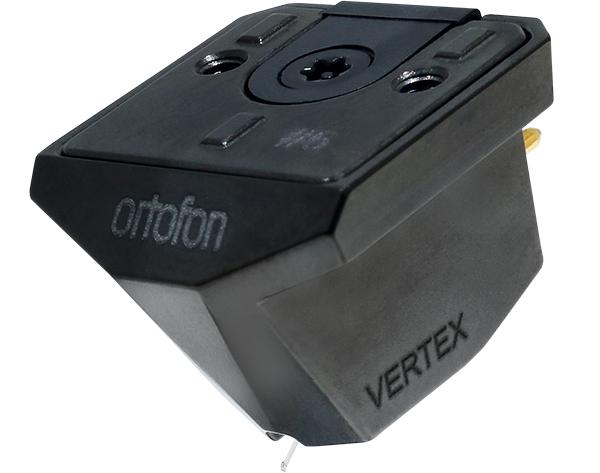

A quick web trawl shows that there are now more than a dozen cartridges on the market costing over £10,000, with Kuzma's CAR-70 at roughly $42,000. Ulp! Premium models from Glanz, Clearaudio, ZYX, et al aren't far off that. I suppose it was only natural that Ortofon would find it prudent to top its range of over 50 models with the new MC Vertex costing £12,999, almost double that of the second dearest in its catalogue, the MC Diamond [HFN Dec '22].
Tech talk
Such prices are no longer shocking, but in order to justify the existence of heart-stopping costs, there has to be a modicum of high technology rather than mere mythological nonsense. In the case of the MC Vertex, 'diamond' is again the operative term for both stylus and cantilever, maximising its coupling to the vinyl groove. It's already been pointed out many times that the raw cost of a solid diamond cantilever can leave the manufacturer facing a four-figure sum before margins, labour, etc, are added to the price.
In the case of the Ortofon MC Vertex, the money fully pays for ingredients that look like they were lifted from a wristwatch catalogue. That leads us to the second operative term: 'titanium'. Because it is highly resistant to chemical attack, relatively unaffected by temperature, immune to rust and corrosion, anti-magnetic, and with one of the highest strength-to-weight ratios of any metal, titanium has found roles in the manufacture of racing cars, jet engines, sporting goods, watch cases and anywhere else where strength, lightness and imperviousness are desirable.
So why is it a rarity in cartridges? Simple: it's a devil to work with, especially for machining. Ortofon has chosen titanium for the MC Vertex's housing and internal core in its quest for a 'mechanically stable structure that reduces unwanted resonances and supports clean, accurate signal reproduction'. To manage it, the manufacturer has employed SLM (Selective Laser Melting), a technique which enables precise control over geometry, mass distribution, and internal damping.

Above: Mounted in a sumptuous presentation case, each numbered MC Vertex (ours was #6) is packed with specialised Torx tools and bolts
For its new flagship cartridge, Ortofon has refined the magnetic system by fitting a reduced mass, non-magnetic armature that eliminates unwanted magnetic interaction. As installers will find, the magnet system is so powerful that it'll grab the supplied Torx tool and can even upset readings from electronic stylus balances. PM advised me to use one of the old plastic 'see-saw' type balances to be sure of a true reading.
Inside the MC Vertex are high-purity silver coils, preferred here by Ortofon for stable, linear signal generation. The company also claims improved transient response, and upon auditioning, among the first impressions are noteworthy speed and attack, especially on fast guitar work.
Completing the mechanical aspects of the design, the MC Vertex uses Ortofon's patented Wide Range Damping system, which uses a platinum disc between two dampers. These are made of proprietary rubber compounds, developed 'to manage resonance across the audible frequency range'. All in all, this cartridge oozes a sense of control.
Watch your weight
Installation – the powerful magnet notwithstanding – requires a tad more attention than most because the MC Vertex weighs a chunky 15g, which is a good 5-6g more than most moving-coil pick-ups. This weight, however, might aid some arms as it needs to track at 2.5g. Again, you have to set the force with care, and anti-skating seemed more critical with the MC Vertex, possibly due to the extreme profile of its stylus [see boxout].

Above: 'With the MC Vertex, the money fully pays for ingredients that look to be lifted from a watch catalogue'
As is the current fashion, the MC Vertex has three raised contact points on its top surface to mate with the underside of the headshell. This rather exacerbates another curious issue. Because the body is titanium and its threads might not match the screws in your toolbox, it is imperative to fit the cartridge with one of the three pairs of Torx screws supplied, along with the necessary screwdriver.
These screws are disarmingly short, and the holes are not drilled through, hence their limited length. I do foresee a problem if one's headshell has a particularly thick top plate, as even the longest screw might not reach through. The good news is that it is easy to align the MC Vertex and set overhang as the narrow body allows a clear view of most setup grids.
 Special delivery
One area which links the Ortofon MC Vertex with the earliest moving-coil designs that took over in the 1970s is the low 0.3mV output [see PM's Lab Report]. It also requires at least 100ohm loading, but it sounded even better at 180-200ohm via another phono amp. As this cartridge is so refined and precise in just about every area, I would recommend a phono stage with fully variable load settings and variable gain, adjusting by ear.
I have no idea if the review sample was 'run in' for any period of time, but it sounded special straight out of the box, and the character didn't change at all after a dozen LPs had been played. This attests to Ortofon's quality control, the evenness and stability suggesting that consistency is something one pays for at this level. Before even delving into the details and niceties, it was obvious that the Vertex is firmly of the 'high end', a real thoroughbred that oozes refinement.

Above: Emerging from the MC Vertex's black-finished SLM titanium shell, the laser-polished diamond cantilever is fitted with a new Vertex stylus, cut to provide a slender 4x110µm profile
Although concerned that the hyper-etched sound and retrieval of the teensiest details might veer toward the clinical, there remained enough warmth, soul and humanity in Ruth Brown's rousing 'This Little Girl's Gone Rockin'' from Miss Rhythm [Pure Pleasure PPAN18026] to remind me that I was listening to a classic MC despite its arch modernity. The voice was rich and liquid, supported by a rhythm section that was full in a way that attests to the worth of mono recordings nearly 70 years after stereo rendered them obsolete.
Prestige performance
Here the newest Ortofon MC showed prowess with soundstaging that reminded me of the best Decca London and Denon carts. Soundstage is a questionable test for mono recordings, but they can exhibit a real sense of depth, while occupying more than a tiny spot between the speakers. Here the sound was room-filling without sounding bloated, also evinced during a marathon session with Miles Davis' Miles 56 – The Prestige Recordings [Craft CR00639]. As with electric guitar, Miles' trumpet bursts were reproduced with speed and attack nearly the equal of the Decca Reference Type II [HFN Jun '26].
If the Ortofon MC Vertex proved a champion with mono, its skills with stereo might even set a new standard. I hadn't before experienced quite the scale in both width and depth on the O'Jays' Serious [EMI EI90921], a fairly representative soul/funk album of the late 1980s. The spacing of the vocal trio and the instrumentation was pinpoint-precise, such that you could measure it with a tape. As with Ruth Brown's album, the voices proved rich and warm, if staying on the cool side of 'lush'.
Love story
Cautioned by PM about the new stylus profile's proclivities, I tried it with the oldest LP in my collection, Doris Day's soundtrack of Love Me Or Leave Me [Columbia CL710], knowing it has surface noise. The MC Vertex navigated the wider mono grooves with ease, no sibilance, and little intrusion from the crackles as it dug deeper into the tracks. Better still, it enjoyed the expanded presence afforded to the other mono LPs, while Day's voice was as crystal-clear as I would have hoped. The anguish in 'You Made Me Love You' crossed a chasm of 71 years with such grace that the urge to play it with a period-appropriate mono system was obviated.
Just as worn out but possessing remarkable stereo was The Torero Band's Lennon & McCartney – Tijuana Style [Music For Pleasure MFP STEREO 1318]. This corny LP from 1969, which sounded so much like Herb Alpert's Tijuana Brass that I'm surprised legal action didn't result, still managed to feature enough challenges for the MC Vertex, not least the brass. After cleaning with an ultrasonic machine, it still suffered a few clicks, but the speed of Ortofon's cartridge rendered them insignificant, the sheer punch and the fat bottom end proving to be just the kind of distraction one needs when playing well-worn (but well-loved, irreplaceable) LPs.

Above: No mistaking the colour-coding of the chamfered cartridge pins here, and note the bolt that secures the MC mechanism into the titanium SLM body
Sadly all-but-forgotten, the late Dewey Martin was the drummer of Buffalo Springfield and he failed to enjoy the success of the other band members. But his lone LP, Dewey Martin And Medicine Ball [Uni 73088], is a long-lost gem. Martin's voice is diametrically opposed to the clarity of Day, a gruff rasp used to good effect on this melange of soul and folk-rock. But Martin was a drummer, so the percussion is key.
With respect
Via the MC Vertex, it had slam and mass, giving the performance the kind of foundation that places this product in the realm of systems which warrant £13k on a cartridge. This moving-coil needs to be respected, and that means speakers which can deal with its powerful bottom octave. The MC Vertex sounds huge, but never at the expense of delicacy nor intimacy, as Miles' small groups illustrated. While my heart belongs to Ortofon's legacy SPU, my brain tells me this could be the new state-of-the-art.
Hi-Fi News Verdict
Value for money is moot with cartridges this pricey, so it's best to just ignore it. In this rarefied field, the MC Vertex represents Ortofon's unmatched legacy as well as its performance and cutting-edge tech. It sounds so 'modern' that it's almost impossible to accept that it's a great-great-grandchild of the far warmer-sounding SPU. But for transparency, detail and clarity, the Vertex may be revolutionary.
Sound Quality: 91%
 | |||||||||||

|
|
| |||||||||












 SPONSORED VIDEO







| Equipment Reviews | |
Music Reviews Awards | |
Latest News Features | |
Resources Newsletters | |
Subscriptions |
WHERE TECHNOLOGY BECOMES ENTERTAINMENT
 © 2026 Hi-Fi News
AVTech Media Ltd
All rights reserved