Luxman D-100 Centennial SACD player/USB DAC


First impressions usually set the mood. In the case of Luxman’s new flagship CD/SACD player and DAC, the D-100C (£15,995) with ‘C’ for Centennial, it’s the weight. I have no idea how many high-end digital front-ends tip the scales at 25kg, but it told me that this unit must have one chunky chassis, accounting for dimensions of 440x154x420mm (whd). If you’re a ‘tyre-kicker’ – and I admit to succumbing to the notion that ‘massive’ equals ‘better’ – then this player impresses even before you’ve opened the triple-layer carton.
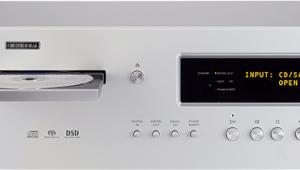
There’s plenty new about the D-100C but the best way to understand why it sits at the top of the Luxman model list is how it replaces the D-10X launched in 2020. Visually, there are few changes beyond the badging, but an extra 3kg attests to more than the chrome ‘Centennial’ badge celebrating Luxman’s first century. The upgrades are extensive.
Poetry in motion
It starts with a reworked transport, the proprietary LxDTM-i mechanism now with 8mm-thick aluminium side panels and base plate, and a 5mm steel top plate. This is directly integrated into the main chassis for added stability. For those who love the ballet of moving parts, the D-100C’s tray is protected by a front cover that slides down to allow the tray to emerge. Fit and finish borders on the horological.

Above: Underside of the D-100C hosts a custom USB board [bottom], PSU and regulation for the transport [bottom left & top], and two ROHM DACs [bottom right]. Main PSU and LIFES analogue stage are in the top compartment
PM describes Luxman’s choice of DAC, with its new high-precision clock, on p65. Meanwhile, the analogue stage features the manufacturer’s fully symmetrical LIFES 1.1 output circuit. Completely revised for this latest generation of components, the ‘Luxman Integrated Feedback Engine System’ [HFN May ’24] is an evolution of its older ODNF (Only Distortion Negative Feedback) regime, devised specifically to correct distortion components. Like the feed-forward technique used by Simaudio, Chord, Quad and others [see p53], the benefit is superior measured performance [see PM's Lab Report] ‘while preserving the natural musicality of a non-feedback design.’
For the D-100C, Luxman’s engineering team has also revised the chassis architecture [see pic, below] while component selection was re-examined to further optimise the player’s balanced line output circuit.
Further justifying the size and weight of the D-100C beyond its primary role of CD/SACD player is its secondary function as an outboard DAC. Accessible via the remote [see p67], the coaxial, three optical, and USB-B digital inputs are situated in a group at the back of the chassis. To feed the D-100C into another DAC, should you wish, it also provides optical and coaxial outputs.
While I concentrated on the D-100C as an SACD player, the DAC proved exceptional when fed by three different transports and two portable digital players.
When used with a brace of devices which on their own seem rather ‘meh’ by today’s standards, Luxman’s USB input rendered them noticeably smoother and sweeter-sounding. There’s no Ethernet/Wi-Fi streaming on offer here but, via USB, the D-100C at least renders computer streams and servers more tolerable.
Character building
What will keep tinkerers amused are the DAC’s built-in filters – three choices for PCM playback and two for DSD – which can be set from the remote to deliver the tonal character that most pleases the user. Supported sampling frequencies over USB go up to PCM 768kHz and DSD512 while the coaxial and optical inputs support up to 192kHz and DSD64 over DoP.

Above: The OLED display shows track/time details and filter settings, and even has a 4x zoom mode
The D-100C is part of Luxman’s commemorative Centennial range, joining the P-100C headphone amp and L-100C integrated amp, with a power amplifier to follow. Although the individual Centennial components are available only in a silver hue called ‘Blaster White’, a limited-edition Centennial system is available, comprised of existing products in a black finish.
At your fingertips
A design signature of Luxman gear, the D-100C possesses a clean fascia which one can describe as ‘minimalist’ despite it containing all the transport controls and push buttons to choose digital inputs or outputs, switch polarity inversion, and to select a CD or SACD layer on hybrid discs.
Everything bar one function is available via the remote, and it is the one omission that puzzles me: phase inversion should be on the remote as it is – like the filter choices – something one wants to select from the listening position. Note that, by default, the XLR out is wired as phase-inverted.
To the right of the eject button is the nicely oversized, newly developed high-definition OLED display. Approximately 70% larger than the D-10X’s, it can show elapsed time, remaining time, source format, all of the filter settings, and playback modes. In addition to a four-level dimmer function, the display also features a four-times zoom mode so you can read it from across a room.
As well as the aforementioned digital inputs and outputs, the rear panel contains the AC mains input, primary on/off switch, control triggers and both XLR balanced and RCA single-ended phono outputs. All listening was undertaken with the balanced outputs and mainly SACDs, with exceptions noted.
 It’s Miller time
Admittedly, the first disc I played was a CD, The Unforgettable Glenn Miller [RCA 74321 57801 2], because I wanted to know if a recording from, say, 1940 could survive playback through a high-resolution system some 85 years younger. While at first I attributed the silky sound to the disc, which glowed with ‘big band’ lushness, the D-100C was proving to be something I had not expected: a brilliant mimic of a valve component.
Let’s dismiss how these recordings were vintage mono. The sound filled the space beyond the speakers, demonstrating for the umpteenth time that a mono source can create a massive, almost spherical soundstage – it certainly exhibited stage depth. What the D-100C was doing was supporting commentators who said this CD from 1985 was one of the finest remasterings of the Miller canon to date.

Above: Single-ended RCA/balanced XLR outputs, and coaxial/optical digital outputs, are joined by 2x optical and 1x coaxial digital ins (to 192kHz, DSD64 DoP) and USB-B (768kHz, DSD512). Trigger/control ports offer limited system integration
It only took the next disc to demonstrate that the D-100C was capable of sound I hadn’t heard from digital sources since the late, lamented and tube-equipped California Audio Labs Tempest II CD player [HFN Apr ’89]. The title song from Roberta Flack’s Killing Me Softly [Analogue Productions CAPA054SA] was so bold and natural that it was like hearing it for the first time – a rare occurrence with a work so familiar.
Attesting to my belief that someone at Luxman loves valves were warmth in the vocals and a deep, fulsome bass that revealed the capabilities of Wilson’s WATT Puppys [HFN Sep ’24].
Aural ally
If I was seeking vindication – to support both my continual raving about SACD and 50 years as a valve proselytiser – the D-100C was proving to be an astounding ally. The Doobie Brothers’ Minute By Minute [Mobile Fidelity UDSACD 2300] is so slick, so polished that the gloss, detail, extended highs and transients (especially from the guitars) can tighten up even a soft-sounding system – the album has become a secret weapon at hi-fi shows.
It was the way Michael McDonald’s vocals were conveyed on ‘What A Fool Believes’ that startled. Luxman’s player/DAC simply brushes away any lingering ‘digititis’ 42 years after Compact Disc begged the question, ‘Does digital have to suck?’. The answer is clearly ‘No’, repeated from disc to disc, with even plain vanilla CDs benefitting and basking in the glow.
Because listening so far consisted of the kind of albums which were superbly recorded and which flatter systems, I needed something that aurally offends. Aside from two or three tracks on No. 4 [Mobile Fidelity UDSACD 2298], the Stone Temple Pilots’ brand of rock on this 1999 album is mainly what I call ‘music where the needles don’t move’. Grunge, like thrash, does not beg high resolution so much as it demands high levels.

Above: Luxman’s RD-21 remote is a very solid affair packed with buttons for direct track access, play/pause/random/repeat play modes, PCM/DSD filter selection, and display mode/brightness
What impressed me about the D-100C was a sense of coherence. Cutting through the noise of ‘Down’ to single out instruments proved possible thanks to the player’s openness, allied to a massive soundstage. So, too, was bass of juggernaut proportions, which proved a useful tool when comparing the single-ended and balanced outputs, as well as trying the various filters and CD vs SACD.
Grace and favour
As analytical and detailed is the new Luxman flagship, its forte is gracefulness. Wanting to part with the D-100C with a feeling of longing rather than relief after the Stone Temple Pilots, I fed it John Coltrane’s jazz masterpiece My Favorite Things [Analogue Productions CAPA 011SA].
Again, it was tube-like heaven, the assorted saxes exuding palpable body and form, plus fluid, foundational bass that supports rather than swamps. Regardless of genre – yes, including hard rock – the D-100C isn’t just versatile, it’s accommodating. If it came to life, it would be David Niven.
Hi-Fi News Verdict
When you can drop £300k on a digital stack, £16k almost seems a bargain. Where does that place Luxman’s D-100C? For fastidious listeners who know that SACD is the finest-ever digital source, who want one component rather than four or more, and who can afford the fee, the D-100C is one of the sweetest, smoothest players I have ever heard. And with build and looks to match, it puts the ‘Lux’ into Luxman.
Sound Quality: 89%
 | |||||||||||

|
|
| |||||||||











 SPONSORED VIDEO







| Equipment Reviews | |
Music Reviews Awards | |
Latest News Features | |
Resources Newsletters | |
Subscriptions |
WHERE TECHNOLOGY BECOMES ENTERTAINMENT
 © 2026 Hi-Fi News
AVTech Media Ltd
All rights reserved