Dunlop Systemdek II turntable
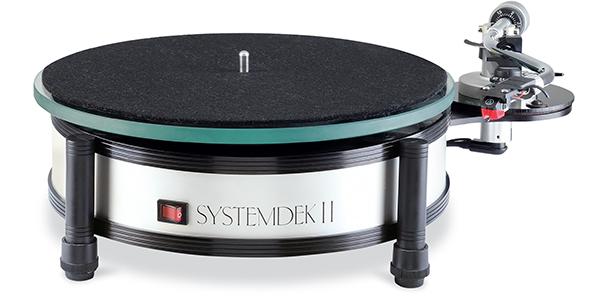

One might ask what was in the water in Scotland in the mid/late 1970s, as a swell of capable turntable designs hailed from the country. Names like Ariston, Fons, STD, Source and Linn laid the foundations for high-quality vinyl replay alongside another popular manufacturer of the day, Dunlop, with its range of Systemdek models.
This vinyl engineering output was at least partially due to investment into new facilities and infrastructure by the Scottish administration of the time, responding to increasing uncertainty and unemployment caused by the loss of traditional 'heavy' industries such as shipbuilding, steel production and coal mining. The area between Dundee, Inverclyde and Edinburgh became known as 'Silicon Glen'.
Family affair
Several large multinational engineering and electronics manufacturers established their European headquarters in the region, but joining them were several small, precision engineering firms that turned their hands to audio. Links between Ariston and Linn are well documented but, less so, is the fact that owner Hamish Robertson sold Ariston to an engineer and hi-fi enthusiast named Peter Dunlop. Peter had run his own metalwork company called Dunlop Westayr, producing everything from boilers to optical projectors. He had also manufactured parts for Ariston.

Above: The three-point suspension was easily adjusted from above. Also seen here is the ABS plastic sub-platter with belt and AC synchronous motor providing the drive
In due course, Peter sold Ariston and setup his own audio company with his two sons, Derek and Ramsay, to manufacture turntables. Such was the link with Ariston that an early Dunlop prototype was actually badged 'Aristodek' but, by the time it reached the market in 1978 at the Hammersmith Hi-Fi Show, it was known as the Systemdek Transcription Turntable.
Finish failure
The Systemdek was a conventional design, albeit with a sleek-looking 'pagoda' style plinth covered in a stylish but ultimately far from hard-wearing Nextel finish. The inevitable decay of this coating afflicted several other key hi-fi components of the time – 'one of 3M's rare failures!', as Derek Dunlop ruefully describes it today.
The turntable was belt-driven by the usual synchronous AC motor and featured a three-point sprung suspension, but with the subchassis hung from the springs, rather than sitting on top of them. This not only made the whole set-up far more stable, but meant that the suspension could be easily adjusted from above.
A key part of the Systemdek was its bearing, which had a fine helical groove machined up the outside of the bearing shaft to continually pump lubricant from an oil bath at the base. This eliminated metal-to-metal contact and, said Dunlop, 'prevents the generation of rumble at this point' [see PM's Lab Report].

Above: The early 1980s was still a fertile period for UK-based artisan turntable brands
The deck received excellent reviews and sold well but, by the early 1980s, Peter resolved to produce a more affordable version. He identified that removing the costly lid, and as much of the plinth as possible, would result in a turntable with the same essentials but a lower build cost. The Systemdek II, with its distinctive 'biscuit tin' form factor, was born.
Launched at CES in 1982, the model went on sale for £100+VAT, marrying a slightly simplified version of the original Systemdek's suspension with a lightweight, reinforced subchassis. The arm platform took the form of an outrigger, and an armboard with different mounting options bolted to this. A clamp at the rear of the plinth [see p133] secured the arm leads to ensure they did not interfere with the suspension operation.
Options and upgrades
The helical groove bearing was still in place and a plastic subplatter was topped by a solid, flat 10mm-thick glass platter. The deck was supplied with a felt mat, Dunlop's well-regarded drop-on record clamp being an optional extra. A circular plastic cover emblazoned with 'Systemdek' was also supplied to keep dust off the platter [see pic, above]. No lid was initially offered, but one did become available later.
Such was the success of the Systemdek II that a higher specification IIS model came next. This changed the painted columns and trims of the II's plinth from black to silver, fitted the lid as standard and swapped the glass platter for the 4.75kg cast Mazak type fitted to the original Systemdek. The original II also benefitted from a relaunch in 1986, by which time it was fitted with an upgraded (stiffer) suspension set-up, taken from the later and very well received IIX model. These decks can be identified by the flush surround around the subplatter beneath the glass platter.

Above: The 1.7kg glass platter is seen here with its customary thick black felt mat. The deck was easily levelled via its three adjustable limbs
Subsequent Systemdeks included the IIX Electronic, IIX 900 and 2X2. However, by the mid-'90s the company, now fully in the hands of Peter's sons Derek and Ramsay, was wound down and the tooling and rights to the turntables sold to Audio Note.
A brand reborn
Derek and Ramsay went on to form Art Loudspeakers in 1998 – a company that is still going strong. However, the story of Systemdek came full circle when the name rose from the ashes in 2011, with the brothers launching the 3D Precision and 3D Reference turntables [HFN Aug '11]. Art has also recently released the new Systemdek Revolution turntable [see p29], so the Dunlop vinyl legacy looks set to continue.
 Adam listens
Fitted with a mint-condition example of the Linn Basik LV V tonearm (a very popular companion in the deck's heyday), plus an Audio-Technica AT-VM95ML moving-magnet cartridge, it is easy to understand why the Systemdek II caused something of a stir when it was released over 40 years ago. The big, warm and capacious sound that it offers is completely at odds with its compact footprint and visual simplicity.
Some turntables take you on a wild rollercoaster ride that can become wearing after a while, but the Systemdek II is more grown-up and easy to listen to. No matter what kind of material passes under the stylus, the presentation is relaxed and assured – you'll lose hours by letting whatever is on the platter play to the end.
A notable aspect of the Systemdek II is its soundstage, which has depth, projection and spreads well beyond the loudspeakers. It can fill the listening area and pull you into the heart of the action. Precision and focus isn't quite up to modern standards, but there was never any sense of elements just swimming around randomly.
Rory MacDonald's vocals on Runrig's 'Somewhere' [The Story; Ridge Records RR079] were emotional and nicely located in the centre. Then, when the Prague Philharmonic Orchestra's strings got into their stride towards the end of the track, the Systemdek II showed its strengths, bringing scale to the soundscape.

Above: The Dunlop Systemdek II was first reviewed in Hi-Fi Choice Issue 30, 1983 and [not shown] in HFN Feb '84. Promotional literature shows the Systemdek II, the Systemdek IIS with lid and full-sized Systemdek III
Equally, this Dunlop-designed turntable threw me deep into the heart of live tracks like 'Alberta' from Eric Clapton's 1992 Unplugged set [Reprise Records 9632-45024-1]. The laughter that arises from the track's false start rang around my room and the applause at the finale begged me to stand up and join in. If you like orchestral and live recordings to be rendered with authentic scale, the Systemdek II will be right up your street.
In the lower registers the turntable sounds both fulsome and authoritative. Basslines were warm and weighty yet retained good detail and pace – the Systemdek II doesn't sound sluggish or blurred, even without offering the sort of 'start and stop on a sixpence' delivery of a vintage direct-drive design, such as the Hitachi HT-660Q [HFN Nov '25]. The opening bass notes of the title track from the Eagles' One Of These Nights album [Asylum Records K53014] were sufficiently meaty, and distinct from the lighter, pacier playing that then carried the track along with a pleasing deftness.
Shimmer and shine
At the top end, the Systemdek II sounds well defined, with high violin strings vivid but free of any hint of screech or shriek. The cymbal strikes that are a key feature of the percussion throughout 'Sea Within A Sea', from the Horrors' Primary Colours album [XL Recordings XLLP 418], rang out with crisp confidence before shimmering delicately off into the distance.

Above: Because the subchassis suspension was very compliant – originally tuned to just 3-4Hz – the dressing of the arm cable onto the rear leg of the deck was critical in obtaining an unimpeded vertical 'bounce'
Much as I have a long-standing soft spot for the Linn Basik LV V tonearm, it does have its limitations. Changing to an Audio Note Arm Two/II showed that Dunlop's Systemdek II has more to give. Soundstage organisation was better defined with the modern arm in place. It also tidied up the bass delivery a little and made the spaces between notes more explicit. While the Systemdek II works like a charm with age-appropriate ancillaries, it is more than capable of allowing newer arms and cartridges to give of their best.
Buying secondhand
Systemdek IIs are a relatively common sight in the secondhand market, where their high build standards, excellent engineering and overall simplicity typically means there's very little to go wrong. Obviously, dropping the glass platter is something of a deal breaker but aftermarket options exist in a variety of materials, including acrylic. Belts and replacement third-party armboards with Linn, Rega or SME mounting cut-outs can also be purchased online.
The biggest worry in electrical terms is failure of the deck's motor phase shift capacitor. However, this can affect any of the many turntables with the same synchronous motor set-up and replacements are plentiful.

Above: Pages from the Systemdek II/III manual. Lightweight puck was optional
The original Dunlop clamp is something of a rarity, as is the lid assembly that was fitted to the IIS model. If you do want something to keep the dust off your Systemdek II and would like it to approach the visual appeal of the original lid, then the Michell Unicover does a very passable impression for £85.
Talking of the IIS variant with Mazak platter, this is far less common – I have only seen a handful in the wild. That said, the performance gains it brings over the standard Systemdek II are notable, making it worth waiting for if you have your heart set on one.
Hi-Fi News Verdict
Dunlop's Systemdek II is a simple and affordable turntable offering a surprising level of performance. Suspension adjustment is easy, maintenance demands are minimal and the superb build quality means it should go on spinning happily for years. It makes a great classic piece with the Linn LV V arm, but fit something more high-tech and modern and it will hold its own in a contemporary set-up.
Sound Quality: 80%
 | |||||||||||

|
|
| |||||||||










 SPONSORED VIDEO







| Equipment Reviews | |
Music Reviews Awards | |
Latest News Features | |
Resources Newsletters | |
Subscriptions |
WHERE TECHNOLOGY BECOMES ENTERTAINMENT
 © 2026 Hi-Fi News
AVTech Media Ltd
All rights reserved