Celestion A3 loudspeaker


You could be forgiven for failing to notice some of Celestion's more recent achievements in the light of the changes that have occurred since the company – along with KEF – came under the control of Gold Peak of Hong Kong in 1992. Many of Celestion's engineering resources have now been moved to the KEF headquarters at Tovil, and you might not be surprised to hear that the new three-way speaker reviewed here is actually built on KEF's line, but to Celestion's specification.
Meet the A-team
The current flagship A series of speakers could therefore be said to represent something of a statement by Celestion's design team. Perhaps the various members were determined to remind their corporate masters of the brand's sound credentials in specialist loudspeaker design.
The A series comprises just three models: the compact A1 standmount at £899 [HFN Mar '97], the £1499 A2 floorstander, and the mighty A3, at typically £2399. In terms of market niche, the A3 is roughly comparable to the highly capable KEF Reference Four [HFN Apr '96]. It also competes with other UK designs such as the Mordaunt-Short Reference 880 and Epos ES25.
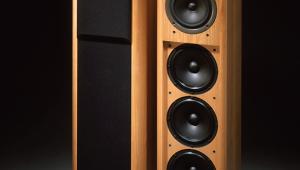
I got a shock when the A3 was delivered – I had real trouble picking it up! Weighing 46kg, it's bulky enough to make it difficult to get your arms round. This speaker certainly makes a statement – standing well over a metre tall on floor spikes, it has a footprint and weight that makes consideration of a plinth or other accessories redundant. Finished in real wood veneer, accentuated by full height hardwood corners, the A3 is a three-way, five-driver design capable of playing loud... very loud indeed.

Above: The mid-level A2 floorstander eschewed the dedicated bass cabinet of the larger A3, instead featuring a two-and-a-half-way driver arrangement
Balancing the goal of high sound pressure levels were requirements for good linearity, low distortion and uncompromised dynamics at full power. It is no good having a big speaker which will take a lot of power, but which sounds muddy and compressed when taken to the limit. Celestion's experience making PA systems helped to define performance limits here.
Tweeter specialist Bob Smith, a key figure in Celestion's SL700 project and still based at Ipswich, designed the A3 tweeter to produce low distortion, high efficiency and high power handling. Meanwhile, Richard Lee, a former Wharfedale designer and long-term devotee of BBC standard midrange tonality, took care of the midband, and the bass units and overall system design were the responsibility of engineer Steve Matthews.
Sensitive souls
A 4ohm load and solid-state amplifier compatibility are claimed for the A3, with an above average 90dB sensitivity rating and a tightly specified ±2dB frequency response spanning 36Hz to 20kHz.
A vertical in-line formation characterises the speaker's front panel driver array, with the 25mm titanium dome tweeter placed uppermost. All driver magnets are shielded. Three 210mm bass drivers operate in parallel in the lower chamber, and are bass-reflex tuned by two large ducted ports on the back. These are 70mm in diameter and 225mm long, jointly tuned to 33Hz and promising good power delivery down to that frequency.
The bass drivers have massive magnet systems operating on four-layer, high-power motor coils. Each magnet incorporates a Faraday ring, a conductive copper sleeve placed over the pole-piece to control eddy currents and maximise linearity. The effective cone area of the three bass drivers is equal to a 15in/380mm design – no half measures here.
Keeping it cool
In common with the bass units, a precision injection-moulding technique is used to form the A3's midrange cone, a mineral-loaded polypropylene polymer of graded thickness for optimised resonant behaviour. The apex region is stiffened for good coupling to the voice coil, the latter being ferrofluid-cooled to improve thermal capacity.
Matching the performance profile of the system, the titanium tweeter has a low-loss, high-temperature Kapton coil former. The assembly is built on massive low-resonance front plate casting. Ferrofluid cooling adds to the power capacity, while sensitivity and linearity are again augmented by a Faraday ring.

Above: Opening page of Martin Colloms's review of the Celestion A3 in HFN Nov '97
Laser interferometry was used to analyse structural vibrations in the A3's generously braced enclosure. Primarily built of 25mm MDF, this contains doubled, full-height panel braces which form the sealed-box mid enclosure and lock all the panel faces together. The result is most effective – more inert even than the heavy mass would suggest. Acoustic polyether foam loads the required internal space.
 Living large
Once broken in, and used with amplifiers and sources from Krell, XTC, Musical Fidelity and Conrad Johnson, the Celestion A3s operated optimally when placed further from the wall than usual (1m to 1.4m). They achieved their cleanest upper bass in this location. There's no shortage of bass and my prediction that these speakers would drive large rooms was confirmed many times over. In my 35ft studio, ample sound levels were possible with as little as 50W of load-tolerant power. The upper bass improved in speed and crispness with good low-resistance cable, such as NAC-5 for the bass section when bi-wiring, and with the more lusty amplifiers.
This is an accurate, well-balanced loudspeaker reaching deeply and powerfully into the bass, yet finding space for a neutral midband and a clean, clear, extended treble range. Its fine balance was apparent time after time, using a huge variety of programme type and style. The A3 very rarely missed the point.

Above: The 'baby' speaker of Celestion's range, the A1 paired its 25mm titanium dome tweeter with a 175mm bass/mid driver. Finish options for all A series models were Black Ash, Cherry and Santos Rosewood (pictured), the latter at extra cost
Generally clarity was good, indeed very good in the mid and treble, if somewhat cloudier in the upper bass and lower mid. Complex textures sometimes were denser than they should be in the lower mid, for example on French horn.
String theory
Fed with wide-range programme, focus approached 'very good' with good perspectives and depth layering in the soundstage, particularly in the upper frequency range. Classical material showed neutral string tones almost to BBC monitor standards and the weight and scale of a big orchestra was beautifully portrayed. On jazz and rock, rhythm was quite good, if not as snappy as I had anticipated.
This shortfall was made good to some degree by the fine dynamics and amazing dynamic range. The A3 could play very loudly indeed and yet there was no sign of character change or compression anywhere in the frequency range. Floorshaking bass was possible, as my long-suffering family will testify, and here the speaker showed a good helping of the slam and tune-playing abilities that help make the Wilson Audio X-1 Grand SLAMM [HFN Oct '94] so special.

Above: For the A series, laser interferometry was used to analyse both cabinet resonances and driver motion characteristics. Shown here are 'before' and 'after' measurements during the design of the A3's 25mm titanium dome tweeter
Vocals were particularly natural and yet heavy percussion scoring on powerful rock tracks was handled with supreme confidence. Taken overall, the sound was lively and open, yet occasionally there was a hint of 'plastic cone dryness', a failure to reach all the way back into the programme mix. In context, in the company of compatible and appropriate amplifiers, this is not going to be a problem. Easy to live with, this speaker proved a reliable and trusty design of considerable ability, reaching rather beyond its (relatively!) moderate price.
Reference difference
If the results of much of this review remind you of the KEF Reference Four, then you'd be right. The Celestion A3 matches the powerful KEF speaker in many respects – high sensitivity, 5-6ohm impedance, high loudness capability and high power handling. The two loudspeakers are even similar in appearance: tall, fairly slim but weighty pillars.

Above: Cut-away illustration shows the internal separation of the A3's sealed mid/treble and rear-ported bass enclosures. Split crossover network (lower right) used polypropylene capacitors and air-cored inductors
In some respects the Reference Four is more technically advanced. But although the KEF speaker relies on bandpass bass loading and a Uni-Q concentric mid/treble driver, the A3 achieves comparable bass extension and quality, overall frequency response accuracy and moderately good rhythm.
Ultimately the A3 proved a mite purer and sweeter as well as more open in the upper range, had slightly better dynamics, but lost out a little in terms of stereo focus. Both have a good slice of an audiophile performance profile, matching more expensive designs, if lacking the last ounce of speed and clarity which would give them true audiophile status.
This leaves the Celestion model as a very strong performer for the price – it's 30% less expensive than the KEF Reference Four. Another good value choice from a famous UK producer, the A3 floorstander offers big speaker bandwidth, sound quality and dynamic range, and comes firmly recommended.










 SPONSORED VIDEO







| Equipment Reviews |  |
Music Reviews Awards | |
Latest News Features | |
Resources Newsletters | |
Subscriptions |
WHERE TECHNOLOGY BECOMES ENTERTAINMENT
 © 2026 Hi-Fi News
AVTech Media Ltd
All rights reserved