Canor Verto D3 USB DAC


Such is Canor's devotion to tubes that its product naming system (for which there's a detailed discussion on its website) treats triodes as the default technology. That's how buyers can tell the Verto D3, an outboard DAC priced £3799, incorporates a tube stage, whereas the Verto D4S doesn't – the S suffix denoting a fully solid-state design. As for the '3', that signifies the DAC is from Canor's mid-level Performance line, the others being Reference (1), Premium (2), Foundation (4) and Essential (5).
In the same range is the Virtus A3 integrated [HFN Feb '26], a tube/solid-state hybrid with a very similar styling and chassis size. Yet the Verto D3 is not an obvious partner for that Performance line amplifier, which has its own built-in DAC stage. This new standalone converter is more likely to find use with the Slovakian brand's all-analogue integrated amps, including the Virtus I2 [HFN Mar '24]. Alternatively, a choice between fixed and variable output means it can be used directly into a power amplifier.
Swipe right
With many compact DACs entering the market recently, from Topping's D900 [HFN Feb '26] to LAiV's Harmony µDAC [HFN Sep '26], the full-width, chunky aesthetic of the Verto D3 feels like a breath of fresh air. Measuring 435x122x370mm (whd) and tipping the scales at 12kg, this converter looks and feels like it means business. Perhaps even more so if you opt for the black rather than silver finish.
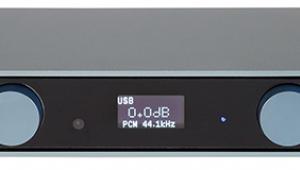
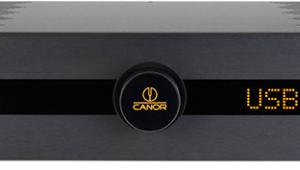
The aesthetic is far from austere, however. The slender display that slices through the right side of the Verto D3's fascia shows the selected input, plus output level or 'FIX', in a bold, orange dot-matrix layout [see pic, p83]. Further, in-depth information is presented on a touch-sensitive screen at the centre of the DAC's volume control – a design innovation recently implemented by Canor as if to prove that tube tech doesn't have to adhere to old-fashioned principles. Yet this interface is perhaps too slick for its own good, as the limited real estate makes it easy to accidentally change a setting rather than swipe past it. On one occasion, during listening, I discovered I had inadvertently flicked the DAC's output from variable to fixed…

Above: Linear PSU [top] is fed from a screened transformer [top right]. Digital board [bottom right] includes a WM8805 transceiver, XMOS USB chip and two ES9039Q2M DACs. Balanced output has pairs of E88CC triodes [bottom left]
Save for the legend 'Vacuum Tube DAC', there's nothing else to see on the Verto D3's fascia. The rear view is also uncluttered, with inputs (2x optical, coaxial, AES/EBU, USB-B and HDMI ARC), plus a choice of balanced XLR and unbalanced RCA outputs, spread along the width of the chassis. Mains power is via an IEC socket with on/off rocker switch, and the unit also features 12V trigger in/out ports to enable basic system automation.
Double DACs
Our lid-off shot [see below] shows the Verto D3's neat and tidy internal construction. The PSU stage is fed by a transformer that's shielded to suppress 'any vibrational and mechanical hum'. Printed circuit boards are made using the brand's proprietary 'Canor Milling Technology', which is claimed to drastically reduce dielectric loss, and digital inputs benefit from galvanic isolation in order to counter circulating noise and interference.
The D/A stage is based around two ESS 9039Q2M devices, operating in a dual-mono mode alongside a dizzying choice of digital filters [see boxout]. Sample rates to 768kHz/24-bit PCM and DSD512 are supported over the DAC's USB-B connection. Switching between inputs involves either cycling through them using the supplied remote [p85] or the front panel display.
Downstream of the DAC circuit is a dual-mono balanced analogue output whose headline feature is a quartet of E88CC tubes. Their presence is intended, as Canor puts it, to add 'unexpected dynamics and naturalness'. The tubes are tested, burned-in and pair-matched at the manufacturer's facility in Presov, just as all its amps, DACs, etc, are fully manufactured and built in-house.

Above: 'Once hooked up, you'll be listening to music as soon as the tube preheating cycle is completed'
Getting going with the Verto D3 is simple, not least because of its non-networked nature. With source and preamp/amp connected, you can be listening to music in minutes – allowing for its tube preheating cycle to be completed, of course. The manual details the DAC's various settings, including 'Analogue' filter and 'Upsampling' modes – [see boxout] – plus useful tools such as input disabling and display dimming. It also explains why you might see 'Relay Cleaning' appear on the Verto D3's display. Every 20th time the DAC is brought out of standby, it begins an automated process sending high-frequency signals in sequence through its various electronic relays. The idea, says Canor, is to preserve the lifespan of relay contacts not regularly used.
 Open season
The Verto D3 was auditioned primarily as a USB DAC, connected to a Roon Nucleus Titan [HFN Jun '25] and set to variable output over XLR. This enabled a simplified set-up with a Primare A35.2 power amp [HFN Dec '19], making use of Canor's 99-step volume control (which is particularly fun to adjust via the Verto D3's smooth rotary). It took only a few bars of Fleetwood Mac's 'Gold Dust Woman' [Rumours, Rhino/Warner; 96kHz/24-bit] to discover that its performance mixes organic, natural detail with a superb sensation of weight and scale.
There's no mistaking it: this DAC crafts stereo images that seem to expand in all directions. The Verto D3 steers clear of the overly focused, pin-point presentation heard with more 'uptight' DACs, acting as an open gate for the music to flow. The string instruments on the 'Mac track (including resonator guitar and electric harpsichord) were spread wide, just as every part of Mick Fleetwood's drum kit was precisely spaced across a soundstage that appeared seamless.
This big but elegant delivery is combined with a sweetened, unstressed mid/treble handling that, subjectively, seems to point towards the Verto D3's tube-tuned output stage. Similar to the Wattson Madison Streamer [HFN Sep '26], this is a DAC that will find favour with audiophiles still wary of a 'digital sound' – albeit that the Canor unit has an even more obvious voicing.
Road songs
Impressive, too, is how the Verto D3 copes with dynamic material and bold transient effects. There was no feeling of constraint as Elton John's 'Goodbye Yellow Brick Road', from the album of the same name [UMC, 96kHz/24-bit], poured out of my speakers, its huge piano chords and fulsome rhythm section sounding wide open. Tom-tom fills offered extraordinary resonance and heft, allied to the distinct texture of drum skins under pressure.

Above: Alongside fixed/variable analogue outs on RCA/XLRs are digital ins on USB-B (768kHz/DSD512), AES, coax and two optical (all 192kHz/DSD64) and HDMI (192kHz)
Of the DAC's settings, the choice of nine separate filters is surely overkill. Taking heed of PM's advice, I left the Verto D3's upsampling and analogue filter options 'off' and focused instead on A/B comparisons between the Minimum Phase and Optimal Transient filters. Differences were minor but apparent, the former sounding more revealing in the upper treble region than Canor's custom-designed NOS-type option. (Another menu setting, 'Precision Timing', is on by default and should be left that way – it's only to be used when the Verto D3 fails to 'lock on' to a low-quality digital source.)
Phase value
Regardless of filter choice, I can imagine some will find this unit's overall sound balance lacking in brightness and attack. Music never sounds congested or short of detail, but at times there's a slightly dark tinge to go alongside its midrange warmth. Judith Collins' vocals on her cover of Stephen Sondheim's 'Send In The Clowns' [Judith; Elektra] were gorgeous in their tone and nuance, but might have soared from the soundstage with more authority.
On first listen, 'Bråtebrann', the lead track from Norwegian rock band Kvelertak's Splid album [Rise Records RR455-2], appears more focused on punkish spirit than musical subtlety. Yet this was one of many tracks which, when heard through the Verto D3 – in this instance on CD via a Hegel Viking [HFN Sep '23] – took on a more refined air. There was still the slam of the bass drum and the raw guitar riffs to revel in, but the DAC proved able to read between the lines of its surface-level chaos, revealing the clever layering of vocal tracks in the unexpectedly Queen-like chorus.

Above: Serving a variety of Canor separates, the remote accesses input, volume, digital filter and upsampling modes
And even while this Canor tube DAC has a certain uniformity to its sound, it remains transparent enough to throw production differences into sharp relief. Moving between the frenetic yet modern feel of the Kvelertak track and Black Sabbath's 'Wheels Of Confusion' [Vol. 4; Sanctuary Records] showed how much the heavy metal pioneers' 1972 album suffers from a murky, distant mix – not that this stopped the track's instrumental coda, and Tony Iommi's multitracked guitar fireworks, from raising a smile.
And it's this – the sheer enjoyment of listening to it – which is key to the Verto D3's ultimate appeal. Separate to audiophile considerations of stage width and depth, resolution, attack, etc, is a 'rightness' to how it sounds. Feed it rock and it will get the blood and feet pumping, switch to the full-bore orchestral majesty of the first movement of Mahler's 3rd, recorded in 1989 by the NYP under Leonard Bernstein [DG], and it swells the heart and tingles the spine.
Hi-Fi News Verdict
Not for Canor a diminutive DAC to be tucked out of sight or parked on a desktop – the Verto D3 is an unashamedly full-size hi-fi separate with the build quality and style to carry it off. It's also a fine example of blended digital/tube-based engineering, delivering an addictive, all-round performance. It's a poster boy for the genre, and if the DAC filter choices are mystifying just leave it in 'Minimum Phase' and enjoy...
Sound Quality: 88%
 | |||||||||||

|
|
| |||||||||












 SPONSORED VIDEO







| Equipment Reviews | |
Music Reviews Awards | |
Latest News Features | |
Resources Newsletters | |
Subscriptions |
WHERE TECHNOLOGY BECOMES ENTERTAINMENT
 © 2026 Hi-Fi News
AVTech Media Ltd
All rights reserved