Cambridge Audio Evo 300 streaming integrated amplifier


While you were busy enjoying your carefully curated system – the one with players, preamp, power amp(s) and loudspeakers, all connected with expensive cables – the hi-fi world has tilted on its axis. The idea of a one-box 'just add speakers' solution is nothing new, but a fresh seriousness seems to have emerged, to the point that the thought 'could just this replace my entire system?' is creeping in.
Take, for example, the Cambridge Evo 300, selling for £3499. It's the latest addition to a range launched with the now-defunct Evo 75, which offered full streaming smarts and 75W per channel of amplification in one sleek, room-friendly package. Next came the Evo 150 [HFN Nov '21], now upgraded to Evo 150SE status and rated at 150W a side. It's not exactly hard to work out the power on tap from this range-topping newcomer.
Power and pedigree
By any standards, 300W per channel is impressive for a unit so compact and keenly positioned. The 'Power Edition' of Naim's Uniti Nova claims 150W/8ohm and is twice the price of the Evo 300, while big-hitters from the likes of Germany's AVM and T+A have plenty of amp power but are larger and much spendier. In other words, on paper at least, the Evo 300 has a lot going for it: style, an established pedigree, and the promise of a relatively small, convenient and clever unit able to take on those complex multi-component set-ups.
As in past Evo models, the secret of the high power/compact dimensions – the '300 is just under 39cm wide and 9cm tall – is in the use of space- and energy-efficient Hypex NCOREx amplification, rapidly becoming the go-to solution for systems where high performance is required without bulk. But there's rather more to this new model than just taking an Evo 150SE and levering in more powerful Hypex amp modules…

Above: Two Hypex NCx500 Class D modules with dedicated switchmode PSU [top left] are driven via a custom analogue line stage and digital PCB [bottom right] hosting the 'StreamMagic' network interface, ES9820Q ADC plus ES9023P and ES9038Q2M DACs
The Evo 300 is based around Cambridge Audio's in-house StreamMagic platform, now in its fourth generation, while much of the audio design is new. The preamp section is fully balanced, the volume control delightfully smooth-acting and the power amplification dual-mono, all in the cause of enhanced performance. There are also two sets of speaker outputs, allowing simple two-zone working if required.
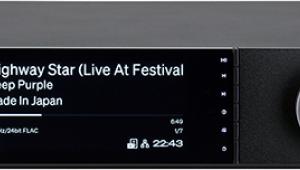
As an expression of that serious intent, Cambridge Audio's amp is only available in anything-but-basic black, complete with the choice of textured black or wood side-panels. Both are supplied in the box, and attach magnetically for easy swapping. The Evo 300 also sports a new 7.8in/200mm display – an inch larger than that on the '150SE – to complement the slightly larger chassis of this flagship model.
Front panel controls are kept minimal. A simple strip of buttons beside the display covers functions such as play/pause and track skip, while a concentric ring behind the volume control allows the Evo 300's various inputs to be selected. Below and to the right of the volume/input control is a 6.35mm headphone socket, which mutes the speakers and preouts when a plug is inserted. By the way, there's also Bluetooth output for suitable wireless headphones.
Choices, choices
That StreamMagic platform delivers both local and online streaming capability, as well as enhanced control functions, courtesy of the company's custom app [see boxout]. The Evo 300 will play from local music stores – eg, on a computer or NAS – as well as services including Qobuz, Spotify Connect and Tidal, plus Internet radio (with a generous 99 presets available). Chromecast, AirPlay and Bluetooth expand the listening options. The Evo 300 is also Roon Ready, while networking is via Wi-Fi or Ethernet.

Above: The StreamMagic platform delivers both local and online streaming capability, with enhanced control functions
Neither is this streaming integrated's connectivity found lacking. There are two sets of analogue ins on RCAs and one on balanced XLRs, plus an MM phono stage, while digital inputs run to optical, coaxial and a dedicated connection for a Cambridge Evo CD player. Both USB-B, for computer connection and with a switchable ground lift to break hum loops, and USB-A, for memory devices, are provided, along with an HDMI eARC port for TV sound. Depending on the input, the Evo 300 can handle files at up to 384kHz/32-bit PCM and DSD256.
Along with the speaker outputs (switchable to A, B or A+B), the Evo 300 has preamp outs, plus a mono subwoofer output. 12V trigger connections allow the remote switching of external components.
 One for all
With that impressive power output on the specification sheet confirmed in PM's independent measurements [see PM's Lab Report], the uninformed might only be interested in 'how loud' the Evo 300 will go. While the simple answer is 'very', with appropriate loudspeakers, there's a lot more to what this impressive 'all-in-one' can do beyond sheer level.
Yes, it can drive just about any speakers you might imagine in a totally assured manner, and not just those price-comparable with the amplifier itself. I had good results with some much more expensive speakers, which the Evo 300 handled with almost disdainful ease. Or perhaps more accurately, with never any sense that its output stage was working hard, even when playing at high levels with the drama of a Radio 3 live Proms broadcast of Respighi's 'Roman Trilogy', performed by John Wilson and his Sinfonia of London.

Above: Switchable A/B speaker binding posts and pre/sub outputs (on RCAs) are joined by MM phono and three line ins (one balanced on XLR). Streaming is offered via wired/wireless Ethernet and BT aptX HD, with digital ins on optical (to 96kHz), coaxial (to 192kHz), USB-A/USB-B ports (to 768kHz and DSD512) and HDMI eARC (to 192kHz)
Instead of sheer volume, what you get is massive confidence, unfettered dynamics and fabulous insight into the music, even when listening to the (relatively) low-bitrate BBC radio feed. And the Evo 300 pulled off the same trick with a very different Proms performance, the exuberant prog rock concert carried on the iPlayer a week after the live radio transmission. Fed from a Samsung TV via an HDMI connection, the amplifier matched the big picture by bringing out all the detail and depth of the BBC Concert Orchestra – and the fact that the various soloists assembled for the evening were clearly having a ball. The powerhouse drumming of Carl Palmer, in his role as the last man standing of ELP, was delivered with serious impact. The old boy's still got it on the big kit, complete with gongs!
Deep impact
Switching to music from my server, in the form of the Espen Eriksen Trio's latest album, Almost There [Rune Grammofon RCD2239], the Evo 300 dug into the carefully recorded sound of the three musicians, always understated but so lovingly crafted. There's no flash or bombast here, but the amp is just as convincing when cruising as it is at the charge, delivering superb expression. It's that old 'getting out of the way of the music' thing, but at the same time dragging the listener deep into what's being played.
This combination of massive power and the utmost delicacy of touch was also in evidence with Geir Sundstøl and Knut Reiersrud's Purcell: Truth, Lies And Bad Memory [Elevator Music/Grappa EMCD6115], on which the two guitarists interpret works by the English Baroque composer. Their take on 'Dido's Lament' was so understated as to be totally captivating, while the precise version of the rondeau from 'Abdelazer', perhaps best-known as the theme on which Britten's 'Young Person's Guide To The Orchestra' is built, was wonderfully resonant. The Evo 300 did a great job of bringing out the character of the instruments and the playing, making what may seem like something of an esoteric project entirely fascinating.
Let it rip
As is often the way when exploring a new piece of equipment, one thing led to another, and I loaded up the 'Young Person's Guide…' itself, in the DSD64 Reference Recordings release by the Kansas City Symphony under Michael Stern [Britten's Orchestra, RR-120]. Quite apart from taking me back to school music lessons, when this work was accompanied by illustrative film-strip projections, the recording is a fine work-out for any system – a 'neighbours out, windows closed' listening experience.
 | Left: Partnering Cambridge remote controls standby, input, volume, mute, speaker/pre output and display brightness. The app is needed for full configuration |
I let rip with the Evo 300, and the amplifier allied the clean, clear timbres from the individual instruments and sections of the orchestra with enthralling dynamics. The percussion hit hard, the strings shone, the brass rasped, and the big conclusion to the final fugue had the power to leave the listener breathless. As if any evidence were needed to confirm the viability of Cambridge Audio's amp as the heart of a very serious system, here it was – and in spades.
Reel good
The ability of the Evo 300 to deliver presence and ambience was very clear with the recently released Atlantic Rain [Chrysalis CRC1850], The Waterboys' compilation of 'lost' tracks from the Fisherman's Blues sessions back in the late 1980s. There's a fine sense of immediacy about this three-disc set, full of alternate takes and cover versions, including Prince's 'When Doves Cry' given the folk treatment. There's also a superb live performance of 'We Will Not Be Lovers', plus an exuberant 'Fisherman's Jam' on the third disc, ending with an extended homage to The Beatles' 'Sgt. Pepper's Lonely Hearts Club Band'.
It's all riotous stuff, and it sounded so live and 'in the room' through the Evo 300, with the band driving hard and rocking out. Taken together with its flexible but intuitive operation, neat looks and solid build, it's hard not to be impressed by this amplifier before it plays a note – and the good news is that, in action, it more than delivers on all that promise.
Hi-Fi News Verdict
With its latest Evo 'all-in-one', Cambridge Audio has really cracked it: the Evo 300 is a no-compromise streaming and amplification system, capable of driving a huge range of speakers and delivering music with total confidence, insight and involvement. Its custom app is the icing on the cake, but if you need something to fuss over there's always that choice of black or wood side-panels.
Sound Quality: 89%
 | |||||||||||

|
|
| |||||||||








 SPONSORED VIDEO







| Equipment Reviews | |
Music Reviews Awards | |
Latest News Features | |
Resources Newsletters | |
Subscriptions |
WHERE TECHNOLOGY BECOMES ENTERTAINMENT
 © 2026 Hi-Fi News
AVTech Media Ltd
All rights reserved