Ayre Acoustics PX-8 phono preamp


For years the humble phono stage was a relatively uncomplicated, known quantity, but the breed has been evolving. Ayre Acoustics' PX-8 is illustrative of the trend, a modular design not only serving MM/MC pick-ups but also with options for DS Audio's optical carts [HFN Oct '24] and a fully fledged ADC board to make the digitisation of vinyl easier.
The standard PX-8 retails for £6500 in either black or silver and features one balanced (XLR) and one unbalanced (RCA) input, plus both balanced and unbalanced outputs. Spend another £2000 and you can add the digital output board, which offers coaxial, optical, USB and AES/EBU connectivity. Alternatively, £3000 on top of the base price brings compatibility with those DS Audio optical cartridges while £11,000 buys you the full house.
Helpfully, these options do not come at the expense of any standard connectivity or functionality. The digital output board occupies a normally empty area to the top rear of the enclosure [see pic, right], and the DS cards fit into dedicated slots on the PCB. There is a suggestion that more modules may follow, but nothing is yet confirmed.
Circuit separation
One might assume the PX-8 is an evolution of Ayre Acoustics' older P-5xe phono preamplifier but, in fact, it's a new design with improved functionality. As an example, the RCA and XLR inputs have their own circuitry up to the first gain stage so that both can be connected simultaneously.
The gain stages are based around low-noise JFETs in Ayre's discrete, balanced 'zero feedback' topology while the RIAA equalisation is entirely passive. The PX-8 also uses Ayre's 'Diamond buffer' output stage that features in its amplifiers [HFN Jun '14 & Sep '20], aiming to confer low distortion and thermal stability.
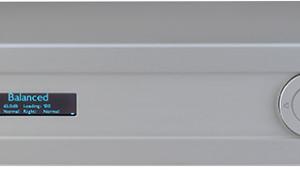
The PX-8 is setup using the front-panel display which, though small, is still relatively intuitive. The button beside the display selects the input, and the four-way control pad on the right of the preamp's fascia is used to cycle through and adjust settings. The far lefthand button brings the unit out of standby and, when operating, mutes the output when pressed briefly, or powers the unit down when held for longer.

Above: Also selectable through the display are the digital output configurations offered by the optional ADC module
There are no distinctly classified 'MM' or 'MC' settings on Ayre's phono stage. Instead, through both its single-ended and balanced inputs, resistive loads of 50, 75, 100, 150, 200, 250, 500, 1k, 5k, 10k or 47kohm can be dialled up, along with gain levels of +45, +55, +65 or 75dB [see PM's Lab Report]. Both inputs can also have their polarity inverted or be set to mono.
An unfortunate omission at this price level is the apparent absence of any remote control option, despite several mentions of an IR receiver in the manual. Neither is there any front-panel adjustment for load capacitance – screw terminals on the PCB inside allow for additional (parallel) capacitors to be fitted if required.
On the menu
Also selectable through the PX-8's display are the digital output configurations possible from the optional ADC module. This offers sample rates from 44.1kHz to 192kHz (384kHz via USB) and bit depths of 16-, 20- or 24-bits while DSD is available up to 4x via the USB output. It's also possible to 'tweak' the analogue signal level in ±2.5dB increments to prevent clipping of the ADC's input [see boxout]. Additional menus allow the display timeout duration to be changed and individual inputs/outputs to be deactivated if not required.
The PX-8 is powered by a chunky PSU based around an E-core transformer. This is surrounded by an alloy strap/shield to minimise stray fields and is located midway along the back of the fascia to, as Ayre puts it, 'make sure that it doesn't affect one channel more than the other'. As a result of this, the IEC input is in the centre of the preamp's rear panel and the input sockets for the left and right channel are located at the extreme ends [see pic, p73].
For some users this will make connecting the PX-8 more difficult than it needs to be, separating the left and right phono leads emerging from your tonearm while 'dressing' the cables at the rear to ensure AC mains and signal interconnects are not lying over one another. And while I'm grumbling, Ayre has only installed one earth terminal on the PX-8 and it is tiny, tucked awkwardly underneath the mains input and requiring an Allen key to undo. An accessible, chunky finger grip terminal for each input would have been preferable.
 Through the Ayre
During my testing of the PX-8 I discovered it runs very warm in use, mostly, I suspect, due to the current-hungry Diamond buffer circuit. While already advisable in these days of energy efficiency, I would definitely not recommend leaving it on 24/7.
Given the limited overload margins [see PM's Lab Report], I auditioned the PX-8 with MC cartridges only on the +55dB gain setting. Used with a Clearaudio MC Essence [HFN Aug '17] and, later, an Ortofon Cadenza Red [HFN Jul '12] on a Michell Gyro SE with SME 309 tonearm [HFN Oct '25], through the balanced outputs it soon became apparent that the PX-8 has the sound of a unit that has undergone careful fine-tuning. There's a preciseness and sense of unruffled calm about its presentation. You'll feel you're getting exactly what's in the grooves without any embellishment.
A large part of this is down to the impressive levels of separation that the unit confers upon performers within a soundstage. It's a good sign when a phono amp can make everything within the central image distinct, and stop the main performer from being crowded out. The PX-8 managed it with ease.

Above: Transformer [bottom] feeds (hot!) PSU reservoir/regulation [centre] for MM/MC input stage [top left/right] with its logic-controlled impedance loading, RIAA network [centre L/R] and ADC/digital board [top]
This meant that I was able to enjoy the enveloping whole of 'Autumn' from Vivaldi's Four Seasons [Virtuosi of England/Arthur Davidson; EMI CFP40016] as it filled the space between my speakers, but could still focus on the delightful acrobatics of Kenneth Sillito's solo violin. The PX-8 offered a textured, natural portrayal of the chamber orchestra, while the detailed top-end led to some of the sweetest violin strings I've heard in a while.
Well of emotion
This also paid dividends in terms of vocal performances, with singers having fine levels of timbre and warmth to their voices. Kacey Musgraves sounded suitably pensive on 'Jade Green' from Deeper Well [MCA 602455847126] and the PX-8 left no doubt that there was real emotion behind the lyrics. The album was recorded after a period of upheaval in Musgraves' life and the Ayre phono stage was a glorious but sympathetic companion as she unburdened her soul.
Once again, an impeccable level of centre-stage solidity and front-to-back depth helped things along superbly, but I would have liked a bit more width or spread to the soundstage. Playing with various loading and polarity settings on the unit resulted in subtle changes to the sound, but the PX-8 never quite managed to break free of the boundaries of the loudspeakers.
Bass beauty
Where there was no doubt about the Ayre preamp's abilities, however, was in the low end. The PX-8 turned in the sort of rich, eloquent bass performance that brings all your LPs to life, not just those with exaggerated LF presence. The considered, deep notes from the Kacey Musgraves track flowed easily, providing a soft, warm foundation for the rest of the instrumentation.
Upping the pace courtesy of Chris Sharrock's frenetic drumming on the aptly named Frantic Mix of 'Birds Fly (Whisper To A Scream)' by The Icicle Works [Seven Singles Deep; Beggars Banquet BBL71], the PX-8 showed that it could more than cope with more dynamic material. Drums pounded with snappy precision.
And even in the midst of all this percussive chaos, the phono stage was still able to pull a softly tapped tambourine to the fore. Ayre Acoustics' new model has a knack of balancing performances so that elements both big and small within a mix can be appreciated.

Above: Our 'fully stacked' PX-8 shows both the optional DS Audio input (including energiser) and digital output module with USB-B, AES/EBU, coax and opt connections [top]. MM/MC ins and pre outs are on single-ended RCAs and balanced XLRs
I took the opportunity to run both the optical and coaxial outputs of our digitally-loaded PX-8 unit through a vintage Marantz CDA-94 DAC [HFN Dec '25], setting the ADC's bit-depth to 16-bit and sampling frequency at 48kHz. Switching between coaxial and optical connections revealed no difference that I could detect and there was no subjective change to the tonal character of the sound compared to the analogue section – indeed, there was very little to tell them apart save a slight foreshortening of depth perspective and a touch more 'congestion' to the central image.
Good night
Through the balanced outputs, Jennifer Warnes had a tangible centre-stage presence when performing 'The Right Time Of The Night' on her eponymous 1976 album [Arista AL 4062], with a good spread of space between her and the instruments around her. Via the PX-8's digital outputs, her central position was maintained but the space around her shrank slightly.
Ultimately though, you really aren't losing much when using the PX-8's digital connectivity – Ayre appears to have done its homework here. Meanwhile, for those uninterested in its optional functionality, this phono stage delivers a beguiling performance. The caveat is the limited cartridge compatibility. Choose wisely.
Hi-Fi News Verdict
The Ayre PX-8 is a mix of novel design ideas and flexible input/output modules, presented in a very familiar chassis. Fully loaded to support DS Audio's optical cartridges and drive 'digital' systems with its ADC board, the PX-8 is a little cumbersome to navigate. On the other hand, used within its MM/MC 'comfort zone' it delivers the generous and inherently musical sound we've come to expect from this brand.
Sound Quality: 84%
 | |||||||||||

|
|
| |||||||||










 SPONSORED VIDEO







| Equipment Reviews | |
Music Reviews Awards | |
Latest News Features | |
Resources Newsletters | |
Subscriptions |
WHERE TECHNOLOGY BECOMES ENTERTAINMENT
 © 2026 Hi-Fi News
AVTech Media Ltd
All rights reserved